Look Up: Is That Magnolia Wood?

(Image/Credit): Artist’s rendering of the wooden LignoSat satellite. (Kyoto University)

The satellite industry may never be the same again. While we hear so much about new metals in our rockets, how often do you hear of simply putting wood into orbit?

I guess we should not have been too surprised now that wood is being used to build office towers. And the best part is that wooden satellites burn cleaner than metal satellites, making them safer for the environment.

Last year we learned about the Kyoto University’s test of wood materials on the International Space Station. The findings indicated that magnolia wood was one of the better materials for spacecraft, though more testing was needed.

The plan is for a summer 2024 launch of a coffee-size probe called LignoSat that can then be monitored for six months. That should be time to better understand the strength and effectiveness of the wood before it burns up in the Earth’s atmosphere.

It reminds me of the old joke about the Americans inventing a billion-dollar pen to write upside down in space while the Russians simply used a pencil. Maybe the Japanese also have some to teach us.
The Moon Landing: Imperfect, but Accomplished

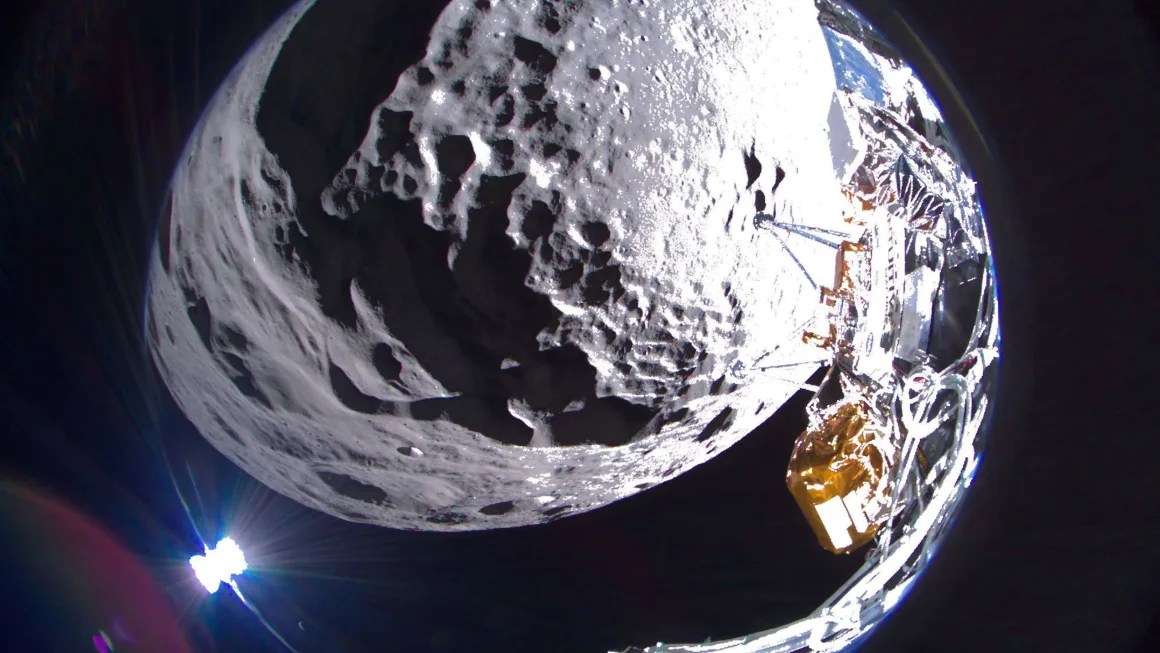
Image (Credit): The Odysseus lunar lander’s view of the moon’s Schomberger crater on Thursday, at about 6 miles altitude and approximately 125 miles uprange from the spacecraft’s intended landing site. (Intuitive Machines)

The United States is back on the Moon, even if the trip was bumpy. Plans to have pictures of the landing via the EagleCam were affected by a last minute switch to a NASA instrument that allowed Odysseus to safely land. The seems to be a fair trade, and the EagleCam can still be used to take pictures now that the lunar lander is stationary on the surface.

Embry‑Riddle Aeronautical University, which created the EagleCam, later noted:

…both the Intuitive Machines and EagleCam teams still plan to deploy EagleCam and capture images of the lander on the lunar surface as the mission continues. The time of deployment is currently unknown.

More importantly, Odysseus stumbled during the landing and is now tipped to one side. A tilted landing disabled the Japanese lunar lander earlier this year. Fortunately, the Odysseus’s solar panels are still catching the Sun’s rays and charging. This should allow the lander to conduct its work for about nine days until the Sun’s location will no longer charge the panels.

It seems the third try this year for the Moon’s south pole was precarious yet ultimately successful. That said, we are finding that the past successes are no guarantee of future success. This is the same region where NASA will be sending the Artemis astronauts. We need to get this right before we drop a crew on the Moon.

Pic of the Week: Odysseus Approaching the Moon

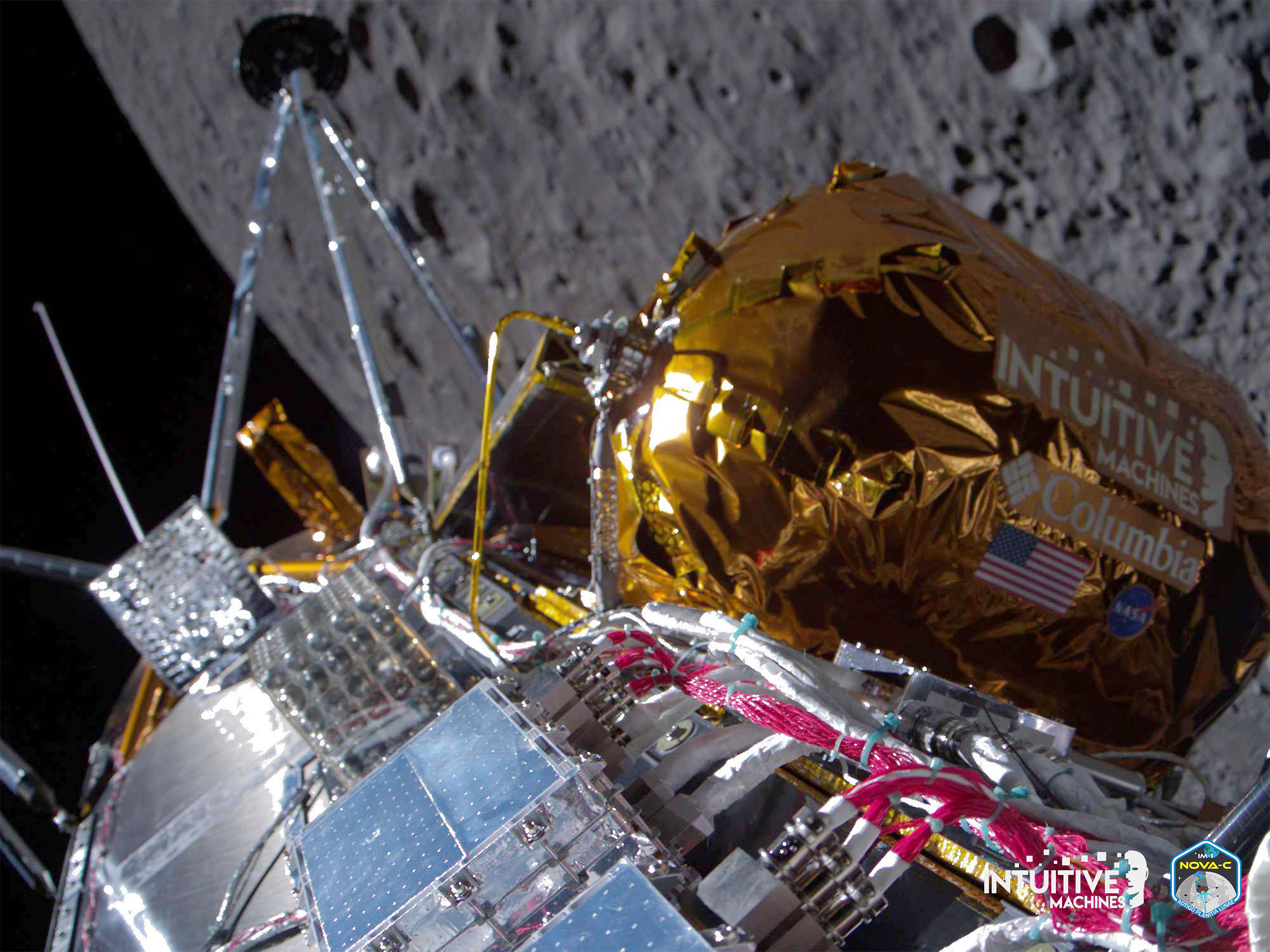
Image (Credit): A view of the Odysseus lunar lander as it flies over the near side of the moon on Wednesday. (Intuitive Machines/AP)

This week’s image come from Intuitive Machines and shows the Odysseus lunar lander orbiting the Moon just yesterday before its historic landing earlier today. After more than 50 years, the United States has returned to the Moon.

Earlier today, Intuitive Machines stated:

After troubleshooting communications, flight controllers have confirmed Odysseus is upright and starting to send data…Right now, we are working to downlink the first images from the lunar surface.

The Odysseus landed near the Malapert A crater, which is about 185 miles north of the Moon’s south pole.

Space Stories: Satellite Returns to Earth, Watching the Moon Landing, and Kuiper Belt Surprises

Image (Credit): Artist’s rendering of the European Space Agency’s (ESA) Earth Remote Sensing satellite. (ESA/dpa/picture alliance)

Here are some recent stories of interest.

BBC: Pioneering European ERS-2 Satellite Burns Up Over Pacific

The two-tonne ERS-2 spacecraft burnt up in the atmosphere over the Pacific. So far, there have been no eyewitness accounts of the mission’s demise or of any debris reaching Earth’s surface. ERS-2 was one of a pair of missions launched by the European Space Agency in the 1990s to study the atmosphere, the land and the oceans in novel ways. The duo monitored floods, measured continental and ocean-surface temperatures, traced the movement of ice fields, and sensed the ground buckle during earthquakes.

ForbesNASA To Live-Stream Spacecraft Odie’s Moon Landing Thursday. Here’s How To Watch

Houston-based Intuitive Machines is targeting 5:49 p.m. EST on Thursday, February 22, to put its Odysseus lunar lander on the surface of the moon—and it will be streamed live on NASA TV on YouTube. The first U.S. commercial moon lander, Odysseus—also known by its nickname “Odie”—will touchdown near a crater called Malapert A in the south pole region of the moon. If successful, this IM-1 mission—which is taking a scientific payload to the moon—will be the first spacecraft from the U.S. to land on the moon since Apollo 17 in December 1972.

Science Alert: NASA’s New Horizons Discovered a Large Surprise in The Kuiper Belt

There may be a lot more than we thought to the belt of icy debris that circles the outer Solar System. Data from the New Horizons probe as it sails serenely through the Kuiper Belt hints at unexpected levels of particles where dust ought to be thinning out, suggesting the donut-shaped field extends significantly farther from the Sun than previous estimates suggest.

More Terra-forming on Earth

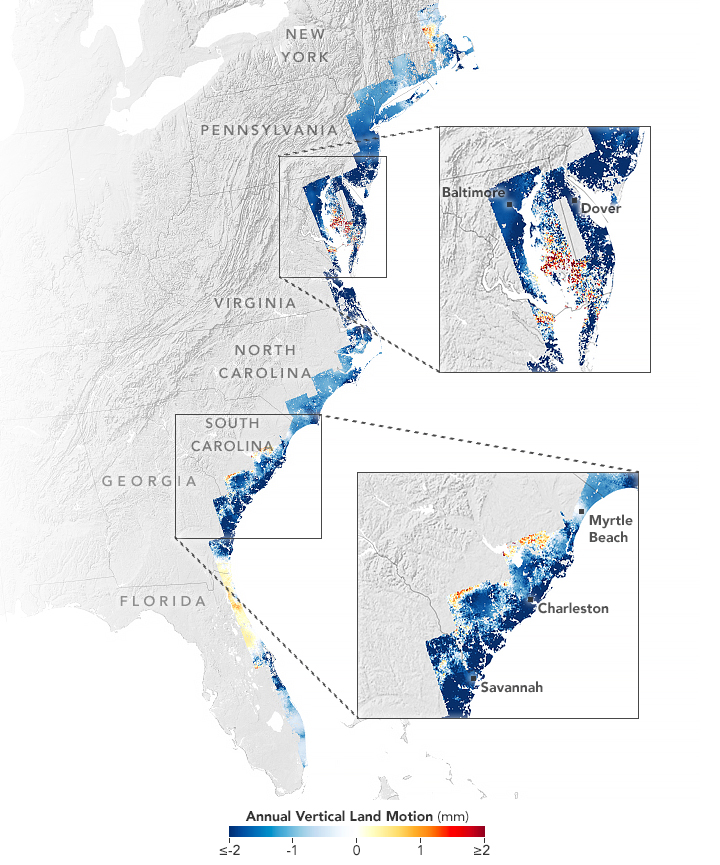
Image (Credit): Changes in land levels on the U.S. East Coast between 2007 and 2020. (Virginia Tech’s EOI Lab).

NASA is funding missions looking near and far to understand planets. One such study issued by scientists at Virginia Tech’s Earth Observation and Innovation (EOI) Lab, who used satellite data and ground-based GPS sensors, shows some ongoing changes here on planet Earth.

In reference to this study, NASA noted:

…the team reported that more than half of infrastructure in major cities such as New York, Baltimore, and Norfolk is built on land that sank, or subsided, by 1 to 2 millimeters per year between 2007 and 2020. Land in several counties in Delaware, Maryland, South Carolina, and Georgia sank at double or triple that rate. At least 867,000 properties and critical infrastructure including several highways, railways, airports, dams, and levees were all subsiding, the researchers found.

The study notes a number of reasons for these changes, including the after effects from the last ice age, man-made dams, and efforts to pump water back into aquifers. For example, in the case of Charleston, South Carolina, which is one of the fastest sinking cities on the East Coast, groundwater pumping is though to be the primary cause of this elevated rate of sinking.

This gives new meaning to the idea of keeping your eyes on the heavens, but also watching where you are stepping.