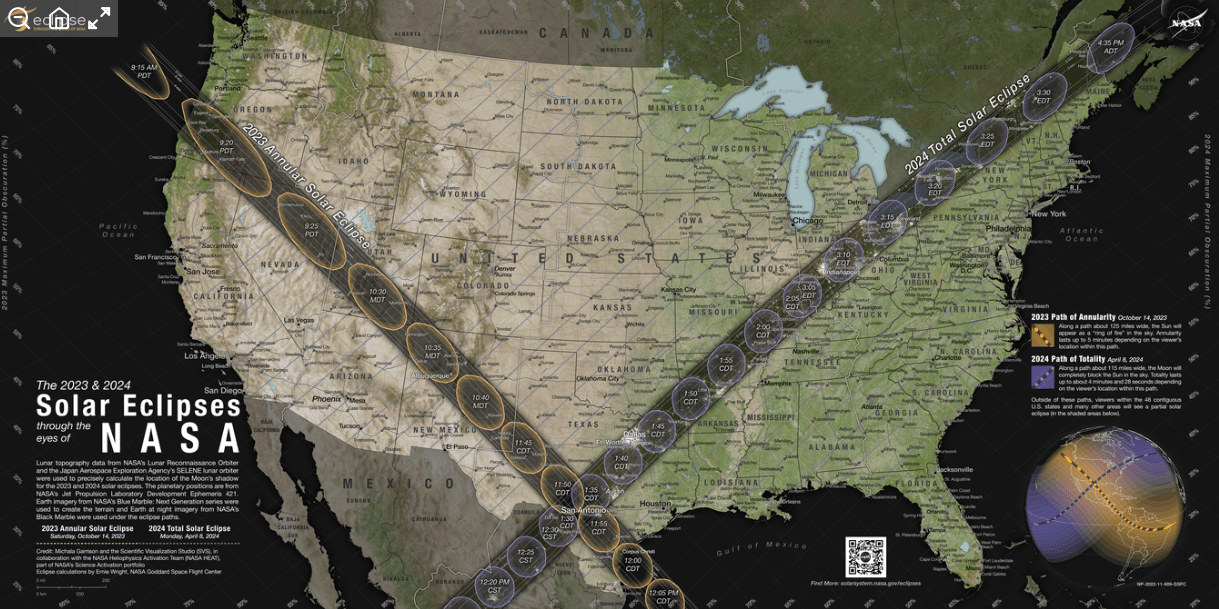
Image (Credit): A U.S. map showing the path of the Moon’s shadow during the 2023 annular solar eclipse (left side) and 2024 total solar eclipse (right side). (NASA)
If you are planning to get a good seat for the total solar eclipse on April 8, you may want to consult the NASA Solar Eclipses map (shown above) to figure our where you want to be. Hint for 2024 – California is not the place to be.
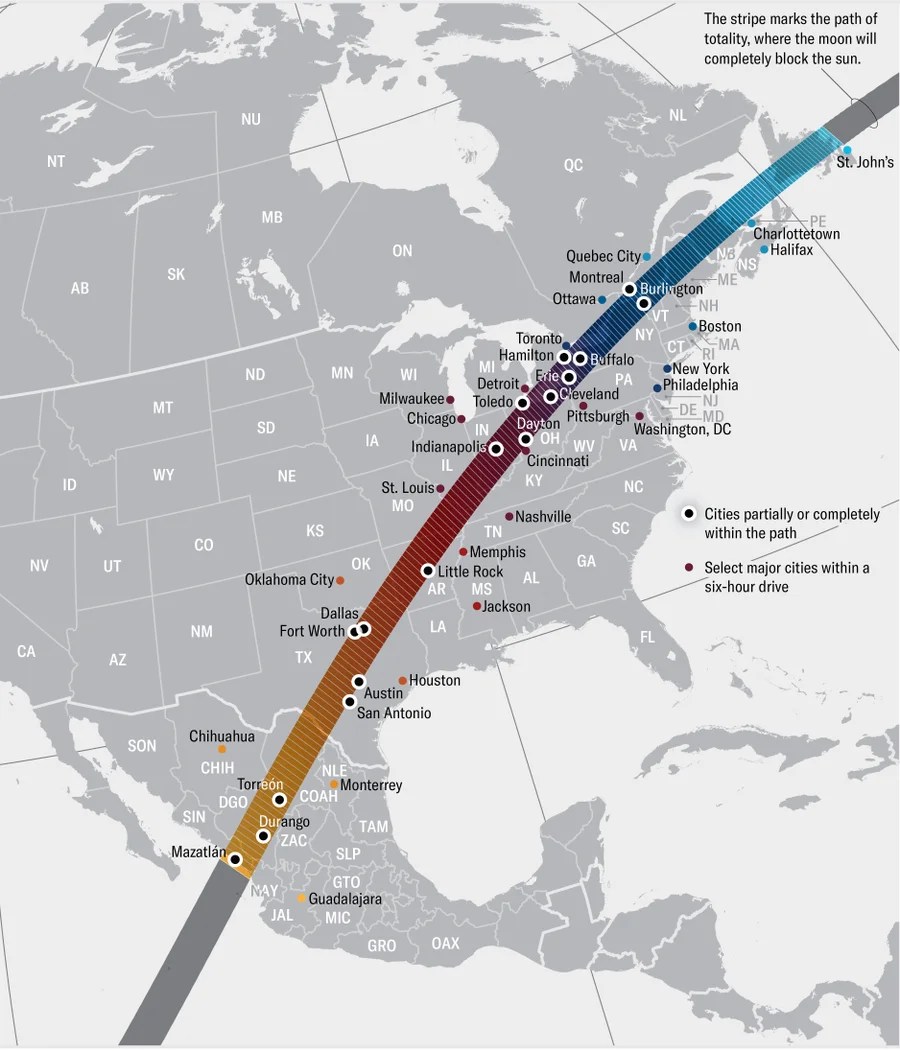
The 2024 solar eclipse map (shown below) from Scientific American magazine might also be helpful. It clearly highlights the cities that will have the best show.
Image (Credit): Map of the U.S. showing the path of the 2024 total solar eclipse on April 8. (Katie Peek/Scientific America, NASA)
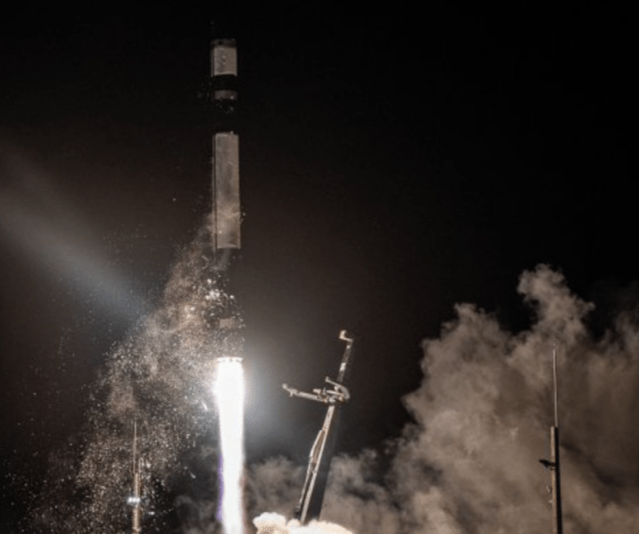
Image (Credit): Rocket Lab’s Electron rocket successfully deploying a fourth synthetic aperture radar satellite to Synspective’s Earth-observation constellation. (Rocket Lab)
Earlier this week, Japanese cargo was launched towards space by two commercial companies. Unfortunately, only of the rockets made it into space.
On March 13, US company Rocket Lab launched a payload for Japan’s Synspective, an Earth-imaging company, from its launch site in New Zealand. The launch was successful and the StriX-3 satellite was placed into Earth orbit.
The second launch on the same day by Japan’s Space One, which would have been the first commercial launch by a Japanese firm, ended quickly when the rocket burst into flames just a few seconds after liftoff. The rocket was carrying a mock-up of a government spy satellite.
Space One President Masakazu Toyoda stated, “We will find out the cause as soon as possible and clarify our measures to prevent a recurrence.”
Getting it right may take time, as we are seeing with SpaceX’s Starship. Japan wants to maintain strong launch capabilities in both the public and private sectors, and this is just part of the process to make that happen.
Image (Credit): Photos showing the launch and midair explosion of Space One’s Kairos rocket. (KYODO)
Image (Credit): An artist’s rending of NASA’s VIPER at the Moon’s south pole. (NASA/Daniel Rutter)
You have until midnight today to submit your name to NASA and be part of the Agency’s first robotic Moon rover, called Volatiles Investigating Polar Exploration Rover (VIPER). Go to this link and provide your name and PIN code to ensure your name goes to the Moon (and you also get your boarding pass as a virtual souvenir).
VIPER is expected to head to the Moon in late 2024 as part of NASA’s Commercial Lunar Payload Services initiative. Once on the lunar surface, it will spend 100 days on the Moon’s south pole to sample the soil and locate frozen water.
If you missed the chance to have your name aboard the Europa Clipper, you still have a chance to be part of this local moon mission.
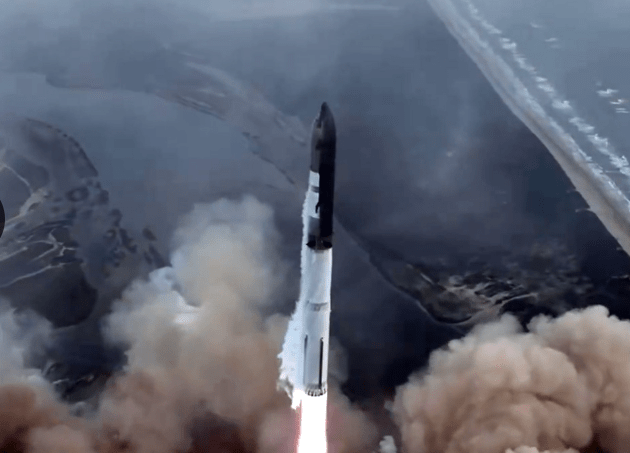
Image (Credit): Starship launch from Boca Chica, Texas on March 14, 2024. (SpaceX)
This week’s pic is from this morning’s launch of the SpaceX Starship from the facility in Boca Chica, Texas. The flight went well until the point of reentry, when SpaceX lost contact and the rocket was lost. The plan had been for both a successful launch and return of the Starship. The Starship’s rocket booster also experienced a malfunction, causing it to crash in the Gulf of Mexico.
Each launch provides more information as it inches towards greater success. We can only hope the progress aligns with NASA’s goals for a return to the Moon.
Image (Credit): One of the ships from Jodorowsky’s Dune drawings. (Sony Pictures Classics)
Now that Dune: Part Two is in theaters, it may be worth your time to revisit an earlier attempt to create a Dune movie by Chilean-French filmmaker Alejandro Jodorowsky Prullansky. The 2014 film, Jodorowsky’s Dune, discusses the filmmaker’s elaborate plans in the 1970s to create a 12-20 hour film covering the life of Paul Atreides. The planned combination of surrealistic art (Moebius), contemporary music (Pink Floyd), and stars (from Orson Welles to Dali) were being aligned to create something that might of been magical or just catastrophic. We will never know because the American film industry turned him down, even if they did use some of his ideas for future films such as Star Wars and Aliens.
When the film rights to Dune were sold again and Peter Lynch was given a green light to direct the film, we got the 1984 cultish mess that still haunts the streaming services. In the 2014 flim, Jodorowsky said he watched the Lynch film and was “happy because the picture was awful.’
In terms of the latest Dune films by Canadian filmaker Denis Villeneuve, in an interview Jodorowsky said he saw the trailer for the first Dune film and thought it was “well done” for standard industrial cinema, but noted that “industrial cinema is incompatible with auteur cinema.”
In my opinion, after a failure and then a flop, we are lucky to have the determination of Denis Villeneuve to finally give us a high-quality, memorable Dune. That said, it would have been fun to see Dali as the Emperor.




 Our Awesome Universe