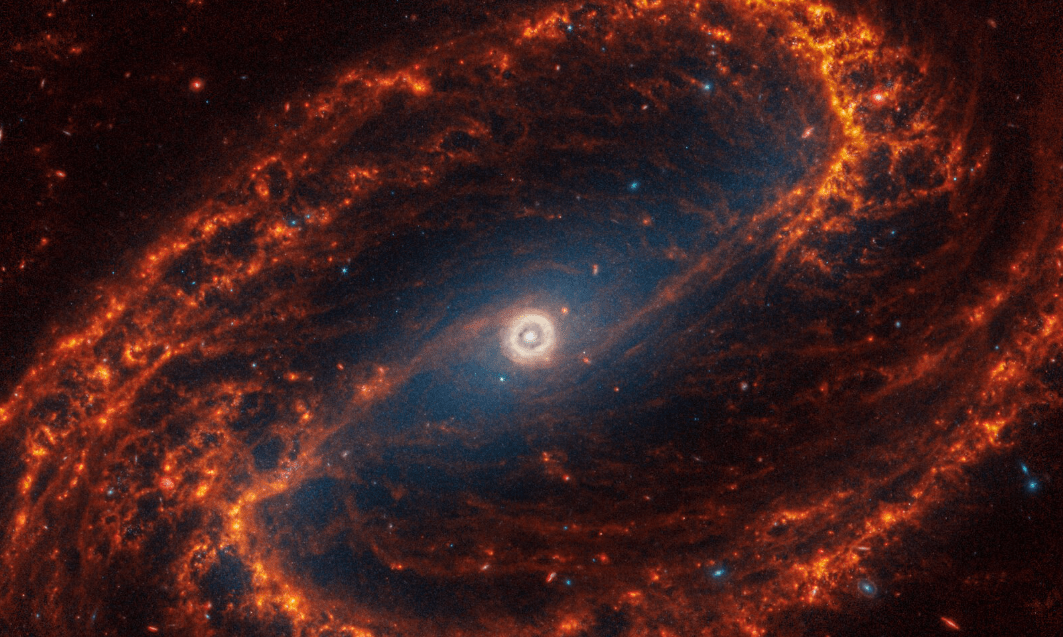
Pic of the Week: Spiral galaxy NGC 1300

Image (Credit): JWST’s view of spiral galaxy NGC 1300. (NASA, ESA, CSA, STScI, Janice Lee (STScI), Thomas Williams (Oxford), and the PHANGS team)

This week’s image is from the James Webb Space Telescope (JWST). It shows a face-on view of spiral galaxy NGC 1300, which is 69 million light-years away.

Here is more about the image from NASA:

Webb’s image of NGC 1300 shows a face-on barred spiral galaxy anchored by its central region, which is circular and shows a bright white point at the center with a light yellow circle around it. The central core is tiny compared to the rest of the galaxy. The core extends into the galaxy’s prominent diagonal bar structure, which is filled with a blue haze of stars. Orange dust filaments cross the bar, extending diagonally to the top and bottom, connecting the yellow circle in the central core to the galaxy’s spiral arms. There are two distinct orange spiral arms made of stars, gas, and dust that start at the edges of the bar and rotate counterclockwise. Together, the arm and bars form a backward S shape. The spiral arms are largely orange, ranging from dark to bright orange. Scattered across the packed scene are very few bright blue pinpoints of light. There are vast areas between where the orange spiral arms wrap that appear black. The top left and bottom right edges are dark black and there are some larger red and blue points of light, some that appear like disks seen from the side.

Space Stories: Biomolecules on Mars, a “Dead” Galaxy, and the Most Distant Galaxies

Image (Credit): Image of Mars captured by the NASA Mars Global Surveyor MOC wide angle cameras. (NASA)

Here are some recent stories of interest.

Tohoku University: Biomolecules from Formaldehyde on Ancient Mars

Organic materials discovered on Mars may have originated from atmospheric formaldehyde, according to new research, marking a step forward in our understanding of the possibility of past life on the Red Planet. Scientists from Tohoku University have investigated whether the early atmospheric conditions on Mars had the potential to foster the formation of biomolecules – organic compounds essential for biological processes. Their findings, published in Scientific Reports, offer intriguing insights into the plausibility of Mars harboring life in its distant past.

University of Cambridge: Astronomers Spot Oldest “Dead” Galaxy Yet Observed

A galaxy that suddenly stopped forming new stars more than 13 billion years ago has been observed by astronomers. Using the James Webb Space Telescope, an international team of astronomers led by the University of Cambridge has spotted a ‘dead’ galaxy when the universe was just 700 million years old, the oldest such galaxy ever observed. This galaxy appears to have lived fast and died young: star formation happened quickly and stopped almost as quickly, which is unexpected for so early in the universe’s evolution. However, it is unclear whether this galaxy’s ‘quenched’ state is temporary or permanent, and what caused it to stop forming new stars.

Webbtelescope.org: Webb Unlocks Secrets of One of the Most Distant Galaxies Ever Seen

Delivering on its promise to transform our understanding of the early universe, the James Webb Space Telescope is probing galaxies near the dawn of time. One of these is the exceptionally luminous galaxy GN-z11, which existed when the universe was just a tiny fraction of its current age. One of the youngest and most distant galaxies ever observed, it is also one of the most enigmatic. Why is it so bright? Webb appears to have found the answer. Scientists using Webb to study GN-z11 have also uncovered some tantalizing evidence for the existence of Population III stars nestled in the outskirts of this remote galaxy. These elusive stars — the first to bring light to the universe — are purely made of hydrogen and helium. No definitive detection of such stars has ever been made, but scientists know they must exist. Now, with Webb, their discovery seems closer than ever before.

Movies: Dune and Denis Villeneuve’s Classy Gesture

Image (Credit): Scene from Dune: Part Two. (Warner Bros.)

It was a classy move by the Canadian filmmaker who gave us of this year’s most anticipated movie, Dune: Part Two.

A dying man in northern Quebec had one last wish before he died – he wanted to see the second installment of Denis Villeneuve’s Dune. Once the request appeared on social media, the film team went into action, even offering to fly the man to the film’s premiere in Montreal. But that was two month’s away, and the man could not wait that long nor was the medical team able to move him to another location.

So the film was flown up to Quebec on Villeneuve’s computer laptop for a private showing. The man watched the film and died a few days later.

Asked about this gesture, Villeneuve’s comment was, ““It’s for him, it’s for that man that we make films.”

As I said, classy.

Podcast: Discussing the XPrize and More

A recent episode of the StarTalk podcast, “Incentivizing the Future with Peter Diamandis,” provides an interesting tale about Mr. Diamanis’s early efforts to spur space inventions through the XPRIZE Foundation as well as his current efforts to spur innovation in other areas, such as healthcare.

It was a good reminder about the start of Virgin Galactic, which began after Burt Rutan’s experimental spaceplane SpaceShipOne won the Ansari X Prize in 2004. One can quickly forget that some of the big names in new industries were piggybacking on the earlier achievements of others, such as Elon Musk buying a pre-existing Tesla company.

If you go to the XPrize Foundation page, you will see a variety of competitions underway. The latest space-related contest is the $30 million Google Lunar XPRIZE, which was

…created with two goals in mind. To spur affordable access to the moon and give space entrepreneurs a legitimate platform to develop long-term business models around lunar transportation and to inspire the next generation of scientists, engineers, space explorers and adventurers to enter the STEM fields.

As Mr. Diamandis was encouraged by contests from early last century, let’s hope other innovators and their supporters continue to carry the torch beyond this century to see what human ingenuity can create when challenged.

Another Crew Departing for the ISS

Image (Credit): The SpaceX Crew-8 (identified below) expected to depart later today. (NASA)

Later today, a SpaceX rocket with carry another crew to the International Space Station (ISS) after a few delays. The crew, shown above, consists of Alexander Grebenkin (Roscosmos), Michael Barratt (NASA), Matthew Dominick (NASA), Jeanette Epps (NASA).

The new crew will be approaching a space station already containing seven crew members as well as a module in need of repair. The Russian components of the space station have sprung a number of leaks over the past several years. The most recent appears to be a recurring oxygen leak.

To date, NASA is playing it cool, though I expect everyone on board would be happy to experience at leakless station as soon as possible. We know the ISS will not last forever, but until the day it is decommissioned it should be a safe vessel for the astronauts and cosmonauts aboard.

Update: The SpaceX launch went off without a hitch Sunday evening. The new crew on the Dragon spacecraft is expected to reach the ISS Tuesday morning.