
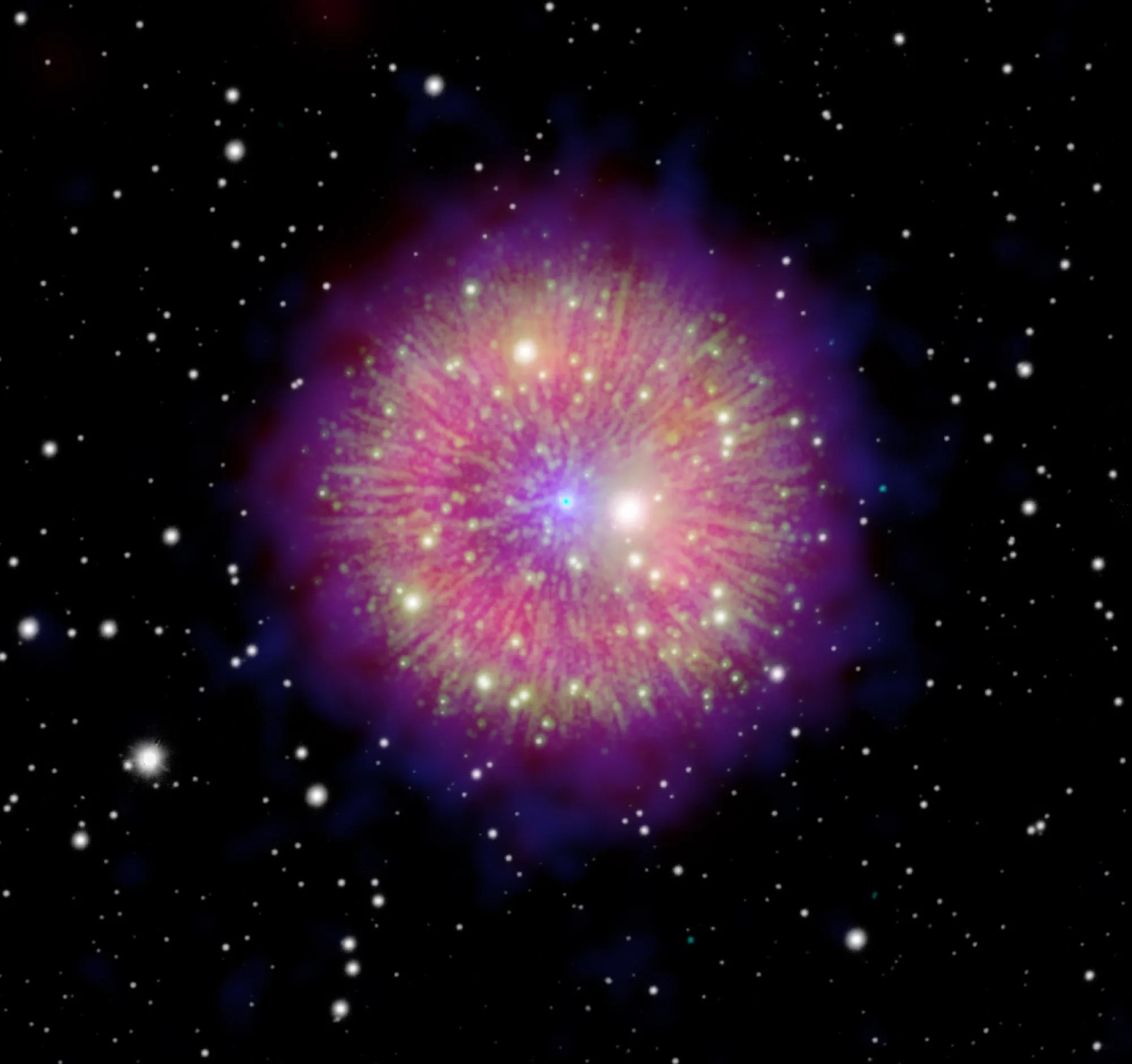
This week’s image is a circular nebula that first appears more than 800 years ago, shocking those observing it on Earth at the time and lasting for about 185 days. The circular nebula, called Pa 30, is shown above as a composite of multiple telescopes, including the Chandar X-ray Observatory, which is now facing a threat to its funding.
Hear is more from NASA concerning this image:
X-ray observations by ESA’s XMM-Newton (blue) show the full extent of the nebula and NASA’s Chandra X-ray Observatory (cyan) pinpoints its central source. The nebula is barely visible in optical light but shines bright in infrared light, collected by NASA’s Wide-field Infrared Space Explorer (red and pink). Interestingly, the radial structure in the image consists of heated sulfur that glows in visible light, observed with the ground-based Hiltner 2.4 m telescope at the MDM Observatory (green) in Arizona, USA, as do the stars in the background by Pan-STARRS (white) in Hawaii, USA.
Studies of the composition of the different parts of the remnant have led scientists to believe that it was formed in a thermonuclear explosion, and more precisely a special kind of supernova called a sub-luminous Type Iax event. During this event two white dwarf stars merged, and typically no remnant is expected for this kind of explosion. But incomplete explosions can leave a kind of ‘zombie’ star, such as the massive white dwarf star in this system. This very hot star, one of the hottest stars in the Milky Way (about 200 000 degrees Celsius), has a fast stellar wind with speeds up to 16,000 km/h. The combination of the star and the nebula makes it a unique opportunity for studying such rare explosions.
 Our Awesome Universe