Pic of the Week: New Crew Launched to the Tiangong Space Station

Image (Credit): April 25, 2024 launch of the Shenzhou 18 mission to the Tiangong space station. (CMSA)

This week’s image shows today’s launch of three astronauts to China’s Tiangong space station on the Shenzhou 18 mission aboard a Long March 2F rocket. The crew successfully reached the space station 6.5 hours after launch.

One of the new crew members has already spent 182 days in orbit aboard the Tiangong space station. The Tiangong space station has been continuously crewed since June 2022.

Image (Credit): Shenzhou 18 crew members Li Cong, commander Ye Guangfu and Li Guangsu. Guangfu has logged 182 days in orbit during a stay aboard the Tiangong space station in 2021-22. (CMSA)

New Crew will Help Strengthen the Chinese Space Station Against Space Debris

Image (Credit): China’s Tiangong space station captured by a returning Shenzhou spacecraft. (CMSA)

China is getting ready to send a new crew to its Tiangong space station tomorrow. The Shenzhou-18 spacecraft will carry three new crew members to the station, replacing the crew that has been on the station since last October.

The current crew had to deal with space debris that damaged its solar panels and led to a power loss. Two spacewalks were recently conducted to make the necessary repairs. The arriving crew is coming with additional repair material, including “space debris protection reinforcements for extravehicular piping, cables and critical equipment,” according to China Daily.

Unfortunately, space debris is a constant hazard in orbit. The International Space Station (ISS) has dodged debris as well as repairing damaged areas. Of course, the ISS is also dropping space debris on Florida, but that’s a different story.

A Day in Astronomy: First Spaceflight Fatality

Image (Credit): Soviet cosmonaut Vladimir Komarov. (RIA Novosti)

On this day in 1967, the Soviet Union’s Vladimir Komarov became the first spaceflight fatality when his Soyuz 1 spacecraft crashed during reentry as the result of a failed parachute. The accident occurred during what was his second trip to space, his first being aboard the Voskhod 1. Yuri Gagarin served as the backup cosmonaut on the Soyuz 1 flight.

The Soyuz 1 mission was already experiencing problems before reentry, particularly with its solar panels. These problems were enough to end the mission early and delay the launch of a second Soyuz spacecraft that would have met up with the orbiting Soyuz 1. The spacecraft was not up to the mission. Before the crash, Komarov could be heard stating, “This devil ship! Nothing I lay my hands on works properly.”

This fellow cosmonauts had this to say via Pravda:

For the forerunners it is always more difficult. They tread the unknown paths and these paths are not straight, they have sharp turns, surprises and dangers. But anyone who takes the pathway into orbit never wants to leave it. And no matter what difficulties or obstacles there are, they are never strong enough to deflect such a man from his chosen path. While his heart beats in his chest, a cosmonaut will always continue to challenge the universe. Vladimir Komarov was one of the first on this treacherous path.

Image (Credit): Burkina Faso stamps commemorating cosmonaut Vladimir Komarov. (stamps-world.eu)

Space Stories: More on Planet 9, A Collision with Pluto, and Explaining Free-Floating Planets

Here are some recent stories of interest.

IFLScience: Astronomers Find Evidence Of A Massive Object Beyond The Orbit Of Neptune

A team of researchers say they have found the “strongest statistical evidence yet that Planet 9 is really out there” in the solar system after studying a population of distant, unstable objects that cross Neptune’s orbit...In a new paper, the team looked at long-period objects that crossed the path of Neptune’s orbit, finding that their closest point of orbit to the sun was around 15-30 astronomical units (AU), with one AU being the distance between the sun and the Earth.

CNN: Pluto Gained a ‘Heart’ After Colliding with a Planetary Body

A huge heart-shaped feature on the surface of Pluto has intrigued astronomers since NASA’s New Horizons spacecraft captured it in a 2015 image. Now, researchers think they have solved the mystery of how the distinctive heart came to be — and it could reveal new clues about the dwarf planet’s origins…an international team of scientists has determined that a cataclysmic event created the heart. After an analysis involving numerical simulations, the researchers concluded a planetary body about 435 miles (700 kilometers) in diameter, or roughly twice the size of Switzerland from east to west, likely collided with Pluto early in the dwarf planet’s history.

University of Nevada: Astronomers Offer New Model for Formation of Recently Discovered ‘Free-floating’ Planets

The recent discovery of a potential new class of distant and mysterious “free-floating” planets has intrigued astronomers since stunning new images captured by the James Webb Space Telescope were shared late last year. These candidate planets, known as Jupiter-mass Binary Objects (JuMBOs), seem to orbit one another as they float freely in space unbound to any star—which counters prevailing theories of how planetary systems were thought to work. Now, a new study by a team of astrophysicists from UNLV and Stony Brook University, published April 19 in the journal Nature Astronomy, introduces a compelling model for how these JuMBOs may have formed.


Juno Views Lava Lake on Io

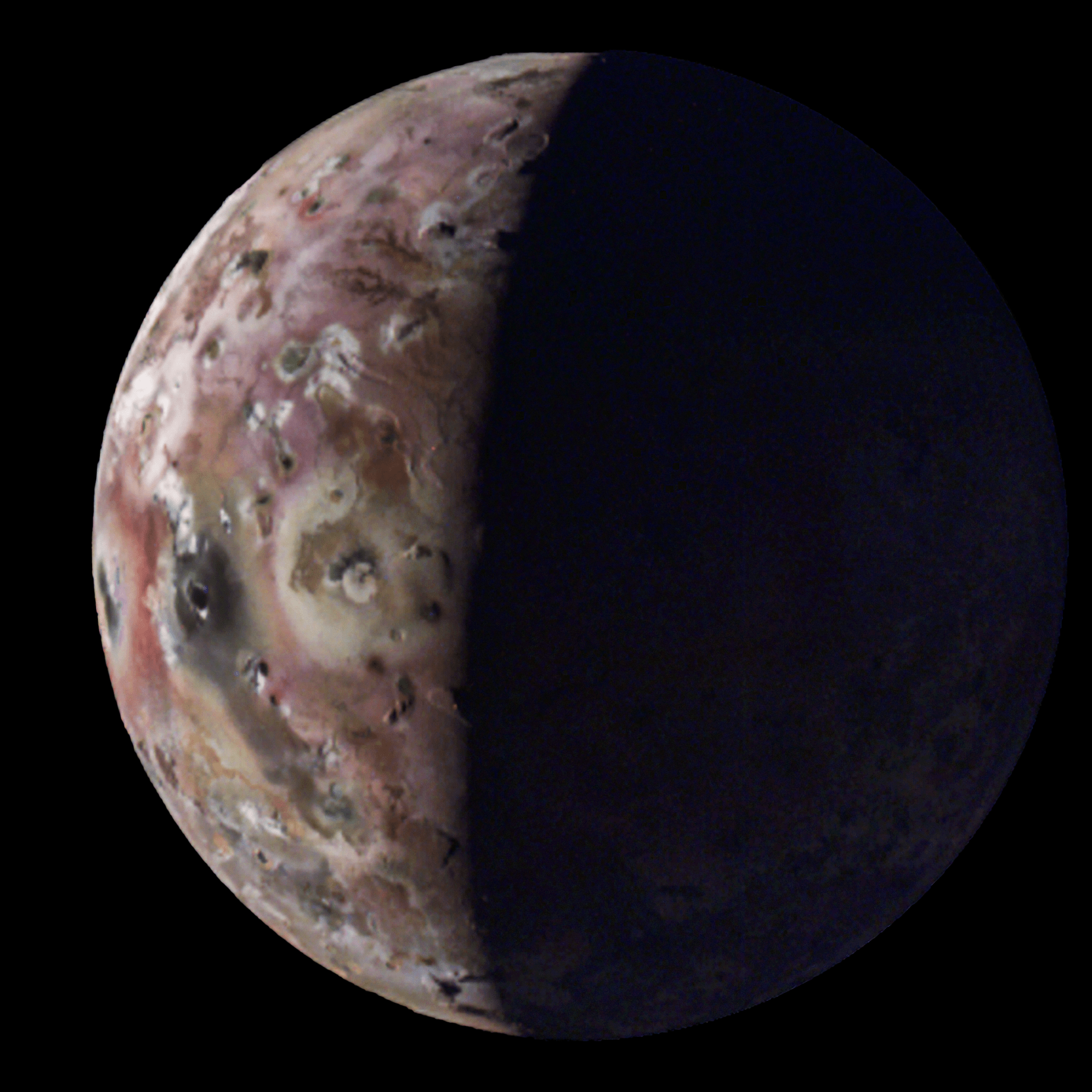
Image (Credit): View of Jupiter’s moon Io as seen by the Juno spacecraft on April 9. It was the first-ever image of the moon’s south polar region. (NASA/JPL-Caltech/SwRI/MSSS. Image processing: Gerald Eichstädt/Thomas Thomopoulos (CC BY))

The Juno spacecraft is still hard a work in the vicinity of Jupiter, with its latest mission being a flyby of the moon Io earlier this month (shown above).

Two recent flybys of the moon were also combined to create an image of a lake of cooling lava (shown below and via the video here). Juno’s principal investigator Scott Bolton explained the new image:

Io is simply littered with volcanoes, and we caught a few of them in action. We also got some great close-ups and other data on a 200-kilometer-long (127-mile-long) lava lake called Loki Patera. There is amazing detail showing these crazy islands embedded in the middle of a potentially magma lake rimmed with hot lava. The specular reflection our instruments recorded of the lake suggests parts of Io’s surface are as smooth as glass, reminiscent of volcanically created obsidian glass on Earth.

Juno has been zipping around Jupiter’s neighborhood since 2016. It’s main task is to study the origin and evolution of Jupiter, believed to be the first planet to have formed in our solar system. By doing so, NASA hopes to learn more about the solar system and the Earth as well.

Image (Credit): An artist’s rendering of Loki Patera, a lava lake on Jupiter’s moon Io, created using data from the JunoCam imager aboard NASA’s Juno spacecraft. (NASA/JPL-Caltech/SwRI/MSSS)