In Case You Missed It: One Way to Get Kids into Planetariums

Image (Credit): Taylor Swift light show at the Saint Louis Science Center. (Saint Louis Science Center)

It may be an unusual way to encourage children to visit a planetarium, but it seems to be working. Taylor Swift light shows appear to be the new rage at planetariums across the country.

The image above comes from the light show at the Saint Louis planetarium, though you can find similar shows at planetariums in Springfield, Massachusetts, Laramie, Wyoming, and Boulder, Colorado.

I suppose this is a way to introduce some kids to the existence of the planetarium while also paying the overhead for the planetarium itself. It would be nice to learn whether the same crowd comes back later to learn more about the solar system and universe, though I have not seen much press on that relationship.

One can only hope that the real stars eventually outshine the Earth-bound ones for some of these children. Maybe the visit will even lead to more interest in the planets, such as Saturn. After all, didn’t Taylor sing about that planet in her song Seven?

Sweet tea in the summer
Cross your heart, won’t tell no other
And though I can’t recall your face
I still got love for you
Your braids like a pattern
Love you to the moon and to Saturn
Passed down like folk songs
The love lasts so long
Study Findings: Genomic, Functional, and Metabolic Enhancements in Multidrug-Resistant Enterobacter Bugandensis Facilitating its Persistence and Succession in the International Space Station

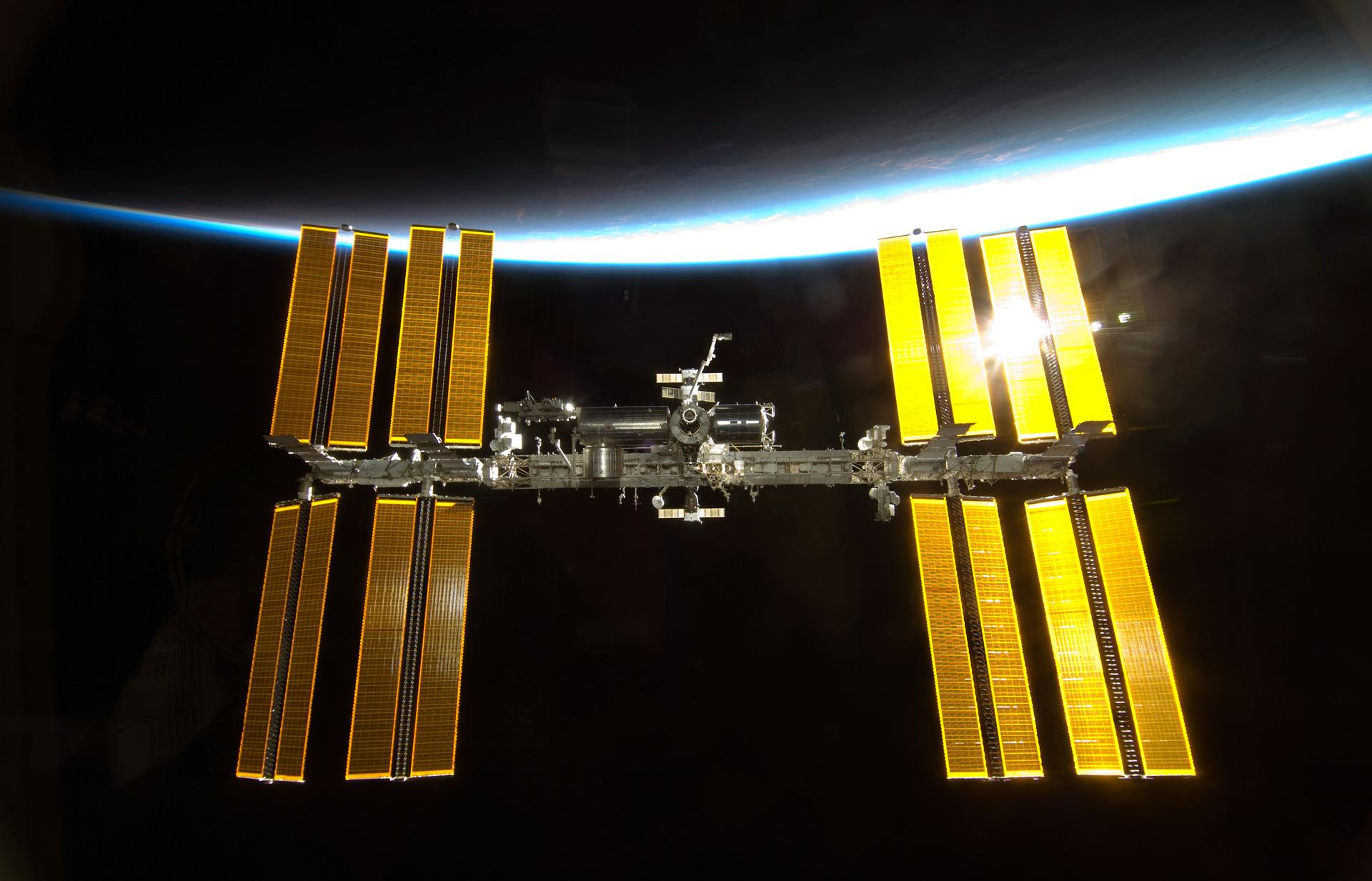
Image (Credit): The International Space Station. (NASA)

PubMed  abstract of the study findings:

Distinct from their Earth counterparts, ISS E. bugandensis strains have exhibited resistance mechanisms that categorise them within the ESKAPE pathogen group, a collection of pathogens recognised for their formidable resistance to antimicrobial treatments. During the 2-year Microbial Tracking 1 mission, 13 strains of multidrug-resistant E. bugandensis were isolated from various locations within the ISS. We have carried out a comprehensive study to understand the genomic intricacies of ISS-derived E. bugandensis in comparison to terrestrial strains, with a keen focus on those associated with clinical infections. We unravel the evolutionary trajectories of pivotal genes, especially those contributing to functional adaptations and potential antimicrobial resistance. A hypothesis central to our study was that the singular nature of the stresses of the space environment, distinct from any on Earth, could be driving these genomic adaptations. Extending our investigation, we meticulously mapped the prevalence and distribution of E. bugandensis across the ISS over time. This temporal analysis provided insights into the persistence, succession, and potential patterns of colonisation of E. bugandensis in space. Furthermore, by leveraging advanced analytical techniques, including metabolic modelling, we delved into the coexisting microbial communities alongside E. bugandensis in the ISS across multiple missions and spatial locations. This exploration revealed intricate microbial interactions, offering a window into the microbial ecosystem dynamics within the ISS.

Citation: Sengupta P, Muthamilselvi Sivabalan SK, Singh NK, et al. Genomic, functional, and metabolic enhancements in multidrug-resistant Enterobacter bugandensis facilitating its persistence and succession in the International Space Station. Microbiome 12(1):62 (2024).
https://doi.org/10.1186/s40168-024-01777-1

Study-related stories:

Pic of the Week: Pa 30 – The Temporary Star

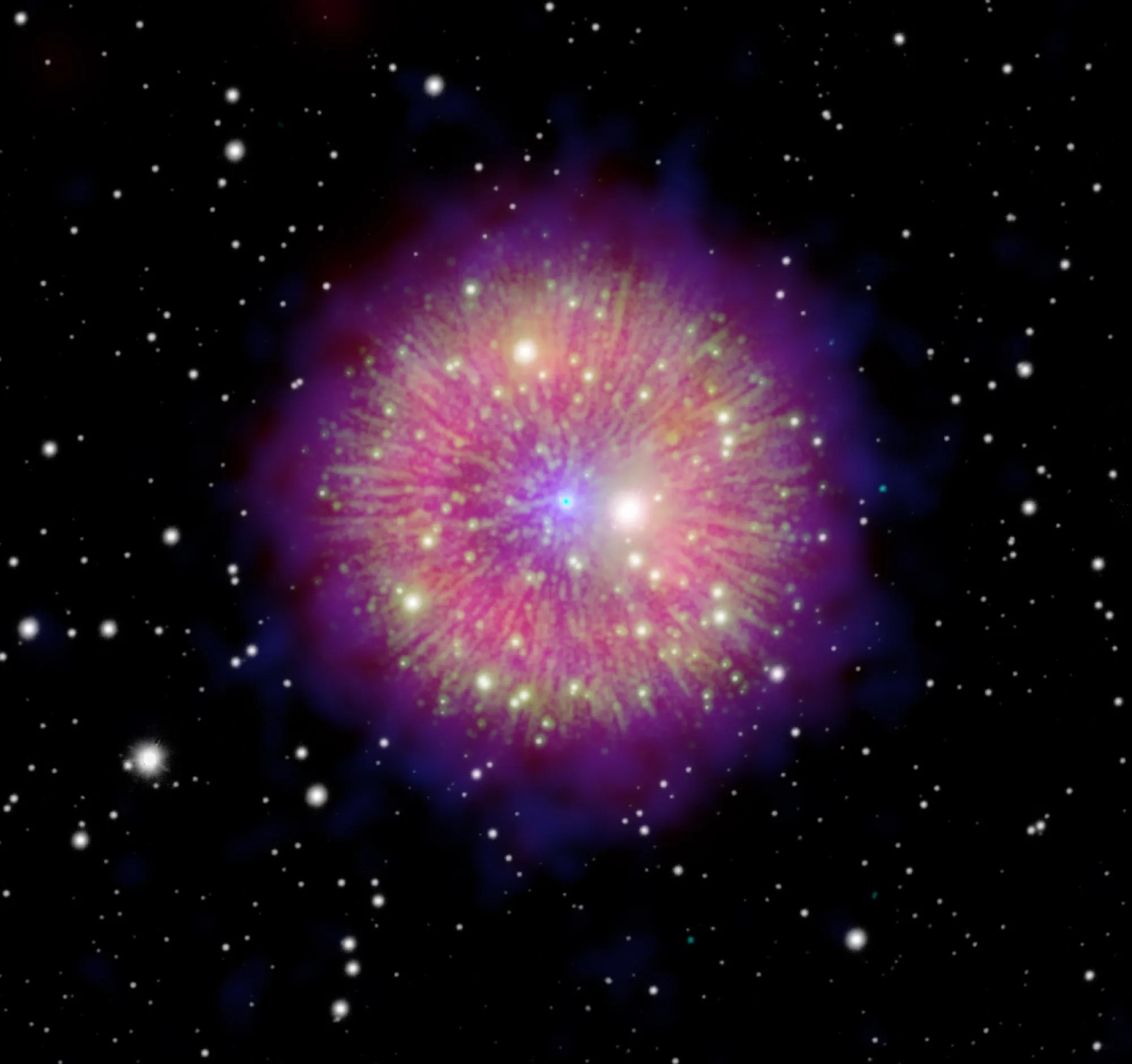
Image (Credit): Composite image of circular nebula Pa 30. (X-ray: (Chandra) NASA/CXC/U. Manitoba/C. Treyturik, (XMM-Newton) ESA/C. Treyturik; Optical: (Pan-STARRS) NOIRLab/MDM/Dartmouth/R. Fesen; Infrared: (WISE) NASA/JPL/Caltech/; Image Processing: Univ. of Manitoba/Gilles Ferrand and Jayanne English)

This week’s image is a circular nebula that first appears more than 800 years ago, shocking those observing it on Earth at the time and lasting for about 185 days. The circular nebula, called Pa 30, is shown above as a composite of multiple telescopes, including the Chandar X-ray Observatory, which is now facing a threat to its funding.

Hear is more from NASA concerning this image:

X-ray observations by ESA’s XMM-Newton (blue) show the full extent of the nebula and NASA’s Chandra X-ray Observatory (cyan) pinpoints its central source. The nebula is barely visible in optical light but shines bright in infrared light, collected by NASA’s Wide-field Infrared Space Explorer (red and pink). Interestingly, the radial structure in the image consists of heated sulfur that glows in visible light, observed with the ground-based Hiltner 2.4 m telescope at the MDM Observatory (green) in Arizona, USA, as do the stars in the background by Pan-STARRS (white) in Hawaii, USA.

Studies of the composition of the different parts of the remnant have led scientists to believe that it was formed in a thermonuclear explosion, and more precisely a special kind of supernova called a sub-luminous Type Iax event. During this event two white dwarf stars merged, and typically no remnant is expected for this kind of explosion. But incomplete explosions can leave a kind of ‘zombie’ star, such as the massive white dwarf star in this system. This very hot star, one of the hottest stars in the Milky Way (about 200 000 degrees Celsius), has a fast stellar wind with speeds up to 16,000 km/h. The combination of the star and the nebula makes it a unique opportunity for studying such rare explosions.

Movie: Rebel Moon, Part Two: The Scargiver

Image (Credit): Poster for Rebel Moon – Part Two: The Scargiver. (Netflix)

If you enjoyed part one of Netflix’s Rebel Moon, then you will be happy to hear that part two will premiere this Friday (April 19). If you are not a fan, then you can simply ignore this announcement.

The full name, Rebel Moon – Part Two: The Scargiver, follows last year’s Rebel Moon – Part One: A Child of Fire, which I previously noted was not completely terrible. From the trailers, it appears to be about as crazy and violent as the first one, but this time with light sabers, of course.

Given that Part One scored only 21 percent on Rotten Tomatoes, the second film has a lot of room to improve, as noted in the comments below:

While watching this first Rebel Moon, you can’t help but wonder if Snyder’s specific idea was to do “Star Wars” but without any of the fun. – Mark Meszoros, The News-Herald (Willoughby, OH)

With enormous scope to innovate, Snyder has instead gathered together a painfully obvious collection of- I hesitate to write ‘influences’, as that seems to give Snyder too much credit. ‘Things to photocopy and then mash together’ feels more appropriate. – Grant Watson, Fiction Machine

Rebel Moon is an entertaining but flawed space opera with some great action and cinematography that would have been better as the first part of an R-rated trilogy. Hopefully Part 2 builds on the opening film’s strengths. – Erik Kain, Forbes

If you have a free night this weekend, you might want to take a look. And don’t worry, if you still don’t care for this one, there may be a part three coming soon (even though that was not the original plan).

Space Stories: Protests to Save Chandra, Problems Retrieving Martian Sample, and TESS is Getting Testy

Here are some recent stories related to NASA missions.

PhysicsWorld: US Astronomers Slam Cuts to the Chandra X-ray Observatory

X-ray astronomers in the US have begun a campaign to save the Chandra X-ray Observatory from budget cuts that would effectively end the mission. They assert that the craft, which was launched in 1999, has plenty of life left in it. Cancelling support could, they say, damage scientific efforts to understand the universe and the careers of an emerging generation of X-ray astronomers.

CNN: NASA Rethinks Plan to Return Rare Mars Samples to Earth

“Mars Sample Return will be one of the most complex missions NASA has ever undertaken. The bottom line is, an $11 billion budget is too expensive, and a 2040 return date is too far away,” Nelson said. “Safely landing and collecting the samples, launching a rocket with the samples off another planet — which has never been done before — and safely transporting the samples more than 33 million miles (53 million kilometers) back to Earth is no small task. We need to look outside the box to find a way ahead that is both affordable and returns samples in a reasonable time frame.”

NASA: NASA’s TESS Temporarily Pauses Science Observations

NASA’s TESS (Transiting Exoplanet Survey Satellite) entered into safe mode April 8, temporarily interrupting science observations. The team is investigating the root cause of the safe mode, which occurred during scheduled engineering activities. The satellite itself remains in good health. The team will continue investigating the issue and is in the process of returning TESS to science observations in the coming days.