Movie/Book Review: Mickey 17

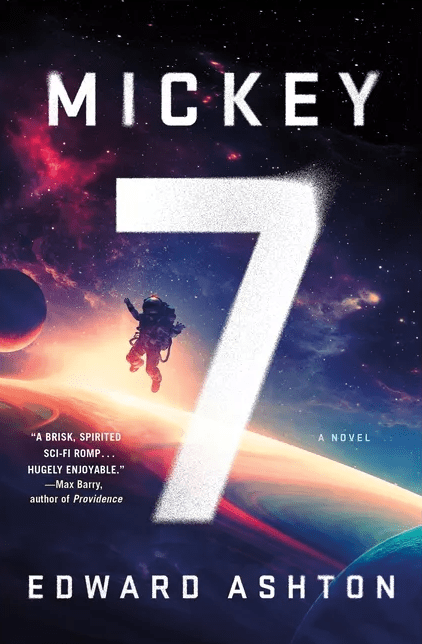
Credit: St. Martin’s Publishing Group

I recently read the book Mickey7 and thought to myself how it would make a great movie. I guess I was not alone since the movie was already in production.

It is the story of a crew member on a spacecraft who was literally dying to do his job. He performed the most dangerous tasks on the mission and when he died he would be reincarnated as the next version of himself. Hence, the term Mickey7 for the seventh iteration of his being.

So now it seems that Robert Pattinson wants to get in on the act, but this time as Mickey 17, who is therefore a little more experienced with death than the character in the book. The film cast also includes Steven Yeun, Naomi Ackie, Toni Collette, and Mark Ruffalo.

Unfortunately, you will need to wait for the film, which was supposed to be released last month. The Hollywood strike caused it to move to January 2025, much like Dune: Part Two was bumped from has year to this year.

That’s okay. Now you have plenty of time to read the book. Here is the teaser:

Dying isn’t any fun…but at least it’s a living.

Mickey7 is an Expendable: a disposable employee on a human expedition sent to colonize the ice world Niflheim. Whenever there’s a mission that’s too dangerous—even suicidal—the crew turns to Mickey. After one iteration dies, a new body is regenerated with most of his memories intact.

On a routine scouting mission, Mickey7 goes missing and is presumed dead. By the time he returns to the colony base, his fate has been sealed. There’s a new clone, Mickey8, reporting for Expendable duties. The idea of duplicate Expendables is universally loathed, and if caught, they face being recycled into protein to feed a hungry colony. Meanwhile, life on Niflheim is getting worse, and the native species are growing curious about their new neighbors, which has Commander Marshall very afraid. Ultimately, the survival of both lifeforms will come down to Mickey7.

That is, if he can just keep from dying for good.
Free E-book From NASA on Dark Matter & Dark Energy

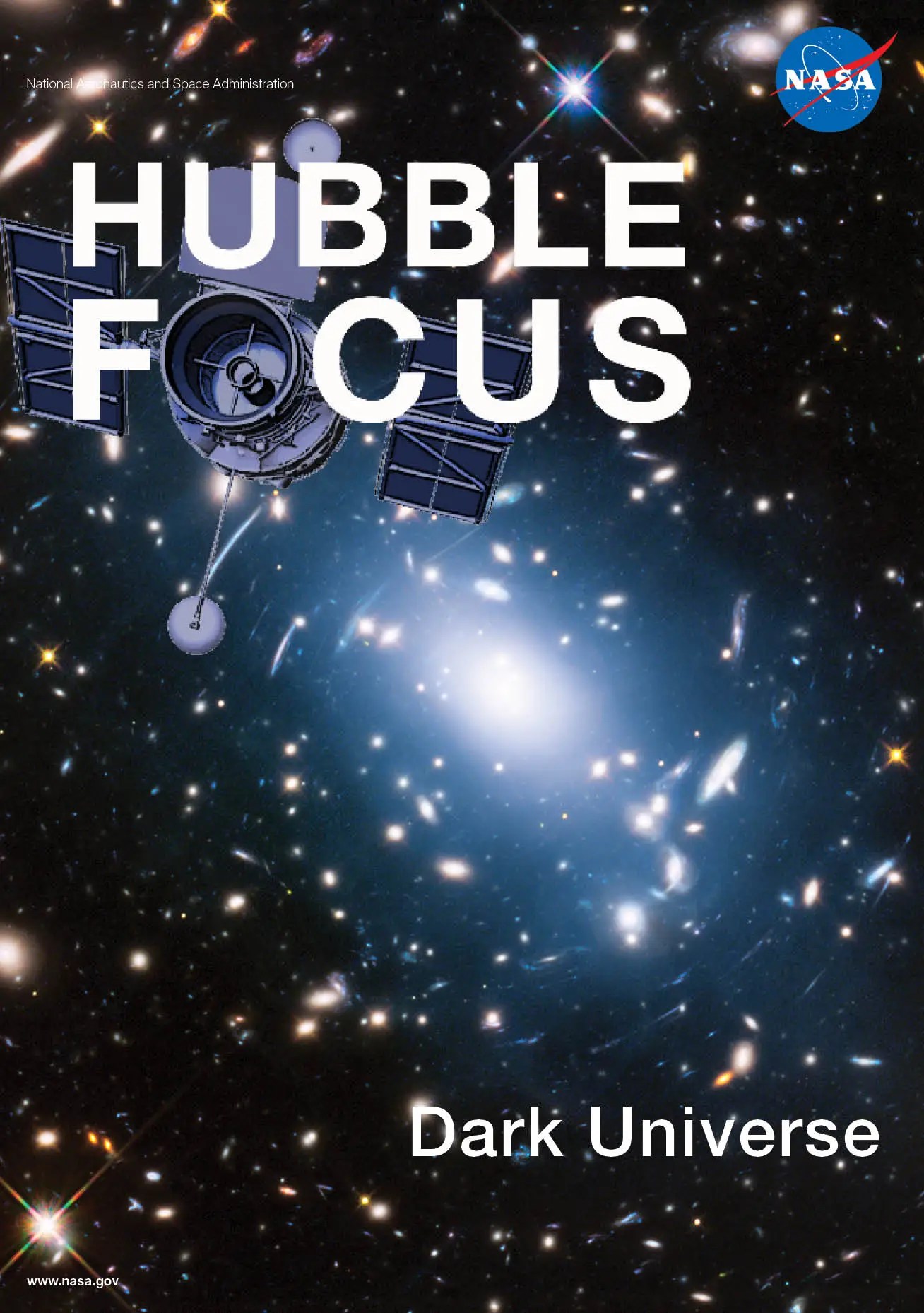
NASA has released a free e-book titled Hubble Focus: The Dark Universe. You can download the book at the NASA site in one of two formats – PDF or EPUB. This is the fifth edition of this book.

You cannot argue with the price, while the content is an impressive story about how the Hubble Space Telescope has helped to study both dark matter and dark energy. In addition to the text and images, the book contains links to numerous videos that further illustrate the points in the book. It is a multimedia experience that can only enhance your understanding of the topic.

Hubble is just the beginning, as the James Webb Space Telescope and other instruments are coming online to assist with the research. The book notes:

Hubble continues to be a vital tool to address questions about the underlying workings of the universe . Scientists will pair its wide wavelength coverage with James Webb Space Telescope’s powerful vision, the upcoming Nancy Grace Roman Space Telescope’s panoramic view, and a fleet of additional space- and ground-based telescopes to explore the cosmos as never before . We have far more left to learn among the stars

Space Quote: Japanese Prime Minister Channels Star Trek

“We are now standing at a turning point in history, embarking on a new frontier, and elevate this unshakable Japan-US relationship to even greater heights and hand it to the next generation. Finally, let me be conclude with a line from Star Trek, which you all know: To boldly go where no one has gone before.”

Statement by Japanese Prime Minister Fumio Kishida at a White House state dinner on Wednesday. He was quoting part of the famous opening credits in the Star Trek television series:

These are the voyages of the starship Enterprise. Its five-year mission: to explore strange new worlds; to seek out new life and new civilizations; to boldly go where no man has gone before!

Oops – Sorry About That, Mars

Image (Credit): Illustration of how DART’s impact altered the orbit of Dimorphos about Didymos. (https://dart.jhuapl.edu/)

You may remember how NASA’s Double Asteroid Redirection Test (DART) mission was a great success in that it demonstrated that we can divert an asteroid, should it be necessary.

Well, that’s not the whole story. A new study has found that the redirected asteroid debris may threaten Mars in the future. How far into the future? In one case, it will be 6,000 years into the future, and the second about 15,000 years into the future.

It would be nice to think that we will have habitats if not cities on Mars at that point (and maybe even a Musk Mountain looming over one of the cities), so this could be relevant. So maybe today’s practice run will be tomorrow’s disaster. Then again, I am pretty sure that such a future society will also have the ability to deflect these asteroids, possible building on what we learned from DART.

All of this does make you think about other areas where our tampering may come back to bite us.

Pic of the Week: The Total Solar Eclipse

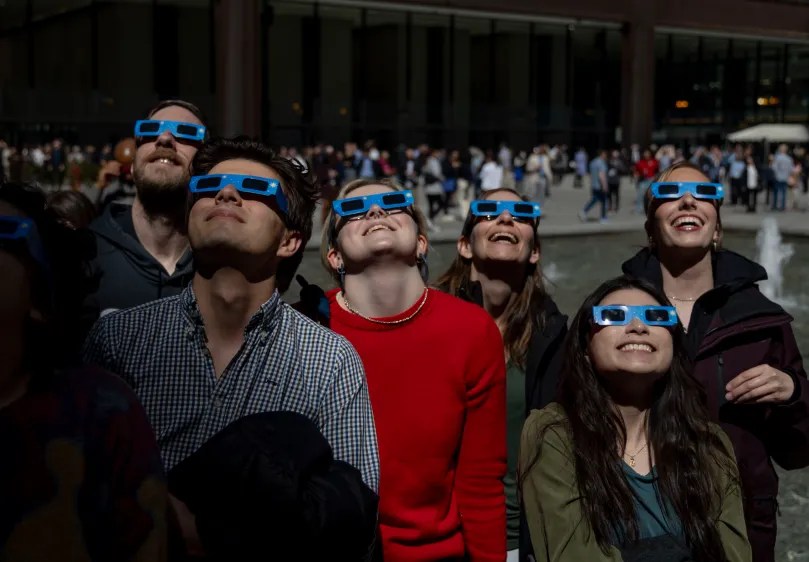
Image (Credit): Chicagoans watch the April 8, 2024 eclipse. (Brian Cassella/Chicago Tribune)

The image of the week relates to the Total Solar Eclipse that captured the nation’s attention. Goofy glasses like the ones shown in The Chicago Tribune (above) and Wired magazine (below) were worn across the country to watch this rare event.

Image (Credit): Eclipse watchers in Washington, DC. (Chip Somodevilla/Getty Images)