One Week Left to Sign-up for NASA Internships/Fellowships

If you are a high school or college student and have always wanted to work on a human landing system,  Mars mission architecture integration, or even crater navigation, then NASA has a place for you. In fact, NASA has published 100 areas where interns and fellows are needed, with many of them being paid positions. You can find the list and start the application process here.

If any of these areas sound like fun, you still have until April 12 to submit an application for an internship or fellowship. And don’t worry. You do not need to be an engineering student or even interested in engineering. NASA has stated,

A common misconception is that NASA only offers engineering internships. Please know that we have opportunities for students who are not majoring in engineering. NASA needs employees with a variety of knowledge and skills. At NASA, our engineers, mathematicians, scientists, accountants, writers, IT specialists, project managers, program analysts, and many other professionals work together to break barriers to achieve the seemingly impossible. Non-engineering interns may support a variety of business and program management work, including procurement, budgeting, accounting, information technology, and security.

For example, among the 100 openings you have assignments such as a NASA audio storytelling intern, an illustration/graphic design intern, and an Earth Information Center coordinator. NASA is a big organization with a variety of needs.

This is a great opportunity if you have any interest at all in a NASA career, or just want to have a unique experience.

Pic of the Week: The Gediz Vallis Channel

Image (Credit): Panoramic shot of Mar’s Gediz Vallis channel taken by the Curiosity rover. (NASA/JPL-Caltech)

This week’s image comes from NASA’s Curiosity rover in the Gediz Vallis channel. It is a 360-degree panorama shot from back on February 3. The rover has diligently continued its exploration of the Martian surface since it first landed in 2012.

In terms of this latest rover location, NASA stated:

NASA’s Curiosity rover has begun exploring a new region of Mars, one that could reveal more about when liquid water disappeared once and for all from the Red Planet’s surface. Billions of years ago, Mars was much wetter and probably warmer than it is today. Curiosity is getting a new look into that more Earth-like past as it drives along and eventually crosses the Gediz Vallis channel, a winding, snake-like feature that – from space, at least – appears to have been carved by an ancient river.

That possibility has scientists intrigued. The rover team is searching for evidence that would confirm how the channel was carved into the underlying bedrock. The formation’s sides are steep enough that the team doesn’t think the channel was made by wind. However, debris flows (rapid, wet landslides) or a river carrying rocks and sediment could have had enough energy to chisel into the bedrock. After the channel formed, it was filled with boulders and other debris. Scientists are also eager to learn whether this material was transported by debris flows or dry avalanches.

Television: For All Mankind

Image (Credit): Promotion for season two of For All Mankind. (Apple TV+)

While awaiting the return of the Star Trek and Star Wars televisions series (by the way, do not forget that the fifth and final season of Star Trek: Discovery is slated to start tomorrow), I started to watch For All Mankind on Apple TV+. I am only halfway through season two, but I have enjoyed every minute so far. I am just surprised there has not been more press about this impressive series.

I was somewhat skeptical to start the series because I knew it was an alternate reality to our actual space program. Yet what I saw as a weakness was actually the show’s strength. The series re-imagines the space race with the Russians, having the U.S. set up a Moon base after the Russians are the first to step foot on the Moon. It just shows us what could have been if we did not stop the Apollo program 50 years ago and dither around until the Artemis program.

And while the series has plenty of action – almost as though your are watching multiple Apollo 13 movies – what makes it different is that it has heart. It is almost the Mad Men of NASA, showing the good and bad of that period in terms of human lives.

For All Mankind is honest about the period from the 1960s through the 1980s, showing that the real drama was right here on Earth as we dealt with Vietnam, racism, immigration, marital and family issues, and even a lesbian astronaut.

I did not expect all of this in one show, nor the superb acting that makes it all come to life. I am now hooked on the series, finding it strange that I already have nostalgia for an American lunar space program that never existed even though it could have.

The series continues with a Mars program in seasons 3 and 4, but I do not want to get ahead of myself. Let’s just say this other America gets to the Red Planet long before we do.

We are creating plenty of drama today with the real lunar program currently under way, as well as an eventual Mars program. It may in fact lead to some great television series down the line. I just hope we stick to the script and keep the current drama going for years to come.

Space Stories: Detailed Views of Mars, Plummeting ISS Space Junk, and Time Zones on the Moon

Image (Credit): Recent high-altitude view of Mars taken by Mars Express’s High Resolution Stereo Camera (HRSC). ( ESA)

Here are some recent stories of interest.

Astrobiology: Mars Express Celebrates 25,000 Orbits

ESA’s Mars Express recently looped around Mars for the 25,000th time – and the orbiter has captured yet another spectacular view of the Red Planet to mark the occasion. The new high-altitude view was taken by Mars Express’s High Resolution Stereo Camera (HRSC). It features many of Mars’s towering volcanoes and even includes a surprise appearance from the planet’s largest moon, Phobos.

Daily Mail: Piece of 5,800lb Battery Pallet Tossed from NASA’s ISS Crashes Through Florida Home – and Nearly Kills Homeowner’s Son

A piece of metal came crashing through a home in Florida that is believed to be from a 5,800-pound battery pallet discarded by the International Space Station (ISS). Naples homeowner Alejandro Otero was on vacation when he received a call from his son, saying he heard a ‘tremendous sound’ and there were gaping holes in the ceiling and floor – while explaining whatever fell almost hit him. The two-pound, cylinder object has since been recovered by NASA to determine its origin and if found to be space junk, the agency could be liable for damages.

Reuters: White House Directs NASA to Create Time Standard for the Moon

The White House on Tuesday directed NASA to establish a unified standard of time for the moon and other celestial bodies, as the United States aims to set international norms in space amid a growing lunar race among nations and private companies. The head of the White House Office of Science and Technology Policy (OSTP), according to a memo seen by Reuters, instructed the space agency to work with other parts of the U.S. government to devise a plan by the end of 2026 for setting what it called a Coordinated Lunar Time (LTC).

Space Quote: Maybe China Can Beat Us Back to the Moon

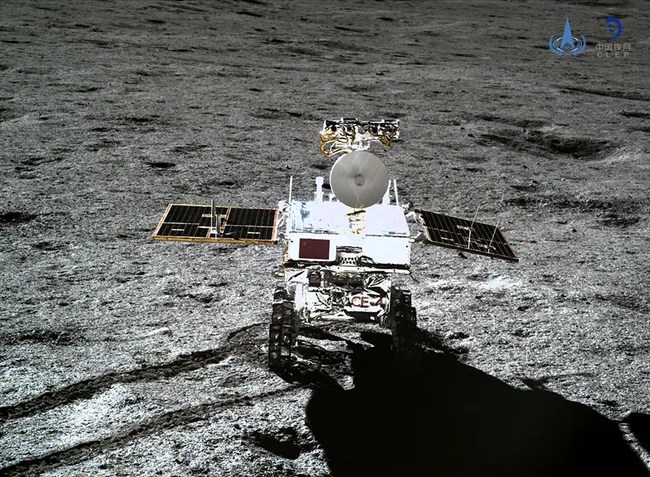
Image (Credit): China’s Yutu 2 rover, as seen by the Chang’e 4 lander, both of which landed on the lunar surface in January 2019. (CNSA)

“If the space agency holds to its notion of flying the Artemis II crew on a looping journey around the far side of the moon late next year, and landing the Artemis III crew in the south polar region in 2026 or 2027, the next boot prints on the moon will indeed be American. But don’t count on it.”

-Statement in a Time magazine article titled, “Why China Might Beat the U.S. Back to the Moon.” The article cites NASA’s delays and budget shortfall related to the Artemis mission. Interestingly, the article notes that the U.S. might have lacked the discipline to return to the Moon if China did not have similar plans. Finally, one key point to remember is that the U.S. beat the Chinese to the Moon by more than 50 years, so this is not really the same as the earlier space race with Russia. As a result, China is taking its time to do it right. We may need to keep that in mind as we face our own struggles.