

The NASA Office of Inspector General (OIG) issued an audit report earlier this week, NASA’s Readiness for the Artemis II Crewed Mission to Lunar Orbit, that expressed concerns about problems with the Artemis I test flight mission in late 2022. For example, the report noted:
…the Artemis I test flight revealed critical issues that need to be addressed before placing crew on the Artemis II mission. In particular, the test flight revealed anomalies with the Orion heat shield, separation bolts, and power distribution that pose significant risks to the safety of the crew…Specifically, NASA identified more than 100 locations where ablative thermal protective material from Orion’s heat shield wore away differently than expected during reentry into Earth’s atmosphere…Beyond the Orion anomalies, the Artemis I launch-induced environment caused greater than expected damage to ML-1 elevators, electrical equipment, enclosure panel doors, and pneumatic tubing, requiring extensive repairs that will cost more than $26 million, roughly 5 times more than the $5 million the EGS Program had originally set aside for postArtemis I launch repairs.
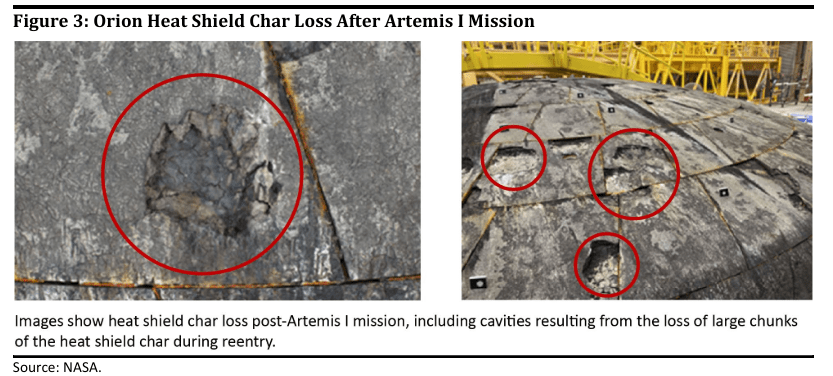
While NASA is already working on repairs and improvements in each of these areas, it still puts a bit of a damper on NASA’s earlier video about all of the successes of Artemis I. NASA has already lost too many astronauts to heat shield issues in the past, so this is a serious matter that needs to be resolved before putting humans in the Orion capsule.
The OIG auditors made six recommendations to NASA management. NASA concurred with these recommendations, but noted that the audit was conducted at a difficult time, stating:
Being audited in the middle of a development process presents several challenges including disruptions to ongoing workflow and priorities due to the reallocation of resources and the coordination challenges associated with audit activities.
Of course, auditors are never really welcome at any point in the process. If they come too late, they are accused of shooting the dead.
NASA conducted the test flight to learn about such issues, so in that sense it was a success. Hopefully, the space agency can make the necessary improvements while keeping the Artemis II mission on track given that it has already been delayed.
 Our Awesome Universe