
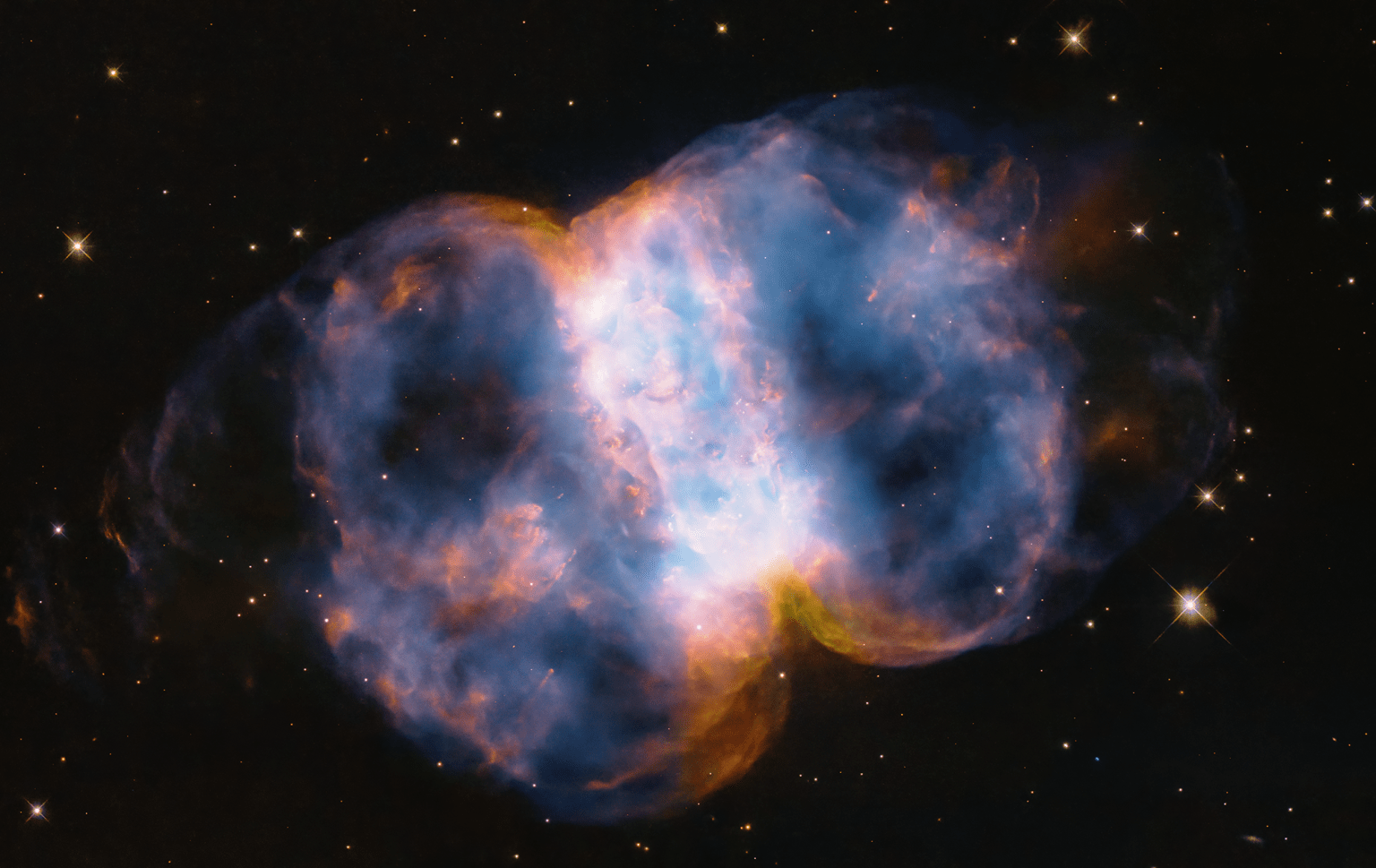
This week’s image comes from the NASA/European Space Agency’s Hubble Space Telescope. It shows what is called the Little Dumbbell Nebula, more formally called Messier 76, M76, or NGC 650/651, which is about 3,400 light-years away. The image is being shared as part of the celebration of Hubble’s 34th anniversary, which is discussed in this video.
Here is more on the nebula from NASA:
M76 is classified as a planetary nebula, an expanding shell of glowing gases that were ejected from a dying red giant star. The star eventually collapses to an ultra-dense and hot white dwarf. A planetary nebula is unrelated to planets, but have that name because astronomers in the 1700s using low-power telescopes thought this type of object resembled a planet.
M76 is composed of a ring, seen edge-on as the central bar structure, and two lobes on either opening of the ring. Before the star burned out, it ejected the ring of gas and dust. The ring was probably sculpted by the effects of the star that once had a binary companion star. This sloughed off material created a thick disk of dust and gas along the plane of the companion’s orbit. The hypothetical companion star isn’t seen in the Hubble image, and so it could have been later swallowed by the central star. The disk would be forensic evidence for that stellar cannibalism.
The primary star is collapsing to form a white dwarf. It is one of the hottest stellar remnants known at a scorching 250,000 degrees Fahrenheit, 24 times our Sun’s surface temperature. The sizzling white dwarf can be seen as a pinpoint in the center of the nebula. A star visible in projection beneath it is not part of the nebula.
Pinched off by the disk, two lobes of hot gas are escaping from the top and bottom of the “belt,” along the star’s rotation axis that is perpendicular to the disk. They are being propelled by the hurricane-like outflow of material from the dying star, tearing across space at two million miles per hour. That’s fast enough to travel from Earth to the Moon in a little over seven minutes! This torrential “stellar wind” is plowing into cooler, slower-moving gas that was ejected at an earlier stage in the star’s life, when it was a red giant. Ferocious ultraviolet radiation from the super-hot star is causing the gases to glow. The red color is from nitrogen, and blue is from oxygen.
Given our solar system is 4.6 billion years old, the entire nebula is a flash in the pan by cosmological timekeeping. It will vanish in about 15,000 years.
 Our Awesome Universe