China Successfully Retrieves Moon Rocks

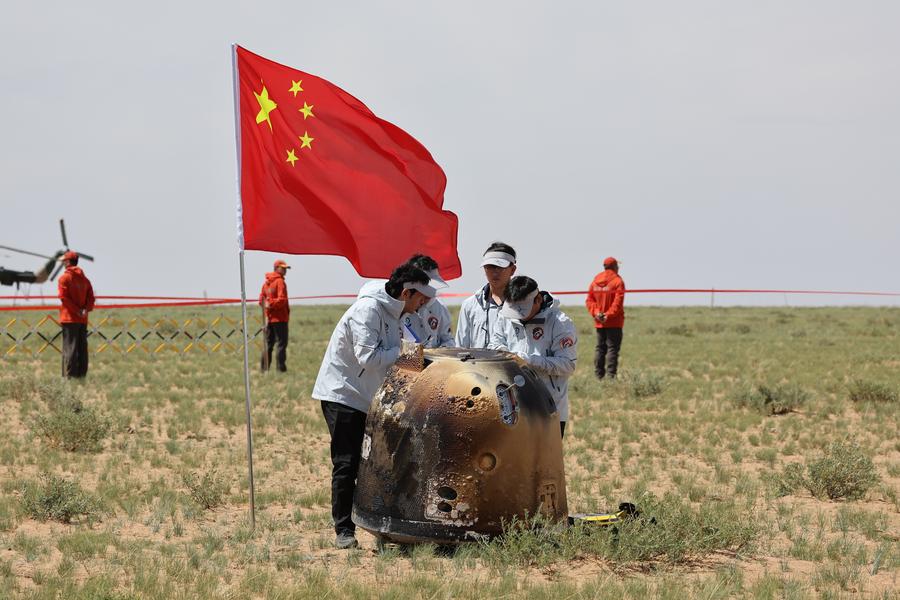
Image (Credit): The capsule retrieval site in north China’s Inner Mongolia Autonomous Region. (Xinhua/Jin Liwang)

It was a good day for China as it became the first nation to successfully retrieve a lunar sample from the far side of the Moon. The Chang’e-6 return capsule safely landed in China earlier today following the mission’s start back on May 3. The sample itself departed the Moon’s surface on June 4.

Wang Qiong, deputy chief designer of the Chang’e-6 mission, stated:

A portion of the samples will be stored permanently, while another portion will be stored at a different location as backup in case of disasters. Then we will prepare the remaining portion, and distribute them to scientists in China and foreign countries in accordance with the lunar sample management regulations.

Congratulations to the Chinese people. Hopefully, the entire scientific community can benefit from what the lunar sample tells us.

Television: PBS Documentary on Space Travel

Credit: Greenwich Entertainment)

If you are looking for a television show on the hazards of space travel, PBS has created a worthwhile documentary titled Space: The Longest Goodbye. It is playing on your local PBS station as well as online.

Here is a little more about the series:

NASA’s goal to send astronauts to Mars would require a three-year absence from Earth, during which communication in real time would be impossible due to the immense distance. Meet the psychologists whose job is to keep astronauts mentally stable in outer space, as they are caught between their dream of reaching new frontiers and the basic human need to stay connected to home.

The series covers various attempts to understand the human mind when constrained to a small place, be it a rocket, a space station, or a planetary/moon base.

The PBS website also has more information on the series as well as comments from the participants. For example, the story “How Science Fiction Confronts the Real Isolation of Space” touches on our favorite movies and television shows to see what they say on the issue, from Black Mirror and For All Mankind to 2001: A Space Odyssey and Alien.

We still have a lot to learn about the human mind before we go any real distance into space or simply sit in place on the Moon or Mars. We may find that equipment challenges are the easiest challenges to resolve in future Artemis missions.

Movie: Alien: Romulus Colonizes Our Summer

Credit: 20th Century Studios

So far it has been a pretty boring summer in terms of space-related movies, but that will change in August with the release of next Alien film. That’s right, the Alien franchise is still alive and kicking.

Alien: Romulus will be released on August 16th. It will be the seventh film in this series, and set between the events of Alien (1979) and Aliens (1986). Yes, more backstory, but we know what to expect going forwards or backwards with this series. Plenty of stomach-popping surprises for all.

20th Century Studios provides this storyline:

The sci-fi/horror-thriller takes the phenomenally successful “Alien” franchise back to its roots: While scavenging the deep ends of a derelict space station, a group of young space colonizers come face to face with the most terrifying life form in the universe.

Check out the trailer, which hits on all the fun bits we expect with any Alien movie.

While we are now 45 years into this series, it is still nice to have something interesting playing this summer. It is always a spectacular view of space travel until everything goes to hell.

Space Quote: The Starliner Delayed Return Continues

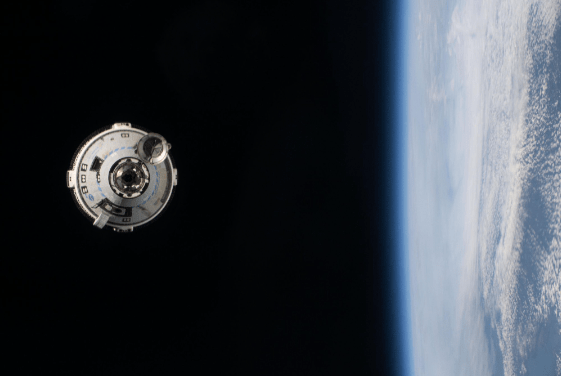
Image (Credit): The Boeing Starliner approaching the International Space Station. (NASA)

“We are strategically using the extra time to clear a path for some critical station activities while completing readiness for Butch and Suni’s return on Starliner, and gaining valuable insight into the system upgrades we will want to make for post-certification missions.”

Statement by Steve Stich, manager of NASA’s Commercial Crew Program, regarding delays in the return of Boeing’s Starliner capsule. The language is becoming as flowery as SpaceX’s language when something goes wrong. NASA has already nixed the June 26 return date and has yet to provide a new date.

What to do When an Asteroid is Heading for Earth

Back in early April, officials from NASA, FEMA, other domestic and foreign government agencies, and private think tanks conducted an exercise – Planetary Defense Interagency Tabletop Exercise 5 – to devise ways to deal with an incoming asteroid that threatened the planet. You can see the presentation components and results in the May 13th NASA report.

Here is the scenario:

  • 72% chance than an asteroid may hit Earth in 14 years.
  • Requirements for preventing its impact are unknown.
  • Models indicate the asteroid could devastate a regional- to country-scale area, if it should impact.

And the objective:

Awareness raising; space mission options; disaster preparedness; information sharing and public messaging.

Some of the takeaways were as follows:

  • Many stakeholders expressed that they would want as much information about the asteroid as soon as possible but expressed skepticism that funding would be forthcoming to obtain such information without more definitive knowledge of the risk.
  • Misinformation and disinformation would have to be dealt with.
  • Although specific disaster management plans for an [Near Earth Object] impact threat do not currently exist, plans for response to other catastrophes may be a suitable starting point.

You can read all about the results in the report itself, but it is clear we are not ready for such an event.

Maybe we would do better with a NASA tabletop exercise covering an alien invasion 400 years in the future, giving us plenty of time to plan it out. Of course, this scenario is already being played out on television (as well as the book that started it all).