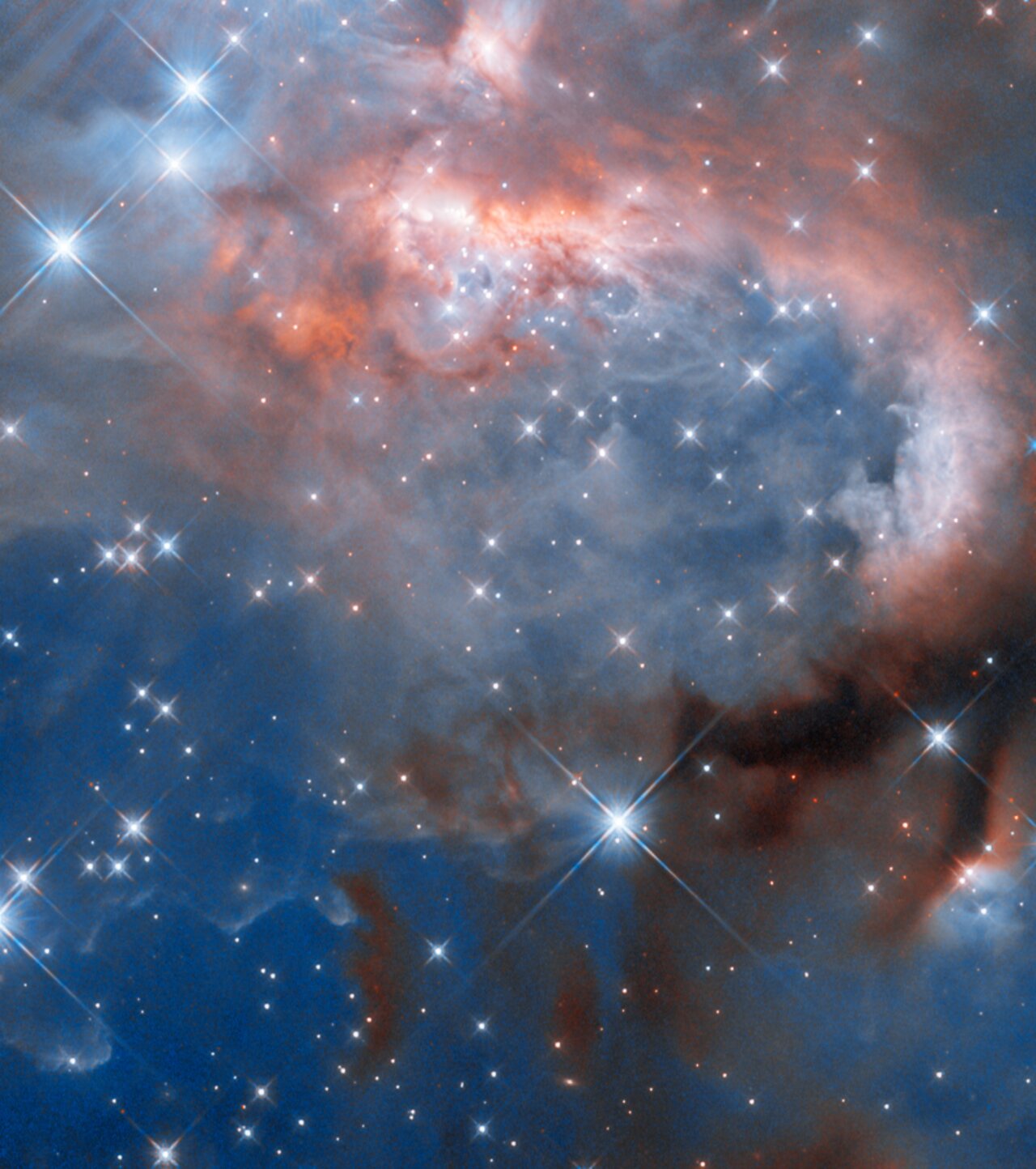
Image (Credit): RCW 7, a nebula located just over 5,300 light-years from Earth. (ESA/Hubble & NASA, J. Tan (Chalmers University & University of Virginia), R. Fedriani (Institute for Astrophysics of Andalusia))
This week’s image is from the NASA/European Space Agency’s (ESA) Hubble space telescope. It shows the nebula called RCW 7, which is located about 5,300 light-years away.
Clouds of gas and dust with many stars. The clouds form a flat blue background towards the bottom, and become more thick and smoky towards the top. They are lit on one side by stars in the nebula. A thick arc of gas and dust reaches around from the top, where it is brightly lit by many stars in and around it, to the bottom where it is dark and obscuring. Other large stars lie between the clouds and the viewer.
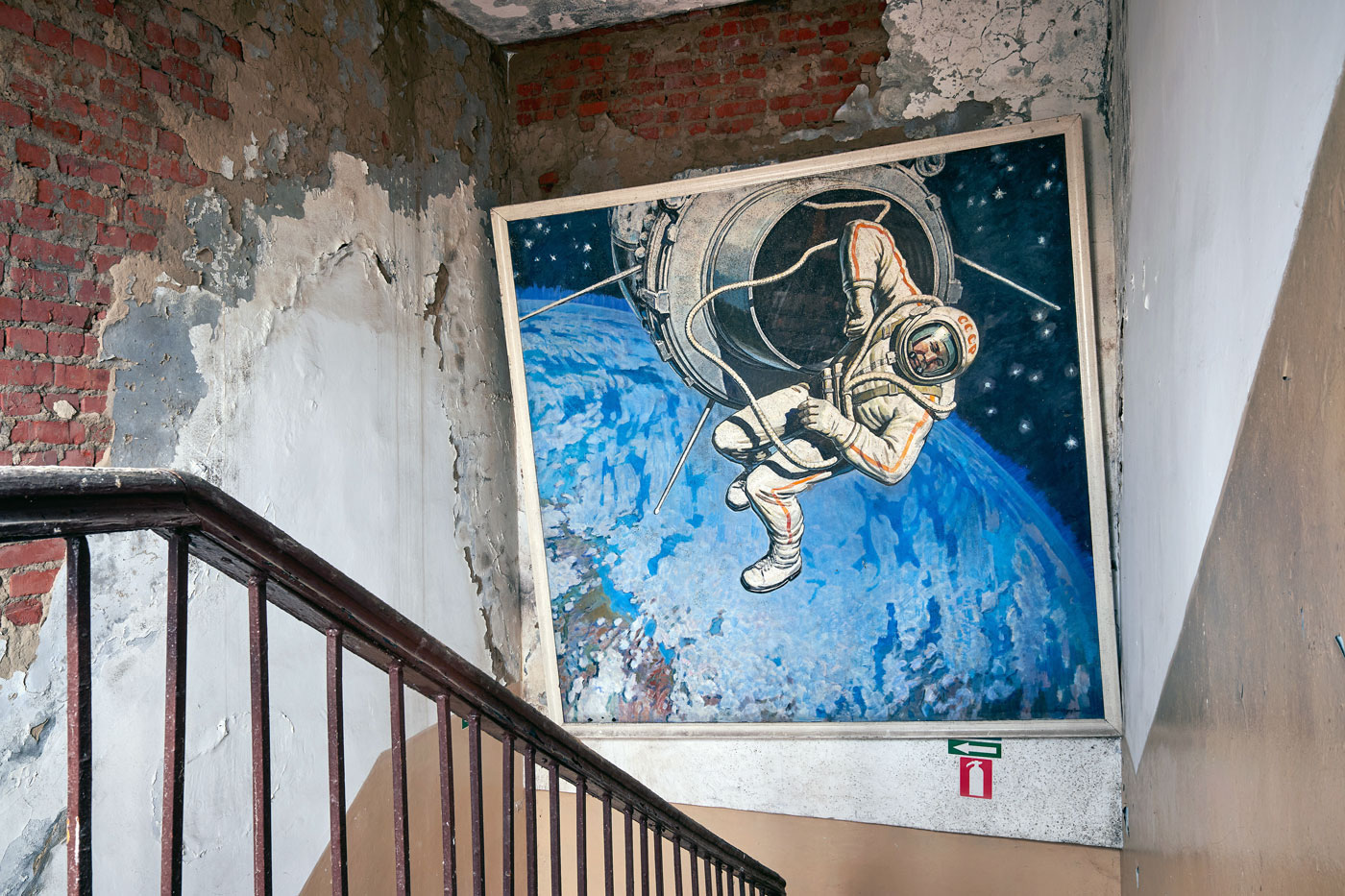
Image (Credit): Stairwell of the Braude observatory’s main building with a painting of Alexei Leonov, the Soviet cosmonaut who performed the first spacewalk in 1965. (Science.org/Eric Lusito)
In November 2023, photographer Eric Lusito made a rare visit to the Braude Radio Astronomy Observatory near Kharkiv, Ukraine, once one of the nation’s flagship scientific facilities. Since his visit, the Kharkiv region, which was partly occupied by Russian forces in 2022 but liberated later that year, has again faced a renewed Russian assault. As of this writing, military specialists say that effort has stalled. Here is Lusito’s account of his visit.
The mysterious brightening of a galaxy far, far away has been traced to the heart of the star system and the sudden awakening of a giant black hole 1m times more massive than the sun. Decades of observations found nothing remarkable about the distant galaxy in the constellation of Virgo, but that changed at the end of 2019 when astronomers noticed a dramatic surge in its luminosity that persists to this day. Researchers now believe they are witnessing changes that have never been seen before, with the black hole at the galaxy’s core putting on an extreme cosmic light show as vast amounts of material fall into it.
As a popular icon among objects in the Solar System, Jupiter’s Great Red Spot (GRS) is probably the best-known atmospheric structure. Its large size (right now its diameter is that of the Earth) and the contrast of its reddish colour against the planet’s pale clouds make it an object that can be easily seen even with small telescopes…Speculation about the origin of the GRS dates back to the first telescopic observations made by the astronomer Giovanni Domenico Cassini, who in 1665 discovered a dark oval at the same latitude as the GRS and named it the ‘Permanent Spot’ (PS), since it was observed by him and other astronomers until 1713. Track of it was subsequently lost for 118 years and it was not until 1831 and later years that S. Schwabe again observed a clear structure, roughly oval in shape and at the same latitude as the GRS; that can be regarded as the first observation of the current GRS, perhaps of a nascent GRS.
Here is a book released this month that may be worth taking to the beach.
The Wrong Stuff: How the Soviet Space Program Crashed and Burned is a tale about a space program that wowed the world in the 1950s and 1960s until the U.S. stole the show with the first man on the Moon. However, the Soviet space program may have had problems long before the U.S. leapfrogged it. If you are interested in the space race, then this is the book for you.
In the wake of World War II, with America ascendant and the Soviet Union devastated by the conflict, the Space Race should have been over before it started. But the underdog Soviets scored a series of victories–starting with the 1957 launch of Sputnik and continuing in the years following–that seemed to achieve the impossible. It was proof, it seemed, that the USSR had manpower and collective will that went beyond America’s material advantages. They had asserted themselves as a world power.
But in The Wrong Stuff, John Strausbaugh tells a different story. These achievements were amazing, yes, but they were also PR victories as much as scientific ones. The world saw a Potemkin spaceport; the internal facts were much sloppier, less impressive, more dysfunctional. The Soviet supply chain was a disaster, and many of its machines barely worked. The cosmonauts aboard its iconic launch of the Vostok 1 rocket had to go on a special diet, and take off their space suits, just to fit inside without causing a failure. Soviet scientists, under intense government pressure, had essentially made their rocket out of spit and band aids, and hurried to hide their work as soon as their worldwide demonstration was complete.
As we watch the Russian military struggle in Ukraine, we are reminded that the Russians and others (North Korea?) have been good at putting on a show, but the truth can be very different.
None of this takes away from the bravery of the Soviet cosmonauts who thrived and died in that space program. As always, the rot was in the system, which could only stand for so long.
Maybe Putin should put this on his beach reading list as he continues to rattle his saber. It may do him and the world some good.
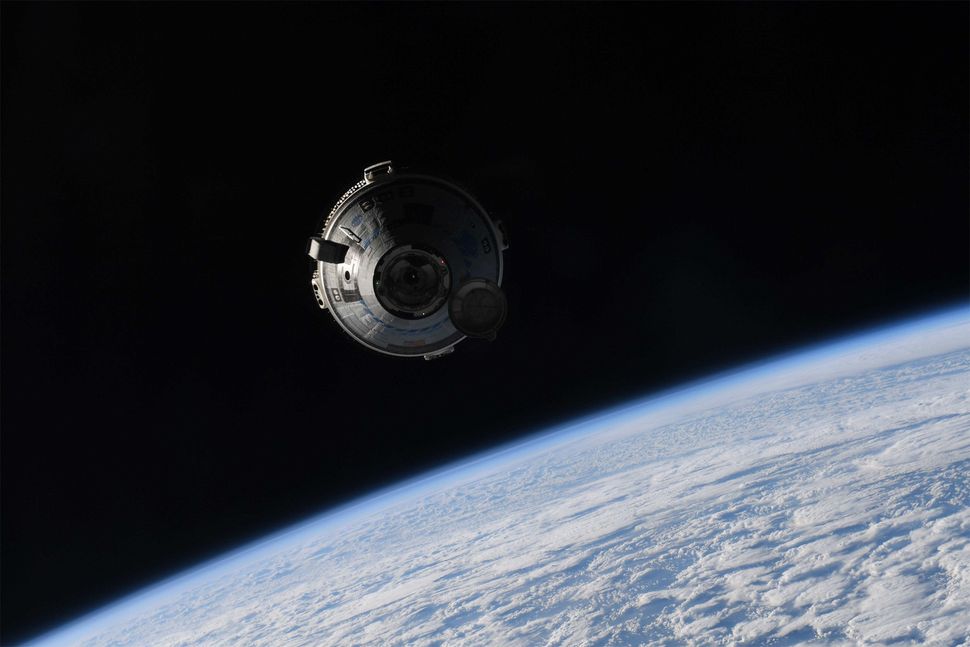
Image (Credit): Boeing’s Starliner approaching the ISS. (Samantha Cristoforetti/European Space Agency)
The return of the two astronauts from the earlier Starliner mission has been bumped a few times now, with the latest return scheduled for this Saturday (June 22).
The Boeing Starliner arrived at the International Space Station with thruster problems, and then encountered further helium leaks after that, so the need for additional time to study the issue makes some sense. NASA will address the status of the mission requirements and weather conditions at a press conference tomorrow (June 18).
It took long enough to get the two astronauts to the ISS after many delays, so maybe should not surprise anyone that we have a few delays on the return.
Boeing needs good press these days, so a quick and simple mission would have been nice. Yet this would be a bad time to throw caution into the wind when they are so close to the finish line.
Image (Credit): Artist’s rendering of the Voyager 1 spacecraft. (NASA)
The Voyager 1 spacecraft is communicating properly again after having issues since November 2023. NASA was able to fix the spacecraft that is currently more than 15 billion miles from Earth, which is a pretty impressive feat.
The team partially resolved the issue in April when they prompted the spacecraft to begin returning engineering data, which includes information about the health and status of the spacecraft. On May 19, the mission team executed the second step of that repair process and beamed a command to the spacecraft to begin returning science data. Two of the four science instruments returned to their normal operating modes immediately. Two other instruments required some additional work, but now, all four are returning usable science data.
Launched back in 1977, the Voyager 1 and Voyager 2 spacecraft explored the solar system before starting a journey to the great unknown. Both are now the only spacecraft outside the heliosphere.
You can read more about the Voyager spacecraft and mission here.



 Our Awesome Universe