Image (Credit): Scene from a Tesla crash. (fox2detroit.com)
While things appear to be going Elon Musk’s way with his ridiculous Tesla pay package, The Wall Street Journal had another story this week that discussed his self-serving management style that should not merit reward. The article, “Elon Musk’s Boundary-Blurring Relationships With Women at SpaceX,” highlights some pretty horrible behavior for a man that then and now believes he is above the law (and all codes of decency).
If you cannot read the Journal article, you can find summaries of the story elsewhere or listen to the Wall Street Journal podcast called The Journal. The podcast is titled “Elon Musk’s Unusual Relationships With Women at SpaceX.”
It is scary that the US space program is so dependent on the behavior of this man, who has already been part of prior Wall Street Journal articles about his drug use.
We need to build greater depth in our space program, be it Blue Origin, Boeing, Northrop Grumman, Rocket Lab, or others. The dream of a stronger space program could die if we tie too much to one man.
An earlier post discussed efforts to restore funding for the Chandra X-ray telescope, noting that the Save Chandra was established to push Congress to restore funding. Well, it appears some in Congress are listening.
On June 6, nine members of Congress wrote to NASA opposing proposed budget cuts to the Chandra X-ray Observatory mission. In the letter, the members write:
As the last remaining flagships of NASA’s original fleet of “Great Observatories” satellites, Chandra and Hubble have safeguarded U.S. leadership in cosmic exploration for decades. Chandra’s enduring functionality after 25 years in space, without the need for servicing, and its unparalleled ability to synergize with other telescopes, underscore American ingenuity and acapability we must not prematurely relinquish.
Of course, the fact that the Chandra Operations Control Center is in Burlington, Massachusetts, may account for the high count of members representing Massachusetts. Even so, the campaign to restore funding has to start somewhere, and this is a logical place to start.
Image (Credit): Frosty summit of Mar’s Olympus Mons. (ESA/DLR/FU Berlin)
This week’s image is from the European Space Agency (ESA) and shows Olympus Mons on Mars, the tallest volcano in the solar system. Captured by ESA’s Mars Express, it shows water frost close to the planet’s equator, which was unexpected.
Colin Wilson, ESA project scientist for both ExoMars Trace Gas Orbiter and Mars Express, stated:
Finding water on the surface of Mars is always exciting, both for scientific interest and for its implications for human and robotic exploration…Even so, this discovery is particularly fascinating. Mars’s low atmospheric pressure creates an unfamiliar situation where the planet’s mountaintops aren’t usually colder than its plains – but it seems that moist air blowing up mountain slopes can still condense into frost, a decidedly Earth-like phenomenon.
NASA and SpaceX are planning for the possibility of modifying the Artemis III mission. Instead of landing on the Moon, a crew would launch in the Orion spacecraft and rendezvous with Starship in low-Earth orbit. This would essentially be a repeat of the Apollo 9 mission, buying down risk and providing a meaningful stepping stone between Artemis missions. Officially, NASA maintains that the agency will fly a crewed lunar landing, the Artemis III mission, in September 2026. But almost no one in the space community regards that launch date as more than aspirational. Some of my best sources have put the most likely range of dates for such a mission from 2028 to 2032. A modified Artemis III mission, in low-Earth orbit, would therefore bridge a gap between Artemis II and an eventual landing.
The satellite galaxy Crater II (or Crater 2) of the Milky Way is located approximately 380,000 light-years away from Earth in the constellation of Crater. This galaxy is extremely cold and exceptionally diffuse, and has low surface brightness. According to new research, Crater II exists thanks to a self-interacting dark matter.
Using NASA’s Chandra X-ray Observatory and ESA’s (European Space Agency’s) XMM-Newton, astronomers are exploring whether nearby stars could host habitable exoplanets, based on whether they emit radiation that could destroy potential conditions for life as we know it. This type of research will help guide observations with the next generation of telescopes aiming to make the first images of planets like Earth. A team of researchers examined stars that are close enough to Earth that future telescopes could take images of planets in their so-called habitable zones, defined as orbits where the planets could have liquid water on their surfaces. Any images of planets will be single points of light and will not directly show surface features like clouds, continents, and oceans. However, their spectra — the amount of light at different wavelengths — will reveal information about the planet’s surface composition and atmosphere.
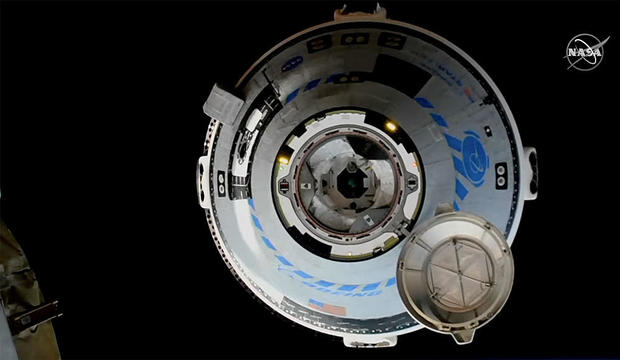
Image (Credit): ISS view of the approaching Boeing Starliner last Thursday. (NASA)
“The Boeing Starliner is contracted to fly just six crewed missions to the International Space Station compared to 14 for the SpaceX Crew Dragon. If Boeing has any hope of earning back a return on its investment, it has to sell commercial flights of the Starliner, just as SpaceX has the Crew Dragon.”
–Editorial by Mark R. Whittington in The Hill, highlighting the issues associated with delays in getting the Boeing Spaceplane into orbit. Does this mean more tourists heading for the International Space Station (ISS)? Mr. Whittington points out the advantages of the Starliner, even if Boeing may lose some money, stating, “As good as SpaceX and its Crew Dragon are, a monopoly is never a good idea.”




 Our Awesome Universe