
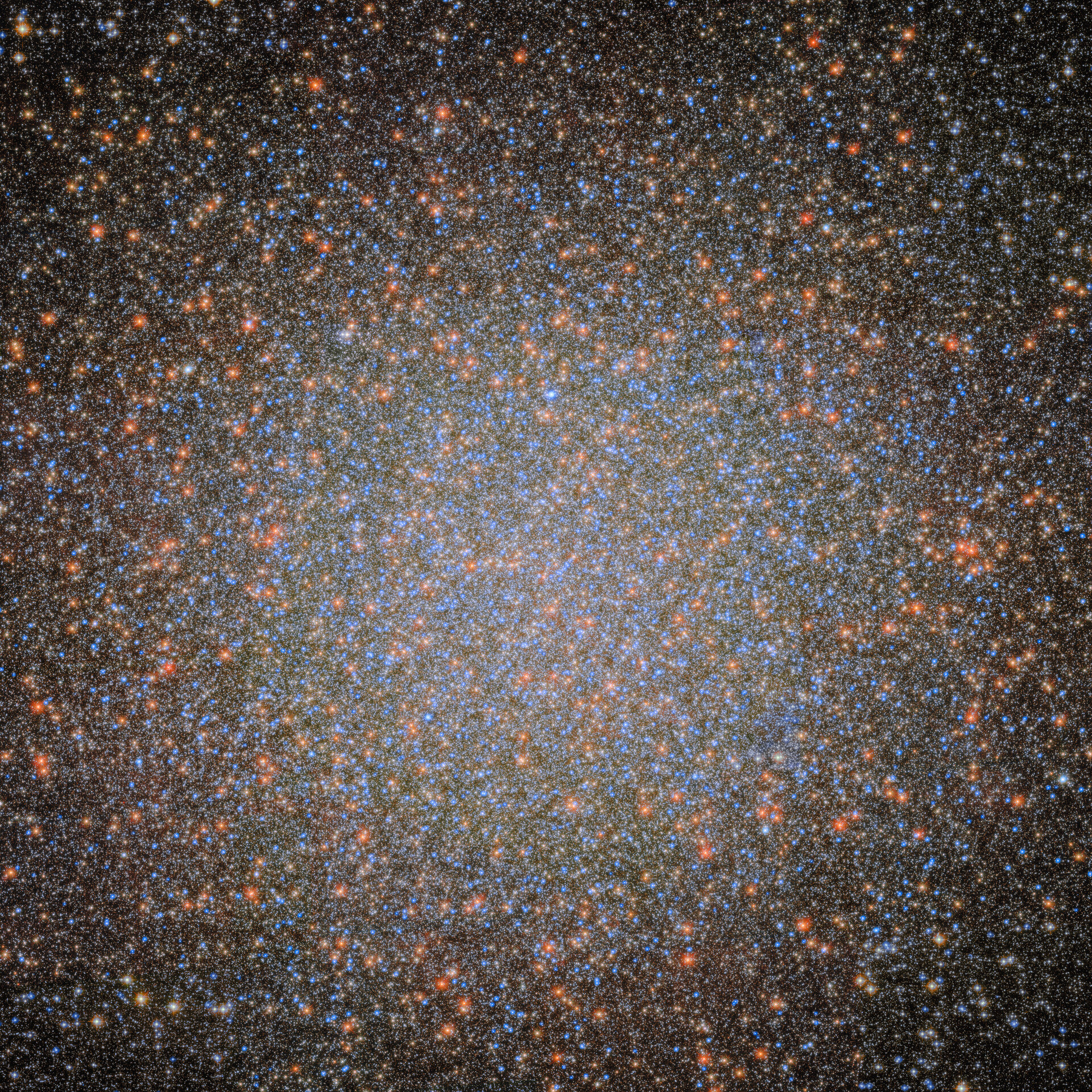
The colorful image this week is from the Hubble Space Telescope. It shows the stars that make up Omega Centauri, a globular cluster one can view with the naked eye.
Here’s a little more about this image from the European Space Agency (ESA):
Omega Centauri is visible from Earth with the naked eye and is one of the favourite celestial objects for stargazers in the southern hemisphere. Although the cluster is 17 000 light-years away, lying just above the plane of the Milky Way, it appears almost as large as the full Moon when seen from a dark rural area. The exact classification of Omega Centauri has evolved through time, as our ability to study it has improved. It was first listed in Ptolemy’s catalogue nearly two thousand years ago as a single star. Edmond Halley reported it as a nebula in 1677, and in the 1830s the English astronomer John Herschel was the first to recognise it as a globular cluster. Omega Centauri consists of roughly 10 million stars that are gravitationally bound.
 Our Awesome Universe