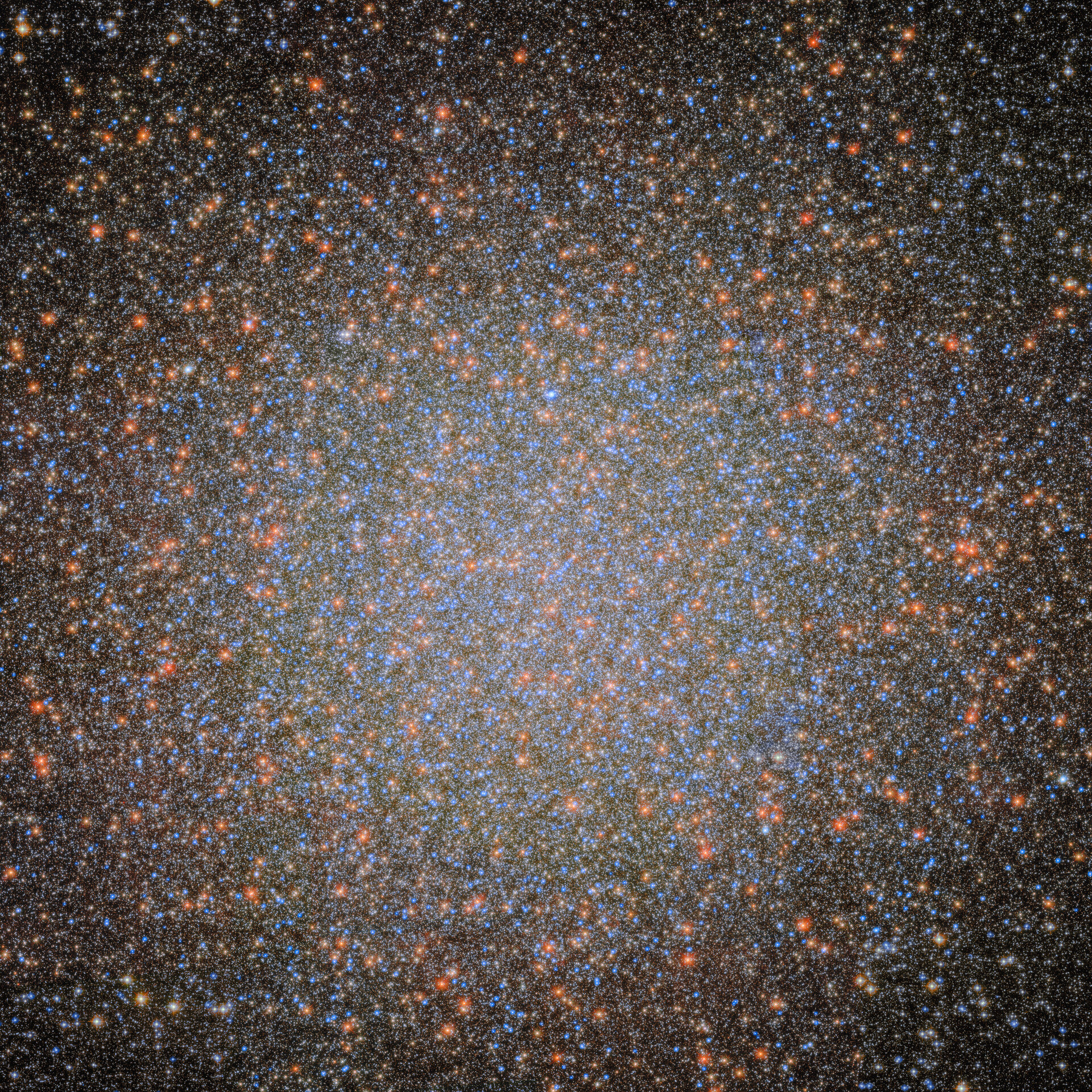
Image (Credit): Hubble Space Telescope’s view of Omega Centauri. (ESA/Hubble & NASA, M. Häberle)
The colorful image this week is from the Hubble Space Telescope. It shows the stars that make up Omega Centauri, a globular cluster one can view with the naked eye.
Omega Centauri is visible from Earth with the naked eye and is one of the favourite celestial objects for stargazers in the southern hemisphere. Although the cluster is 17 000 light-years away, lying just above the plane of the Milky Way, it appears almost as large as the full Moon when seen from a dark rural area. The exact classification of Omega Centauri has evolved through time, as our ability to study it has improved. It was first listed in Ptolemy’s catalogue nearly two thousand years ago as a single star. Edmond Halley reported it as a nebula in 1677, and in the 1830s the English astronomer John Herschel was the first to recognise it as a globular cluster. Omega Centauri consists of roughly 10 million stars that are gravitationally bound.
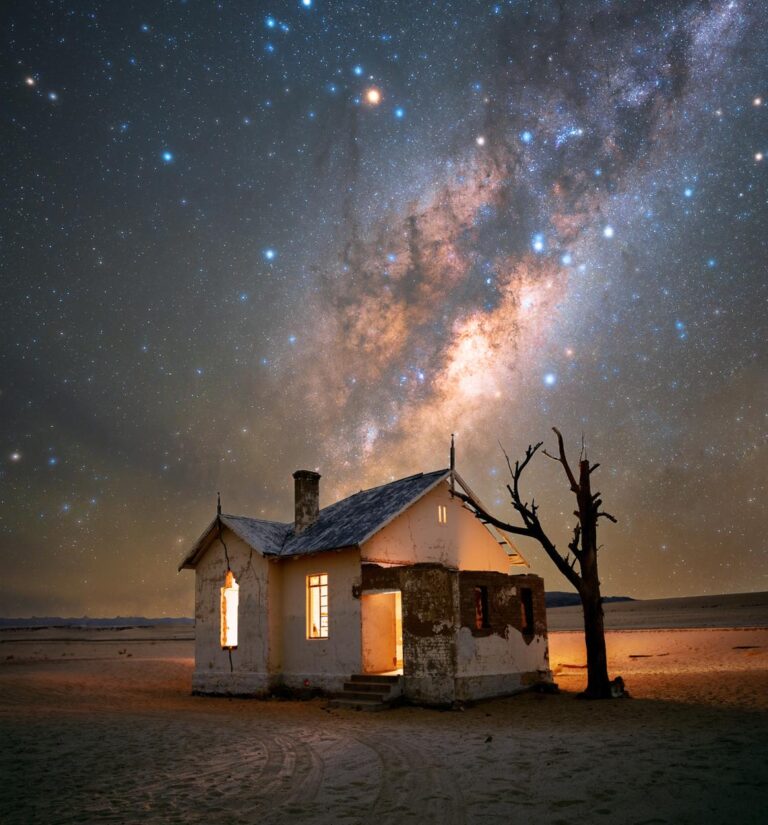
Image (Credit): Entry titled “Abandoned House.” ( Stefan Liebermann)
The Astronomy Photographer of the Year contest is underway again at the Royal Museums Greenwich. You can check out some of the shortlisted finalists for yourself to see if your idea of a winning photo matches up with the judges.
Here is a little more background on the photo above from the photographer:
In the middle of the Namib Desert you can find an abandoned house and, right above it, the Milky Way rises. I put some lights in the house, set up my star tracker and seized the opportunity. Through a veil of clouds, halos around the stars created a dream-like effect. The sky was captured with a star tracker to lower the ISO.
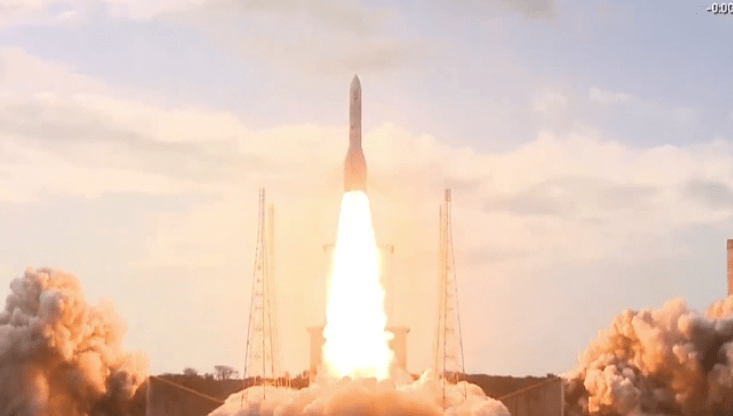
Image (Credit): Today’s launch of the Ariane 6 rocket from the Guiana Space Centre in Kourou, French Guiana. (ESA)
Earlier today, the European Space Agency (ESA) successfully launched an Ariane 6 rocket, the next generation of European space rockets. The launch was from the ESA’s Guiana Space Centre in French Guiana.
Europe is once again moving away from it dependence on US and Russian rockets to get its space program into space. The launch of the new rocket has been delayed for years while the Ariane 5 flew its last mission about a year ago.
We have now entered into a new era of spaceflight for Europe, powering us into space and allowing us to realise our ambitions on the world stage.
The inaugural flight did experience a problem when part of its test payload failed to deploy. This will need to be investigated and corrected before more critical payloads are placed on a rocket.
That said, all in all it was a good day for the Europeans and space enthusiasts everywhere.
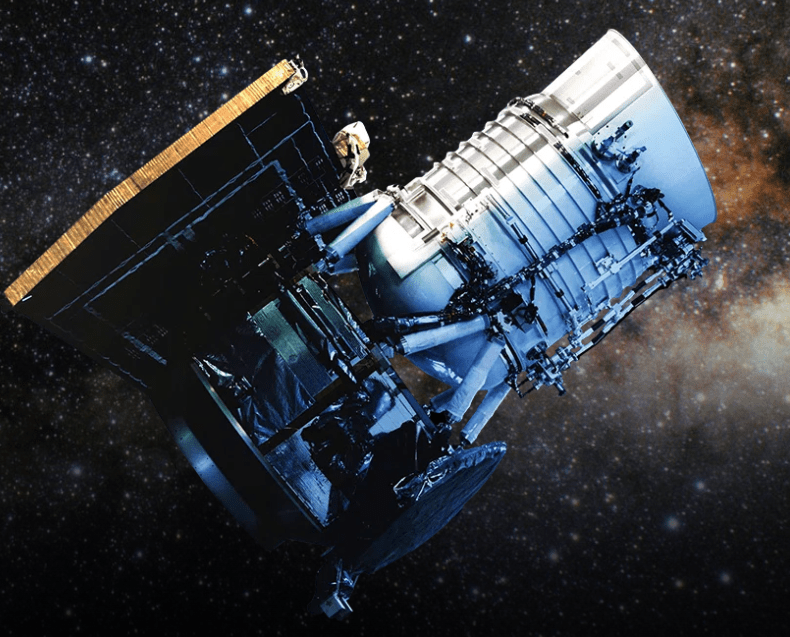
A NASA space telescope designed to “hunt” asteroids and comets that could pose a threat to life on Earth and orbiting spacecraft will soon burn up in orbit. In late 2024 or early 2025, the agency’s Near-Earth Object (NEO) Wide-field Infrared Survey Explorer—or NEOWISE—is expected to come home in pieces following the conclusion of its second mission later this month…However, NASA has a replacement lined up: the Near Earth Object Surveyor (NEO Surveyor), set for a 2027 launch. The infrared space telescope is the first to be designed specifically for hunting large numbers of NEOs in and around Earth orbit. It has a baseline development cost of $1.2 billion to which NASA committed in 2022.
Four volunteers who spent more than a year living in a 1,700-square-foot space created by NASA to simulate the environment on Mars have emerged. The members of the Crew Health and Performance Exploration Analog mission — or CHAPEA — walked through the door of their habitat at NASA’s Johnson Space Center in Houston on Saturday to a round of applause…Haston and the other three crew members — Anca Selariu, Ross Brockwell and Nathan Jones — entered the 3D-printed Mars replica on June 25, 2023, as part of a NASA experiment to observe how humans would fare living on the Red Planet.
Russia is aiming to create the four-module core of its planned new orbital space station by 2030, its Roscosmos space agency said on Tuesday. The head of Roscosmos, Yuri Borisov, signed off on the timetable with the directors of 19 enterprises involved in creating the new station. The agency confirmed plans to launch an initial scientific and energy module in 2027. It said three more modules would be added by 2030 and a further two between 2031 and 2033.
If you missed it, check out Alan Alda’s podcast Clear & Vivid for his recent interview with NASA astronaut Cady Coleman.
It’s a thoughtful interview as only Mr. Alda can do it. Ms. Coleman discusses her experiences on the International Space Station (ISS), which she calls a “floating palace.” Ms. Coleman has been part of three space missions, including two space shuttle missions as well as a stay on the ISS.
Ms. Coleman discusses funny episodes in her career, such as losing control of bbq sauce in zero gravity, as well as her overall feeling that the ISS represents something positive for all of humanity, regardless of the crazy movie plots where the astronauts and cosmonauts are at each other’s throats. She pointed out that the ISS was nominated for a Nobel peace prize back in 2014, which she thought was an appropriate gesture.
Overall, its a good conversation that may give you more insight into how one lives in space in such tight quarters.


 Our Awesome Universe