“He can’t go around insulting presidents, insulting deputies, insulting the Senate, insulting the Chamber, insulting the Supreme Court. Who does he think he is?…That guy has to accept the rules of this country, and if this country made a decision through the Supreme Court, he has to comply. If it applies to me, it applies to him.”
–Statement by Brazil’s President Luiz Inácio Lula da Silva regarding Elon Musk protesting the Brazilian Supreme Court’s order suspending Twitter/X nationwide. The issue relates to the spread of misinformation on Twitter/X and the company’s refusal to name a representative in Brazil. The spat is already having ripple effects on SpaceX’s Starlink operations in the country.
Just in time for the Labor Day weekend, we are offered a new space film that seemed to have had little publicity until it popped onto the scene. The new film Slingshot, starting today and starring Casey Affleck and Laurence Fishburne, takes us on a trip to Saturn’s moon Titan, or that is the plan.
A psychological thriller starring Casey Affleck and Laurence Fishburne, SLINGSHOT follows an elite trio of astronauts aboard a years-long, possibly compromised mission to Saturn’s moon Titan. As the team gears up for a highly dangerous slingshot maneuver that will either catapult them to Titan or into deep space, it becomes increasingly difficult for one astronaut to maintain his grip on reality.
The trailer indicates plenty of issues with both the hardware and software – the softest ware being the mind of man on a distant voyage. Yes, we have another story about the struggle of man with himself, with space playing a supporting actor.
Fortunately, we are not dealing with a film that questions the space program, but NASA may be pleased that it is sending a robot to study Europa rather than taking chances with such fragile humans.
The derivative look and feel of Slingshot – a little bit of Interstellar, a dash of 2010: The Year We Make Contact for whenever Håfström wants to add some grit, and most especially Steven Soderbergh’s Solaris remake – make it unclear exactly what kind of movie Håfström is trying to make.
It’s fairly boilerplate material, and Håfström frankly seems more interested in exploring John’s memories, nightmares, visions and wavering psyche..If you put aside all the space stuff, Slingshot is basically a one-set, one-character thriller that constantly tests the viewer’s belief in what’s happening.
Image (Credit): Supermoon Beyond the Temple of Poseidon. (Alexandros Maragos)
This week’s image comes from NASA’s Astronomy Picture of the Day site. This beautiful photo taken by photographer Alexandros Maragos shows the recent blue supermoon in all its glory with the Temple of Poseidon in Greece in the foreground.
For the second time in two months, a SpaceX Falcon 9 rocket launch has had problems, leading to a temporary grounding of the rocket by the Federal Aviation Administration. In the latest case, a rocket booster crashed into the Atlantic Ocean after a successful launch of Starlink satellites.
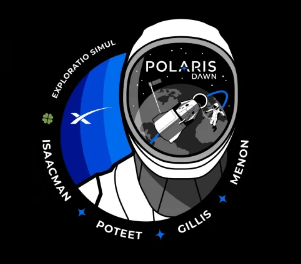
As a result of the malfunction, the privately-funded Polaris Dawn mission scheduled for this Friday will most likely need to be delayed. One of the goals for the Polaris Dawn mission is a spacewalk, which will be the first private space walk to date.
Of greater concern is the role of the Falcon 9 in upcoming International Space Station launches, be it crewed or uncrewed. With the Boeing capsule stuck at the station, SpaceX is currently the one game in town for NASA’s station needs.
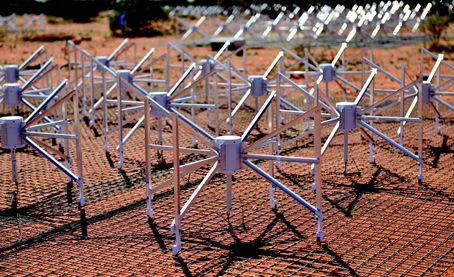
The SETI Institute, the Berkeley SETI Research Center and the International Centre for Radio Astronomy Research announced a groundbreaking study using the Murchison Widefield Array (MWA) in Western Australia. Led by Dr. Chenoa Tremblay of the SETI Institute and Prof. Steven Tingay of Curtin University, this research is the first to search for signs of alien technology in galaxies beyond our own, focusing on low radio frequencies (100 MHz).
This innovative study used the MWA’s large field of view (FOV), allowing the team to cover about 2,800 galaxies in one observation, of which 1300 we know the distance to. Usually, the search for extraterrestrial intelligence (SETI) has focused on signals within our galaxy. This new approach goes further, looking at distant galaxies. This new approach looks at distant galaxies, making it one of the most detailed searches for super civilizations—those more advanced than ours. To send a signal from another galaxy, a civilization would need technology powerful enough to use the energy of their sun or several stars in their galaxy.
NASA needs some help with frozen liquid. As part of the space agency’s planned trip to the moon as part of the Artemis mission, NASA is looking for a way to store “super-chilled” propellants for months on end. They’re asking college students for help. Announced earlier this month, NASA’s 2025 Human Lander Challenge (HuLC) is open for submissions. The competition, now in its second year, is asking for students to develop innovative methods for “in-space cryogenic liquid storage.”
A citizen science project, which invites members of the public to take part in identifying cosmic explosions, has already identified 20 new astronomical discoveries. Over 2,000 volunteers across 105 different countries have worked on 600,000 classifications over a six-month period. The project ‘Kilonova Seekers’ aims to find kilonovae – the cosmic explosions of neutron stars and black holes colliding in distant galaxies. Volunteers are asked to play ‘spot the difference’ using data from the two Gravitational-wave Optical Transient Observer (GOTO) telescopes, which are located on opposite sides of the planet – on La Palma, in Spain’s Canary Islands, and Australia’s Siding Spring Observatory.




 Our Awesome Universe