
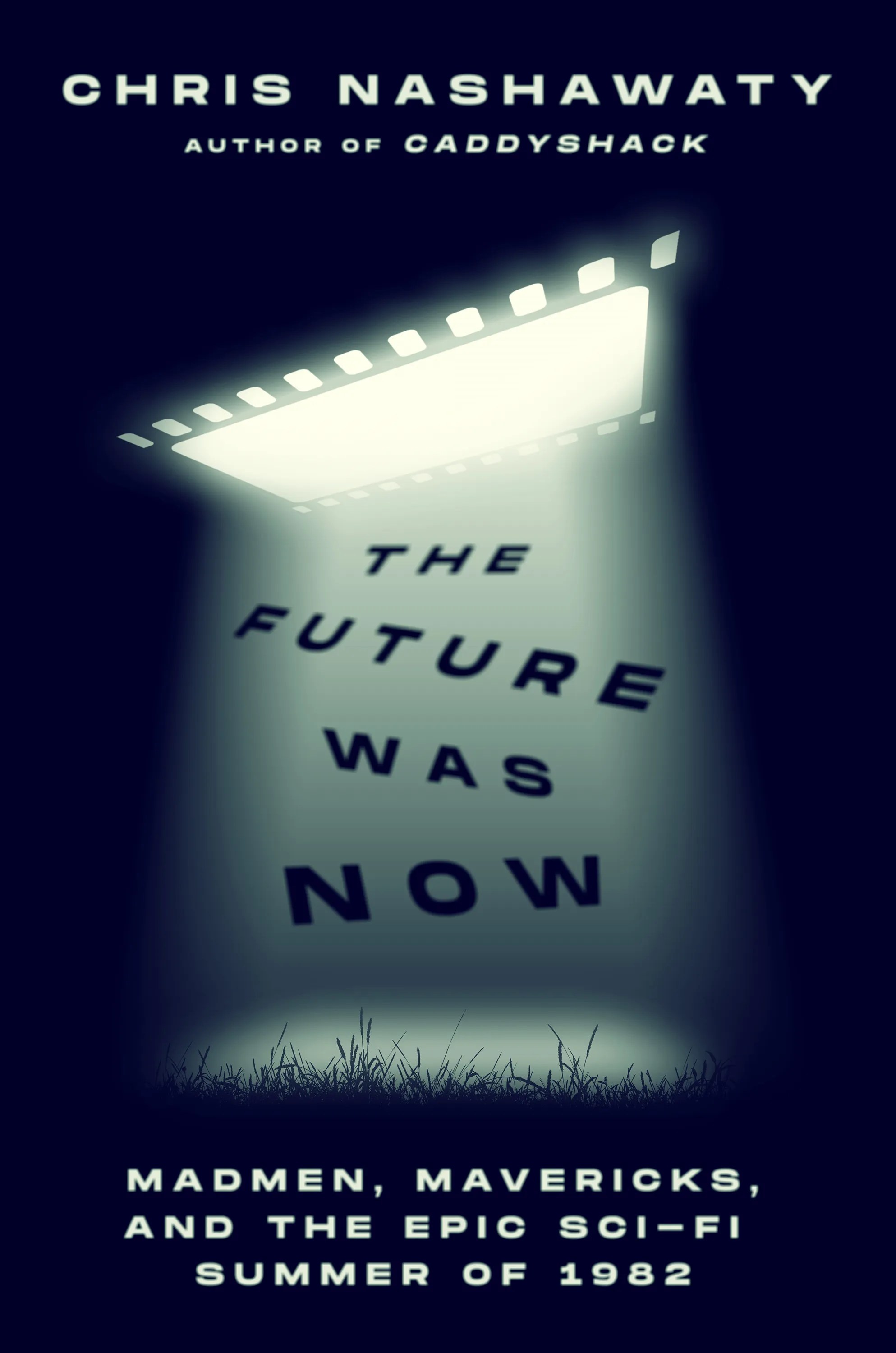
When you consider the weak showing of films this summer, particularly space-related films, its enough to make you give up and go online to revisit the classics. If you do so, you will probably bump into a number of great films that all appeared over eight weeks in the summer of 1982, including E.T. the Extra-Terrestrial, Star Trek: Wrath of Khan, and Blade Runner.
You can read all about this wealth of movie magic that one summer in Chris Nashawaty’s book The Future Was Now: Madmen, Mavericks, and the Epic Sci-Fi Summer of 1982. Here is the pitch for the book:
In the summer of 1982, eight science fiction films were released within six weeks of one another. E.T., Tron, Star Trek: Wrath of Khan, Conan the Barbarian, Blade Runner, Poltergeist, The Thing, and Mad Max: The Road Warrior changed the careers of some of Hollywood’s now biggest names—altering the art of movie-making to this day.
In The Future Was Now, Chris Nashawaty recounts the riotous genesis of these films, featuring an all-star cast of Hollywood luminaries and gadflies alike: Steven Spielberg, at the height of his powers, conceives E.T. as an unlikely family tale, and quietly takes over the troubled production of Poltergeist, a horror film he had been nurturing for years. Ridley Scott, fresh off the success of Alien, tries his hand at an odd Philip K. Dick story that becomes Blade Runner—a box office failure turned cult classic. Similar stories arise for films like Tron, Conan the Barbarian, and The Thing. Taken as a whole, these films show a precarious turning-point in Hollywood history, when baffled film executives finally began to understand the potential of high-concept films with a rabid fanbase, merchandising potential, and endless possible sequels.
Expertly researched, energetically told, and written with an unabashed love for the cinema, The Future Was Now is a chronicle of how the revolution sparked in a galaxy far, far away finally took root and changed Hollywood forever.
Of course, the book may simply depress you when you think of the current state of cinema more than 40 years later. Yes, we have Dune and the nth release of Aliens, but for the most part Hollywood is not offering today’s generation films that make them dream about a different future (and I don’t mean a future with men in spandex).
I just hope we have more up and coming Spielbergs, Scotts, and Dicks out there who read this book and take it as a challenge to make American cinema exciting again.
 Our Awesome Universe