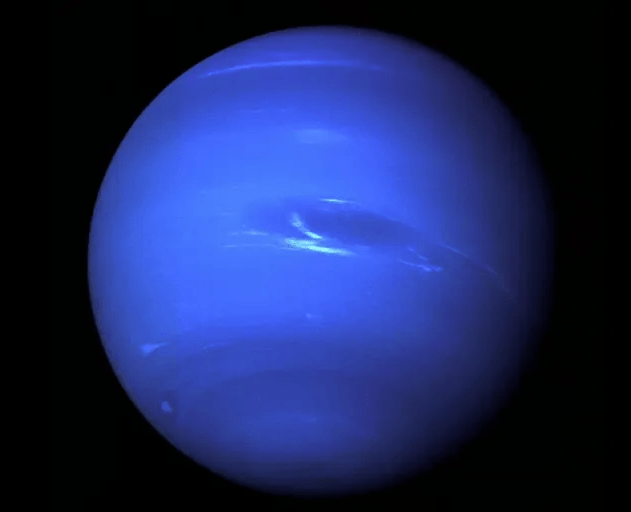
True or False: Neptune has orbited the Sun a total of five times since it was first discovered.
Take a guess and then check your answer by going to the “Astronomy Question Answer Sheet” page.

True or False: Neptune has orbited the Sun a total of five times since it was first discovered.
Take a guess and then check your answer by going to the “Astronomy Question Answer Sheet” page.

The other week, Elon Musk said he was planning to send five uncrewed Starship rockets to Mars in two years, followed by manned flights after that. Why the sudden announcement? It was not clear, but he does have money to burn and also a desire for attention.
In his Twitter/X posting, he said:
SpaceX plans to launch about five uncrewed Starships to Mars in two years.
If those all land safely, then crewed missions are possible in four years. If we encounter challenges, then the crewed missions will be postponed another two years.
Of course, he has yet to prove that the Starship is ready for assist NASA with the Artemis mission to place astronauts on the Moon. The rocket is getting better with every test, but the Starship problems are likely to delay the entire lunar mission. Yet he is already eyeing Mars?
If you read the full post, it appears he is using the Starship announcement to poke at California and Kamala Harris. He also seems to be ready to blame everyone but himself if he cannot meet his self-imposed Mars timetable.
One might ask if Mr. Musk has any idea where his Starship astronauts will be staying under this timetable. I have not heard of any great plans to build the necessary infrastructure to host a colony on the surface of Mars. Does he have a plan?
Mr. Musk had enormous problems meeting his proposed deadline for a Tesla pickup truck here on Earth, and the truck he eventually rolled out has has been less than a stellar vehicle given the hype. So any timetable on a Mars mission seems like mere fantasy at this point.
By the way, if Mr. Musk is so interested in protecting Earthlings from a dangerous future, he already has the ability to tamp down the rage and hate on Twitter/X and cease his calls for civil wars.
It is already in his power to make the Earth a better place to live while we plan for Mars. He just doesn’t seem to be all that interested.

Earlier today, NASA contractor SpaceX successfully launched the Crew-9 mission towards the International Space Station aboard a Falcon 9 rocket. The two crew members should be aboard the station tomorrow to join the rest of the Expedition 72 crew, who arrived at the station as part of two earlier launches.
While some are calling this a “rescue mission,” it is really a planned mission with a truncated crew roster to accommodate the two Boeing Starliner astronauts on the return back to Earth. Nothing to see here folks.
NASA Administrator Bill Nelson said it best:
This mission required a lot of operational and planning flexibility. I congratulate the entire team on a successful launch today, and godspeed to Nick and Aleksandr as they make their way to the space station…Our NASA wizards and our commercial and international partners have shown once again the success that comes from working together and adapting to changing circumstances without sacrificing the safe and professional operations of the International Space Station.
NASA has become quite flexible this year as it works with its commercial partners.
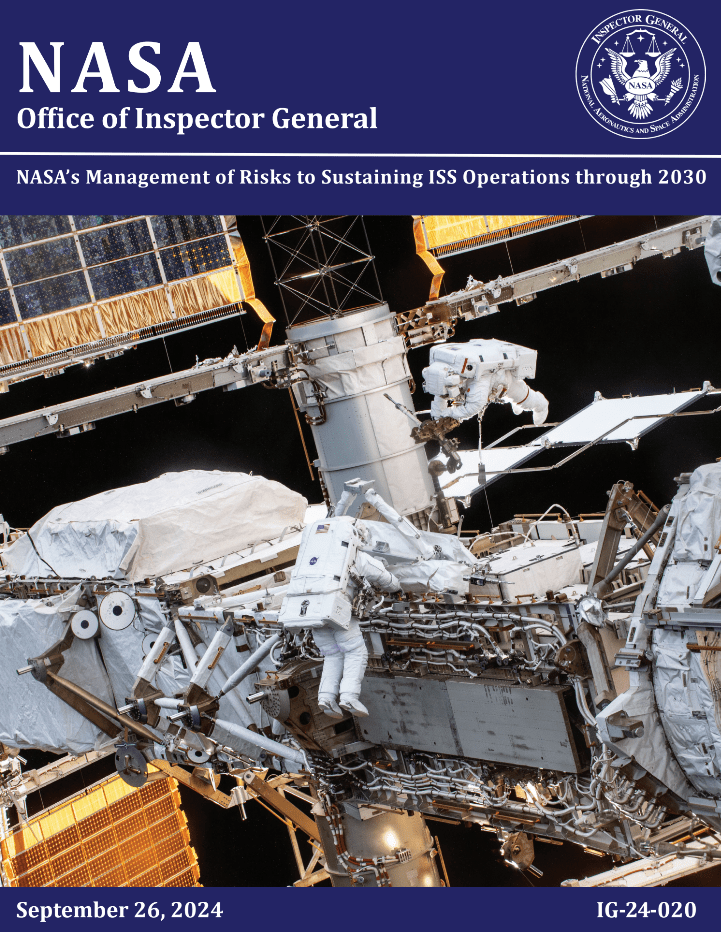
NASA’s Office of Inspect General (OIG) issued an audit report this week, NASA’s Management of Risks to Sustaining ISS Operations through 2030 (IG-24-020), that highlighted the ongoing issues NASA faces to keep the International Space Station (ISS) in orbit as well as plan its decommissioning.
The OIG auditors specifically noted concerns regarding (1) repairing and maintaining the integrity of the station, (2) too little redundancy in the commercial partners carrying crews and supplies to the station, (3) continued risk of micro meteoroids and debris damaging the station, (4) lack of ready-to-use capsules to escape the station in an emergency, and (5) lack of Russian commitment to de-orbiting the station at the end of its life.
That’s a long list of concerns, none of which are surprising given the complexity of the space station and the ongoing environmental issue, be it commercial partners, exterior space, or Russian commitment. It is amazing that the station has had so few major issues to date.
These issues need to be resolved for the current station and be considered as part of any new stations (government-run or commercial), whether they are orbiting the Earth, the Moon, or even Mars.
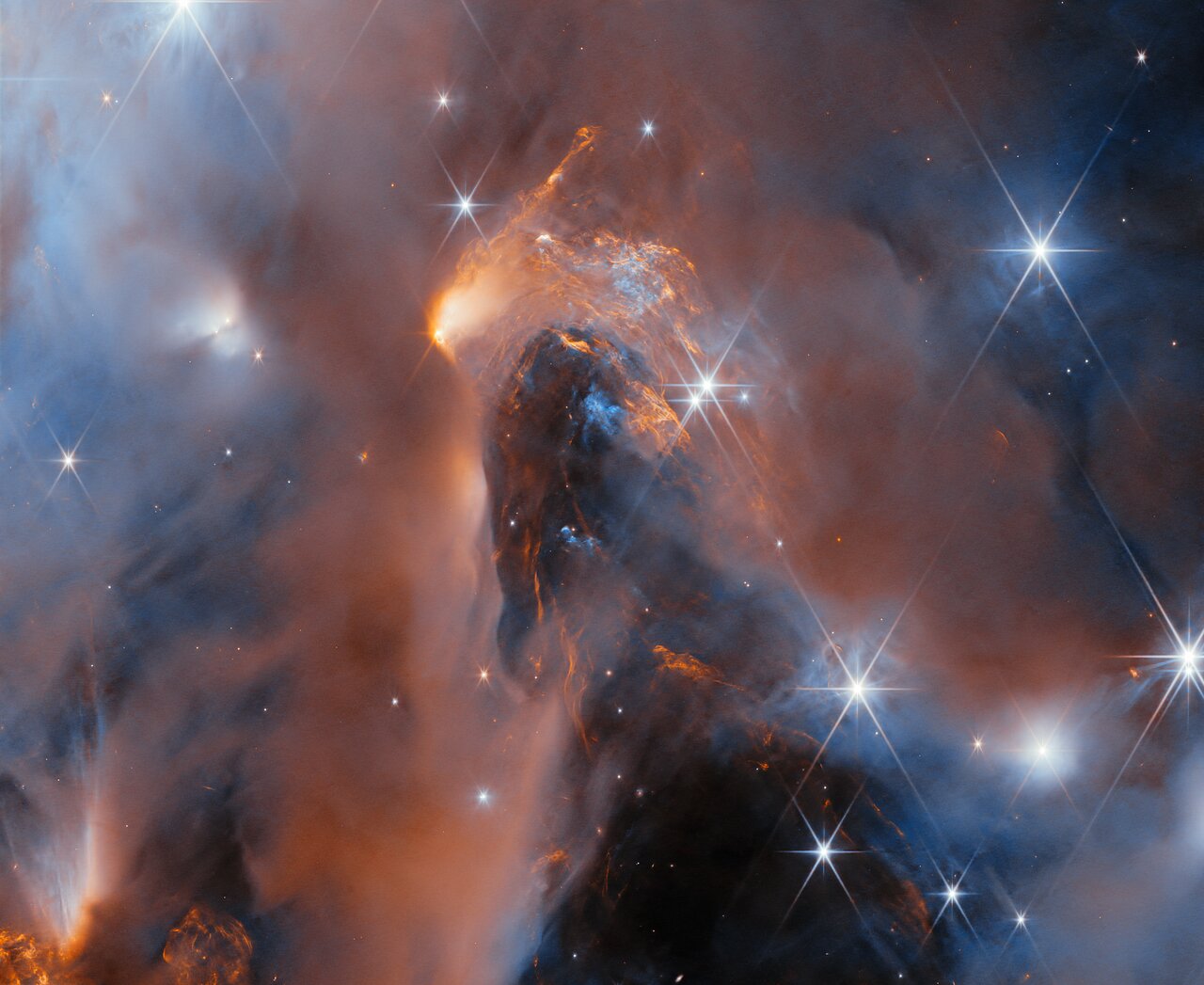
This week’s image of a distant nebula with new stars was captured by the James Webb Space Telescope (JWST). The nebula, NGC 1333, is located in the Perseus molecular cloud, which is about 960 light-years away.
Here is more information on the image from the European Space Agency:
The centre of the image presents a deep peek into the heart of the NGC 1333 cloud. Across the image we see large patches of orange, which represent gas glowing in the infrared. These so-called Herbig-Haro objects form when ionised material ejected from young stars collides with the surrounding cloud. They are hallmarks of a very active site of star formation.
Many of the young stars in this image are surrounded by discs of gas and dust, which may eventually produce planetary systems. On the right hand side of the image, we can glimpse the shadow of one of these discs oriented edge-on — two dark cones emanating from opposite sides, seen against a bright background.
Similarly to the young stars in this mosaic, our own Sun and planets formed inside a dusty molecular cloud, 4.6 billion years ago. Our Sun didn’t form in isolation but as part of a cluster, which was perhaps even more massive than NGC 1333. The cluster in the mosaic, only 1–3 million years old, presents us with an opportunity to study stars like our Sun, as well as brown dwarfs and free-floating planets, in their nascent stages.
 Our Awesome Universe