
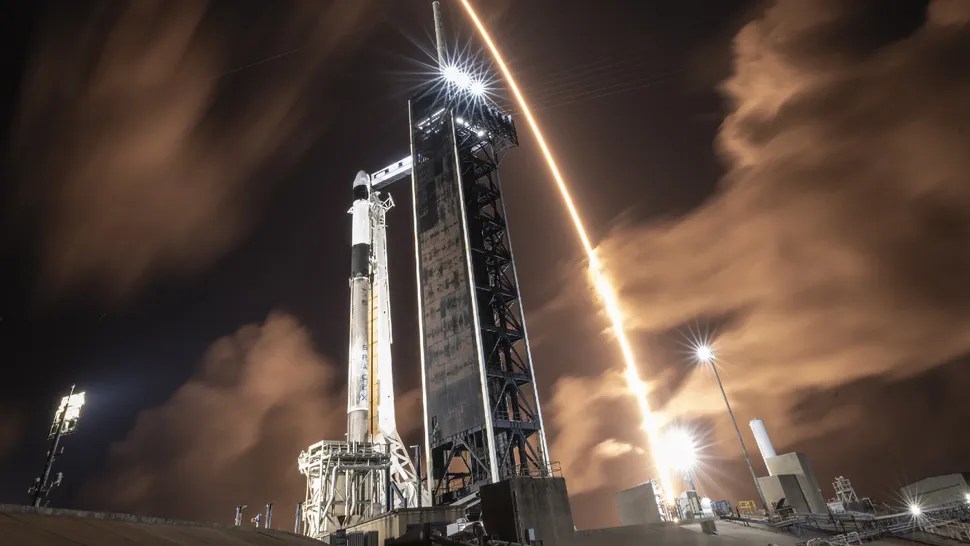
First the good news. SpaceX is able to launch its Falcon 9 rockets following a booster issue last week. That led to the immediate launch yesterday of two back-to-back launches of Starlink satellites.
Now the bad news. Russian scientists have reported that SpaceX’s second launch of its Starship rocket last November created a hole in the ionosphere. Specifically, an exploding engine generated the shock wave that created this hole. The scientists claim this is the first time a “human-caused explosion” has had this impact on the ionosphere.
This is the “plain language summary” from the Russian study:
On 18 November 2023, SpaceX launched the Starship, the tallest and the most powerful rocket ever built. About 2 min and 40 s after the liftoff, the Super Heavy engine separated from the Starship spacecraft and exploded at an altitude of 90 km. The main core Starship continued to rise to 149 km and exploded as well. The rocket launch and explosion produced an unexpected response in the ionosphere—the ionized part of the Earth’s atmosphere. The Starship flew at a velocity, exceeding the local sound speed, and generated cone-like atmospheric shock-acoustic waves. Most unexpectedly, the observed disturbances represented long and intensive multi-oscillation wave structures that propagated northward, which is unusual for disturbances driven by a rocket launch. The Starship explosion also generated a large-amplitude total electron content depletion that could have been reinforced by the impact of the spacecraft’s fuel exhaust in the lower atmosphere. This study appears to be the first-time detection of a non-chemical ionospheric hole produced by a man-made explosion.
I like the fact that Russian’s can share results in plain language. However, it is a little disturbing that we needed the Russians to fill us in on the destructive impact of the Starship rockets. Nature noted that “Ionospheric disturbances can affect not only satellite navigation but also communications and radio astronomy.”
We have seen the mess that the rockets can leave on the ground, but this is something else. We need to understand the impact of such launches and related issues if this is to become the new way of doing things. The FAA and NASA should be looking into this matter.
 Our Awesome Universe