Space Quote: Maryland Delegation Wants NASA to Explain Canceling the OSAM-1 Mission

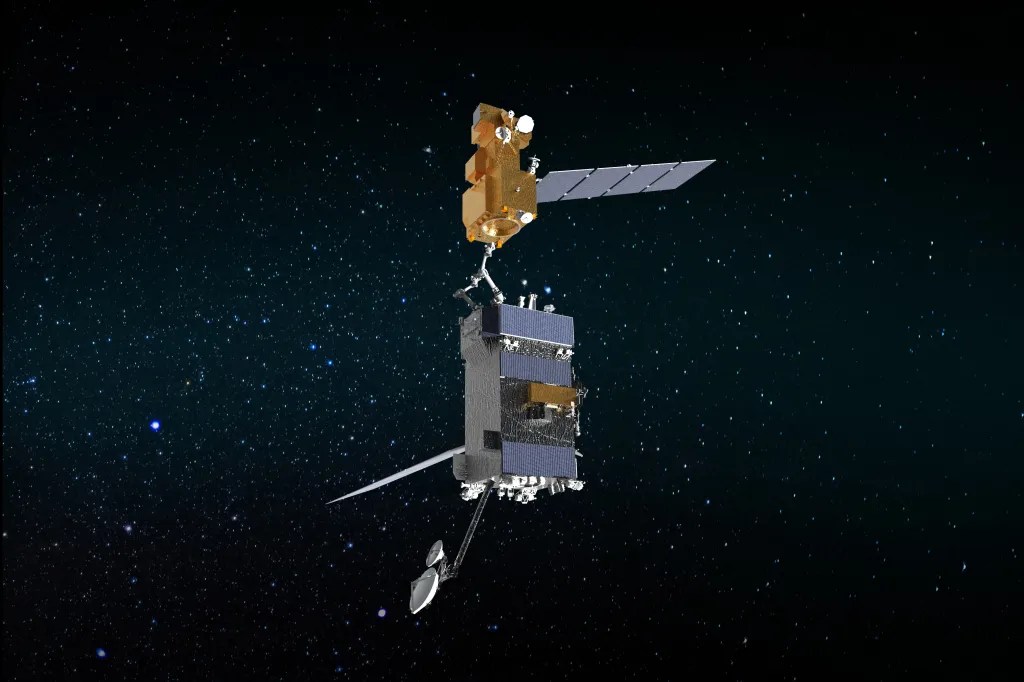
Image (Credit): Artist’s rendering of the OSAM-1 (bottom) docking with a satellite. (NASA)

“As members of the Maryland Delegation, we write to request information regarding NASA’s decision to cancel the On-Orbit Servicing, Assembly, and Manufacturing 1 (OSAM-1) mission on September 4, 2024. OSAM-1 is a space technology mission developed to demonstrate NASA’s capabilities to extend the lifespans of government-owned satellites and other satellites that were not originally built or intended to be serviced in space…On September 4, 2024, members of the Maryland delegation were notified of NASA’s intent to proceed with canceling the OSAM-1 mission. NASA officials cited feasibility of the 2026 launch plan, risk tolerance, lack of interest from potential partners per verbal communication, return on investment, and interest in expanding other Space Technology Mission Directorate (STMD) priorities. The Delegation wishes to note that return on investment and other STMD priorities are extraneous factors that Congress did not include in its direction. Furthermore, we have concerns regarding the Agency’s decision-making process.”

-Statement by Maryland Democratic Senators and Congress members in a September 16, 2024 letter to NASA regarding the status of the OSAM-1 mission. NASA explained on its website that it re-evaluated its earlier decision to cancel the mission and found it was still proper to cancel the mission, noting “factors that informed the decision were cost, schedule, and technical risk associated with the 2026 launch plan, the return on investment of flying OSAM-1 technology, uncertain technology infusion path to industry, and impacts on other NASA technology development efforts.” While these are serious reservations, the growing level of space debris in orbit is also a serious concern. Hopefully, NASA has a back-up plan if it does not move forward with this specific mission.

Pic of the Week: Galactic Emoji

Image (Credit): A composite image of Arp 107.(NASA, ESA, CSA, STScI)

This week’s image comes from the James Webb Space Telescope. It shows two colliding galaxies creating a unique image from the telescope’s viewpoint.

Here is more information about the image from NASA:

Smile for the camera! An interaction between an elliptical galaxy and a spiral galaxy, collectively known as Arp 107, seems to have given the spiral a happier outlook thanks to the two bright “eyes” and the wide semicircular “smile.” The region has been observed before in infrared by NASA’s Spitzer Space Telescope in 2005, however NASA’s James Webb Space Telescope displays it in much higher resolution. This image is a composite, combining observations from Webb’s MIRI (Mid-Infrared Instrument) and NIRCam (Near-Infrared Camera)...Webb has captured these galaxies in the process of merging, which will take hundreds of millions of years. As the two galaxies rebuild after the chaos of their collision, Arp 107 may lose its smile, but it will inevitably turn into something just as interesting for future astronomers to study. Arp 107 is located 465 million light-years from Earth in the constellation Leo Minor.

Television: Last Days of the Space Age

Credit: Hulu

If you are watching the list of fall shows, you might have noticed Hulu’s upcoming series Last Days of the Space Age. The new drama premieres on October 2, 2024.

Here is the summary from Hulu:

In 1979, a power strike threatens to plunge the region into darkness in Western Australia, while the city hosts the Miss Universe pageant and the US space station, Skylab, crashes just beyond the city’s suburbs.

The trailer provides a little more context, but there is a reason that Skylab is mentioned last in the short summary. The space age plays a small part in a bigger human drama. Fortunately, it is not really the end of the space age as much as the end of a bit of the space age as it falls from the sky. The real Skylab disintegrated in the Earth’s atmosphere on July 11, 1979, leading to debris falling into the Indian Ocean as well as Western Australia.

Once the International Space Station is nudged out of orbit in the coming years, we may have more debris fields generating television ideas. I just wonder if it will take another 45 years to make it to your screen.

This series may be as good as it gets on television until Andor returns next year. The space-related television pickings are pretty slim at the moment.

Update: To be fair, there are a few more shows to check out before the end of the year, including Dune: Prophecy coming on November 17 and another Star Wars series called Skeleton Crew premiering on December 3.

Space Stories: Axiom Space Struggling Financially, Intuitive Machines Gets $4.8 billion NASA Contract, and Water and Hydroxyl Widespread on Moon

Credit: Axiom Space

Here are some recent stories of interest.

ARS TechnicaA Key NASA Commercial Partner Faces Severe Financial Challenges

Axiom Space is facing significant financial headwinds as the company attempts to deliver on two key commercial programs for NASA—the development of a private space station in low-Earth orbit and spacesuits that could one day be worn by astronauts on the Moon. Forbes reports that Axiom Space, which was founded by billionaire Kam Ghaffarian and NASA executive Mike Suffredini in 2016, has been struggling to raise money to keep its doors open and has had difficulties meeting its payroll dating back to at least early 2023. In addition, the Houston-based company has fallen behind on payments to key suppliers, including Thales Alenia Space for its space station and SpaceX for crewed launches.

ReutersIntuitive Machines Clinches $4.8 billion Navigation Services Contract from NASA

Intuitive Machines said on Tuesday it has bagged a navigation and communication services contract of up to $4.82 billion from NASA for missions in the near space region. As part of the contract, which has a base period of five years with an additional five-year option period, Intuitive will deploy lunar relay satellites and provide communication and navigation services to aid NASA’s Artemis campaign.

Planetary Science InstituteSources of Water and Hydroxyl are Widespread on the Moon

A new analysis of maps of the near and far sides of the Moon shows that there are multiple sources of water and hydroxyl in the sunlit rocks and soils, including water-rich rocks excavated by meteor impacts at all latitudes. “Future astronauts may be able to find water even near the equator by exploiting these water-rich areas. Previously, it was thought that only the polar region, and in particular, the deeply shadowed craters at the poles were where water could be found in abundance,” said Roger Clark, Senior Scientist at the Planetary Science Institute and lead author of “The Global Distribution of Water and Hydroxyl on the Moon as Seen by the Moon Mineralogy Mapper (M3)” that appears in the Planetary Science Journal. “

Study Finding: Gravitational Instability in a Planet-forming Disk

Credit: Peter Schmidt from Pixabay

Nature abstract of the study findings:

The canonical theory for planet formation in circumstellar disks proposes that planets are grown from initially much smaller seeds. The long-considered alternative theory proposes that giant protoplanets can be formed directly from collapsing fragments of vast spiral arms induced by gravitational instability—if the disk is gravitationally unstable. For this to be possible, the disk must be massive compared with the central star: a disk-to-star mass ratio of 1:10 is widely held as the rough threshold for triggering gravitational instability, inciting substantial non-Keplerian dynamics and generating prominent spiral arms. Although estimating disk masses has historically been challenging, the motion of the gas can reveal the presence of gravitational instability through its effect on the disk-velocity structure. Here we present kinematic evidence of gravitational instability in the disk around AB Aurigae, using deep observations of 13CO and C18O line emission with the Atacama Large Millimeter/submillimeter Array (ALMA). The observed kinematic signals strongly resemble predictions from simulations and analytic modelling. From quantitative comparisons, we infer a disk mass of up to a third of the stellar mass enclosed within 1″ to 5″ on the sky.

Citation: Speedie, J., Dong, R., Hall, C. et al. Gravitational instability in a planet-forming disk. Nature 633, 58–62 (2024).
https://doi.org/10.1038/s41586-024-07877-0

Study-related stories:

MIT News

Space Daily

Universe Today