Space Stories: Polaris Dawn Mission Starts, Report Blasts NASA, and Galaxies Are Larger Than We Thought

Here are some recent stories of interest.

NASANASA to Test Telemedicine, Gather Essential Health Data with Polaris Dawn Crew

NASA researchers will soon benefit from a suite of experiments flying aboard a new fully-commercial human spaceflight mission, strengthening future agency science as we venture to the Moon, Mars and beyond. The experiments are flying as part of the Polaris Dawn mission which launched aboard a SpaceX Dragon spacecraft and Falcon 9 rocket earlier today…“Each mission, whether the crew is comprised of commercial or NASA astronauts, provides a key opportunity to expand our knowledge about how spaceflight affects human health,” said Jancy McPhee, associate chief scientist for human research at NASA. “Information gathered from Polaris Dawn will give us critical insights to help NASA plan for deeper space travel to the Moon and Mars.”

Flying Magazine: “Report to Congress: Shortsighted, Aging NASA Faces Uncertain Future

A report published Tuesday raises serious questions about NASA’s ability to effectively function as the nation’s preeminent space agency. The 218-page document, assembled by the National Academies of Sciences, Engineering, and Medicine (NASEM) at the behest of Congress, warns that NASA is prioritizing short-term missions and commercial contracts over the people and technology that make its out-of-this-world activities possible. Per the report, the space agency’s emphasis on near-term victories and overreliance on private contractors comes at the price of a strained budget, degraded infrastructure, and exodus of talented personnel.

Astro3D: “Galaxies are Much, Much Bigger Than We Thought

A shroud of gas stretches up to a million light years around every galaxy and is its first interaction with the wider Universe beyond. For the first time, scientists have photographed this halo of matter and examined it pixel by pixel. If this galaxy is typical, then the study, published today in Nature Astronomy, indicates that our galaxy is already interacting with its closest neighbour, Andromeda.
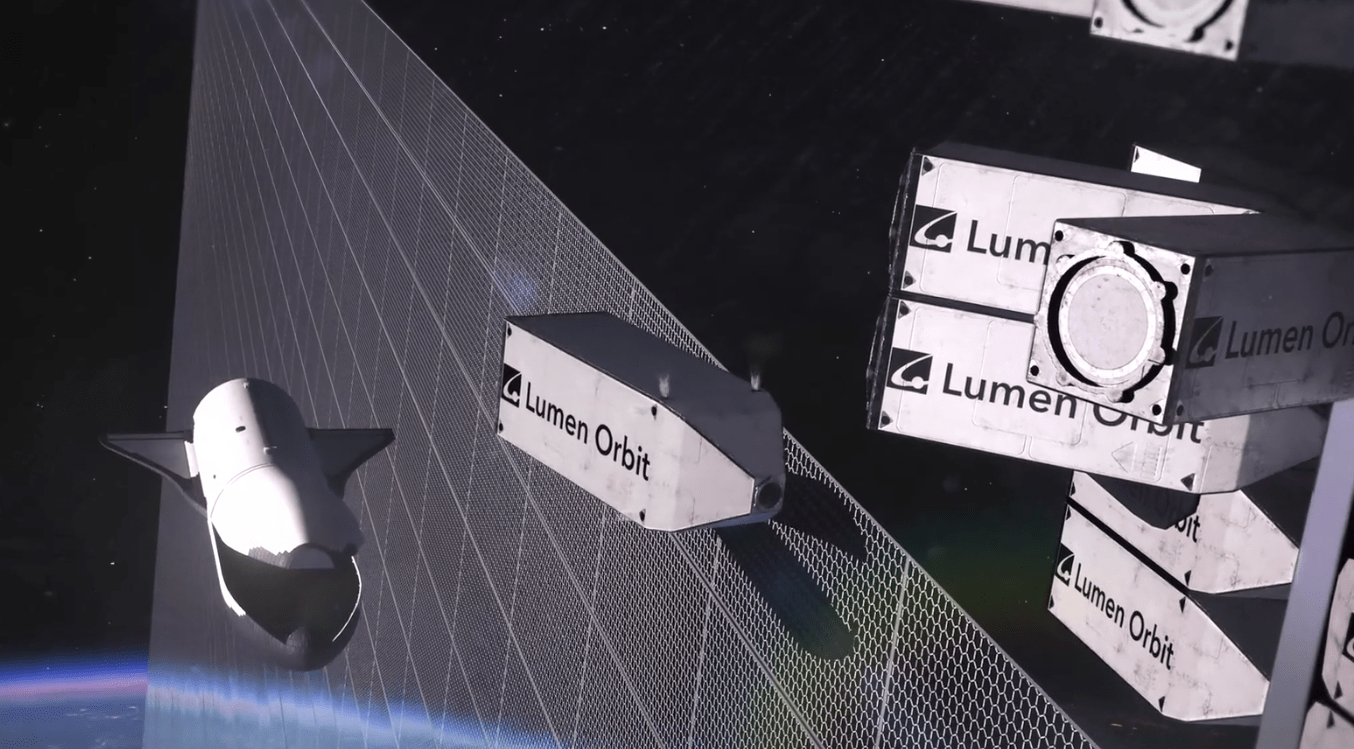

Building Data Centers in Space?

Credit: Lumen Orbit

We have all read stories about the enormous about of electricity being soaked up by data centers. These data centers are removing green energy from the grid faster than it can be produced. So what is the solution?

How about solar-powered data centers in space?

In a recent white paper, Lumen Orbit highlights the advantage of such an approach, including the use of renewable energy, the elimination of fresh water cooling, and unlimited scaling up. In the paper, we read:

Significant operational cost savings can be achieved by using inexpensive solar energy without the limitations of terrestrial solar farms discussed below. Orbital data centers can leverage lower cooling costs using passive radiative cooling in space to directly achieve low coolant temperatures. Perhaps most importantly, they can be scaled almost indefinitely without the physical or permitting constraints faced on Earth, using modularity to deploy them rapidly. All of this will have a net benefit on the environment – a recent study by the European Commission concluded that orbital data centers will significantly reduce greenhouse gas emissions from grid electricity and eliminate fresh water usage for cooling.

The European Commission financed the Advanced Space Cloud for European Net zero emission and Data sovereignty (ASCEND) – a 16-month-long study on the feasibility of placing data centers into orbit. The study found that such data centers are technically, economically and environmentally feasible.

Pushing data centers as well as cryptocurrency data mining into space is a great idea as these processes are not going away. Just ask the Texans about the problems of sharing the state’s electricity grid with these centers. Texas may soon as these data centers to find a new home.

This is something that deserves more attention as we hit our energy limits here on Earth.

A Day in Astronomy: Happy Star Trek Day!

Credit: OpenClipart-Vectors from Pixabay

Today we remember the beginning of the Star Trek phenomenon that started back on September 8, 1966 with the introduction of the Star Trek television series. Created by Gene Roddenberry, the series initiated books, movies, and more over the years that provided a positive vision of our future in space, though it came after some rough lessons (world war) and still posed constant challenges (Klingons, Borg, Cardassians, and others).

Gene Roddenberry once said:

Star Trek was an attempt to say that humanity will reach maturity and wisdom on the day that it begins not just to tolerate, but take a special delight in differences in ideas and differences in life forms. […] If we cannot learn to actually enjoy those small differences, to take a positive delight in those small differences between our own kind, here on this planet, then we do not deserve to go out into space and meet the diversity that is almost certainly out there.

Wise words during the turmoil of the 1960s as well as the turmoil of today.

Space Quote: Exciting Days Ahead for the US Space Program

Image (Credit): An image of Buzz Aldrin’s bootprint on the lunar surface from the Apollo 11 mission. (NASA)

“After having no other U.S. options for over 30 years, three different human spacecraft programs are now underway. In addition to the SpaceX Crew Dragon and the Boeing Starliner, NASA’s Orion spacecraft for the Artemis II mission, is planned to fly four astronauts around the Moon in the next couple of years. These programs have had setbacks and bumps along the way – and there will be more – but I haven’t been this excited about human spaceflight since I was an 11-year-old cheering for Apollo and dreaming about putting the first human footprints on Mars.”

Statement by former commander of the International Space Station Michael Fossum when asked by The Conversation about NASA’s decision to return the craft uncrewed, the future of the Starliner program and its crew’s extended stay at the space station.

Starliner: So Far, So Good

Image (Credit): NASA video coverage of the Starliner pulling away from the ISS earlier today. (NASA)

The Boeing CST-100 Starliner capsule has started its journey back to Earth from the International Space Station (ISS). Soon we will learn whether the spacecraft is operating as expected and could have returned the two astronauts safely.

The extra caution is not unexpected, and this does not spell doom for Boeing, but it is a setback. The real question will be the rate at which the Starliner’s issues can be resolved and another launch attempted.

On August 2, Boeing stated:

Boeing remains confident in the Starliner spacecraft and its ability to return safely with crew. We continue to support NASA’s requests for additional testing, data, analysis and reviews to affirm the spacecraft’s safe undocking and landing capabilities. Our confidence is based on this abundance of valuable testing from Boeing and NASA. The testing has confirmed 27 of 28 RCS thrusters are healthy and back to full operational capability. Starliner’s propulsion system also maintains redundancy and the helium levels remain stable. The data also supports root cause assessments for the helium and thruster issues and flight rationale for Starliner and its crew’s return to Earth.

Let’s hope Boeing is correct and the company is back on the launch pad with an improved Starliner shortly.

Update: NASA reported that the uncrewed Starliner capsule safely landed at 10:01 p.m. MDT on Friday, September 6, at White Sands Space Harbor in New Mexico.