Pic of the Week: Galaxies Passing in the Night

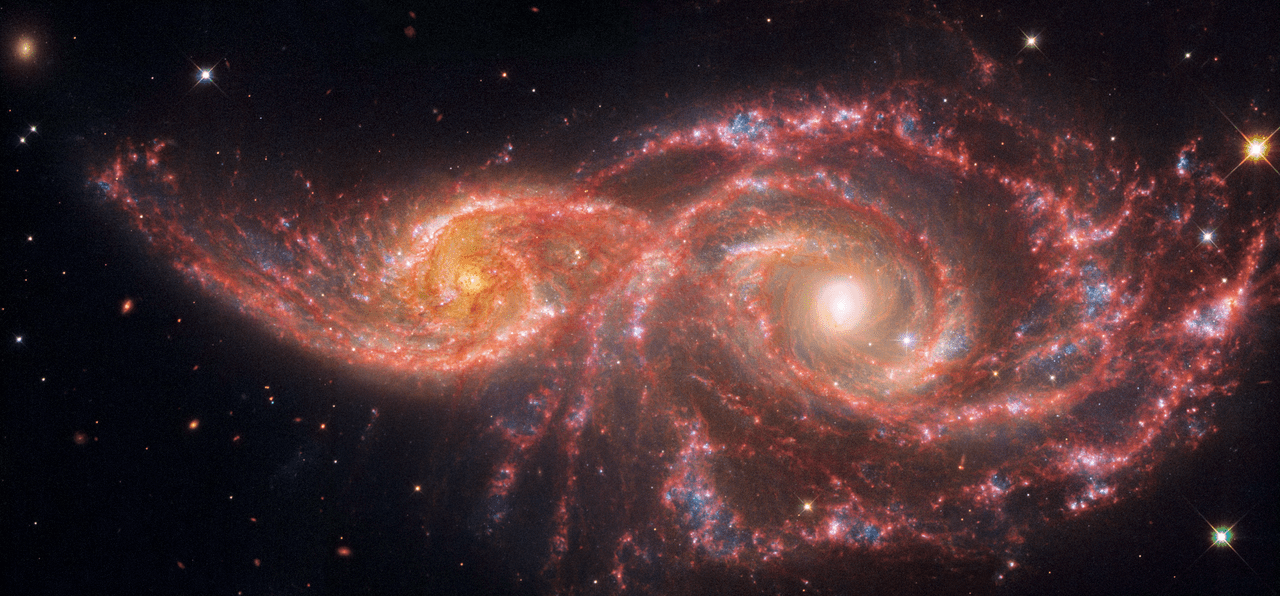
Image (Credit): Galaxies IC 2163 and NGC 2207. (NASA, ESA, CSA, STScI)

This week’s image showing two galaxies – IC 2163 and NGC 2207 – comes from both the Hubble Space Telescope and the James Webb Space Telescope.

Here is more about the image from Hubblesite.org:

The gruesome palette of these galaxies is owed to a mix of mid-infrared light from NASA’s James Webb Space Telescope, and visible and ultraviolet light from NASA’s Hubble Space Telescope. The pair grazed one another millions of years ago. The smaller spiral on the left, cataloged as IC 2163, passed behind NGC 2207, the larger spiral galaxy at right.

Both have increased star formation rates. Combined, they are estimated to form the equivalent of two dozen new stars that are the size of the Sun annually. Our Milky Way galaxy forms the equivalent of two or three new Sun-like stars per year.

Both galaxies have hosted seven known supernovae, each of which may have cleared space in their arms, rearranging gas and dust that later cooled, and allowed new many stars to form. (Find these areas by looking for the bluest regions).

Space Stories: Questions About Orion, NASA’s Impact on Economy, and a New Crew for the Chinese Space Station

Image (Credit): Components of the Orion spacecraft. (NASA)

Here are some recent stories of interest.

ARSTechnicaFor Some Reason, NASA is Treating Orion’s Heat Shield Problems as a Secret

For those who follow NASA’s human spaceflight program, when the Orion spacecraft’s heat shield cracked and chipped away during atmospheric reentry on the unpiloted Artemis I test flight in late 2022, what caused it became a burning question. Multiple NASA officials said Monday they now know the answer, but they’re not telling. Instead, agency officials want to wait until more reviews are done to determine what this means for Artemis II, the Orion spacecraft’s first crew mission around the Moon, officially scheduled for launch in September 2025.

NASANew Report Shows NASA’s $75.6 Billion Boost to US Economy

In its third agencywide economic impact report, NASA highlighted how its Moon to Mars activities, climate change research and technology development, and other projects generated more than $75.6 billion in economic output across all 50 states and Washington, D.C., in fiscal year 2023…Combined, NASA’s missions supported 304,803 jobs nationwide, and generated an estimated $9.5 billion in federal, state, and local taxes throughout the United States.

ABC NewsChina Launches New Crew to its Space Station as it Seeks to Expand Exploration

China declared a “complete success” after it launched a new three-person crew to its orbiting space station early Wednesday as the country seeks to expand its exploration of outer space with missions to the moon and beyond. The Shenzhou-19 spaceship carrying the trio blasted off from the Jiuquan Satellite Launch Center in northwest China at 4:27 a.m. local time atop a Long March-2F rocket, the backbone of China’s crewed space missions.

Television: “Dune: Prophecy” is Almost Here

Credit: HBO Max

If you have yet to see the latest trailer for the upcoming HBO Max series Dune: Prophesy, I recommend you take a look. It provides plenty of information on the battle to come starting November 17th.

The initial images are impressive, though it does not appear we will have the out-of-this-world music we experienced with the first two Dune movies.

Maybe I have seen too many of these series now, but this latest story seems to be a cross between HBO’s Game of Thrones and Apple TV+’s Foundation. Not that I am complaining.

See for yourself, and stay tuned for what looks to be another success from the world called Dune.

Note: For a breakdown of the trailer, visit Secrets of Dune on Youtube. The narrator does a nice job tying the the new series into the two earlier movies.

Videos: The Odds of Life Elsewhere in the Universe

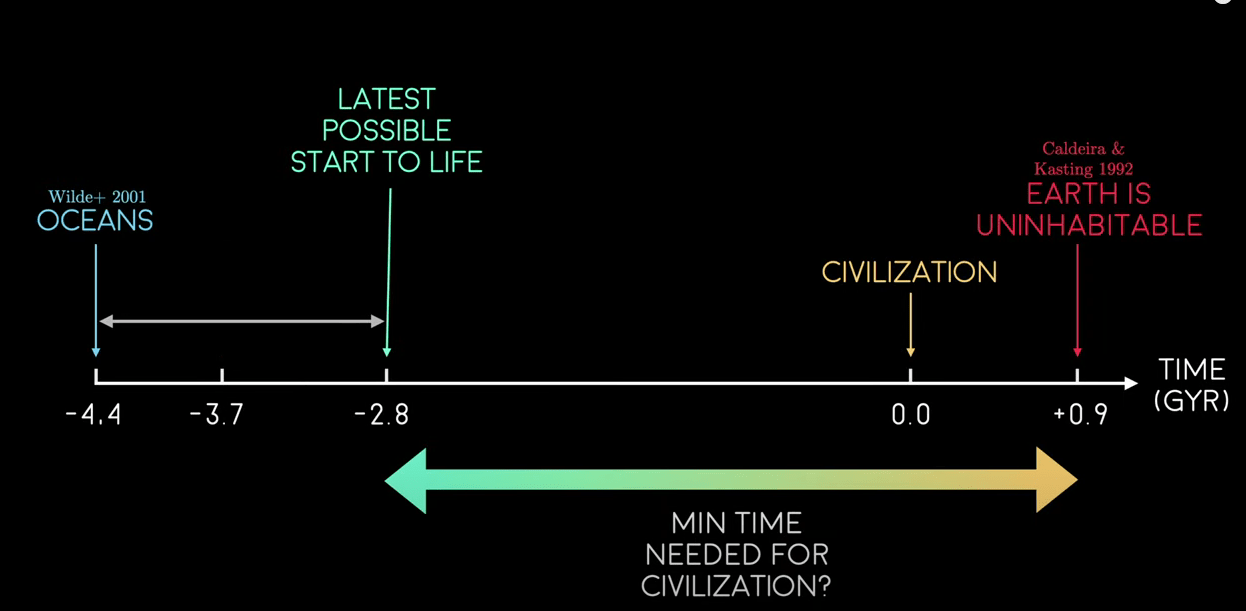
Image (Credit): One of the graphics from the video discussing the progress of life leading to civilization here on the Earth. (Cool Worlds)

Earlier today, a new Cool Worlds video was posted to Youtube titled “The Odds of Life – THIS CHANGED MY MIND.” Its an interesting piece narrated by Professor David Kipping regarding whether life is common in the universe. You will see that Professor Kipping is excited to share his results as he walks you through various papers before concluding that simple life may be more common than he believed earlier, making the chance of an advanced civilization a little more likely.

As always, it’s a fun story to follow as it answers one questions and stirs up other questions. For example, as part of his talk he notes an earlier paper that hypothesized the existence of an earlier technological civilization here on Earth about 350 million years ago. The paper is titled The Silurian Hypothesis: Would it be Possible to Detect an Industrial Civilization in the Geological Record.

Here is the abstract of this paper:

If an industrial civilization had existed on Earth many millions of years prior to our own era, what traces would it have left and would they be detectable today? We summarize the likely geological fingerprint of the Anthropocene, and demonstrate that while clear, it will not differ greatly in many respects from other known events in the geological record. We then propose tests that could plausibly distinguish an industrial cause from an otherwise naturally occurring climate event.

Professor Kipping said he hoped to create another video to discuss this idea about earlier civilizations. In the meantime, you may want to take a look at the paper.