
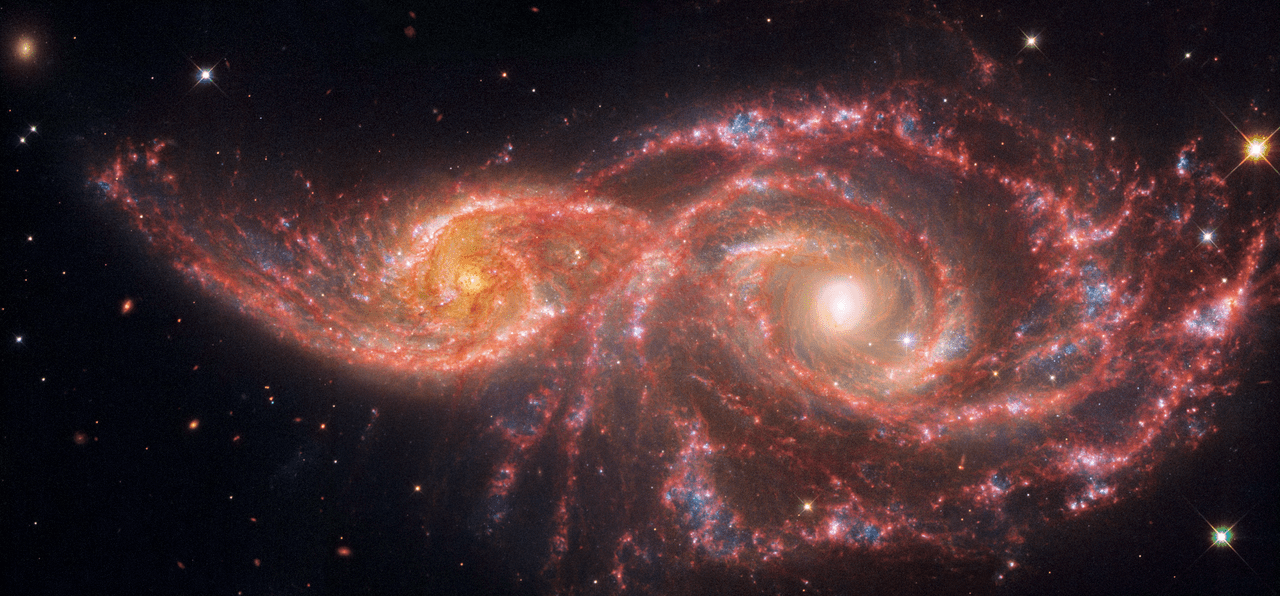
This week’s image showing two galaxies – IC 2163 and NGC 2207 – comes from both the Hubble Space Telescope and the James Webb Space Telescope.
Here is more about the image from Hubblesite.org:
The gruesome palette of these galaxies is owed to a mix of mid-infrared light from NASA’s James Webb Space Telescope, and visible and ultraviolet light from NASA’s Hubble Space Telescope. The pair grazed one another millions of years ago. The smaller spiral on the left, cataloged as IC 2163, passed behind NGC 2207, the larger spiral galaxy at right.
Both have increased star formation rates. Combined, they are estimated to form the equivalent of two dozen new stars that are the size of the Sun annually. Our Milky Way galaxy forms the equivalent of two or three new Sun-like stars per year.
Both galaxies have hosted seven known supernovae, each of which may have cleared space in their arms, rearranging gas and dust that later cooled, and allowed new many stars to form. (Find these areas by looking for the bluest regions).
 Our Awesome Universe