Image (Credit): Instruments on the Voyager spacecraft. (NASA/JPL-Caltech)
Last week, NASA announced its decision to turn off one of Voyager 2’s scientific instruments to save energy. The plasma science instrument is now silent. It was used to measure the amount of plasma, or electrically charged atoms, as well as the direction it is flowing. The same instrument on Voyager 1 stopped working in 1980.
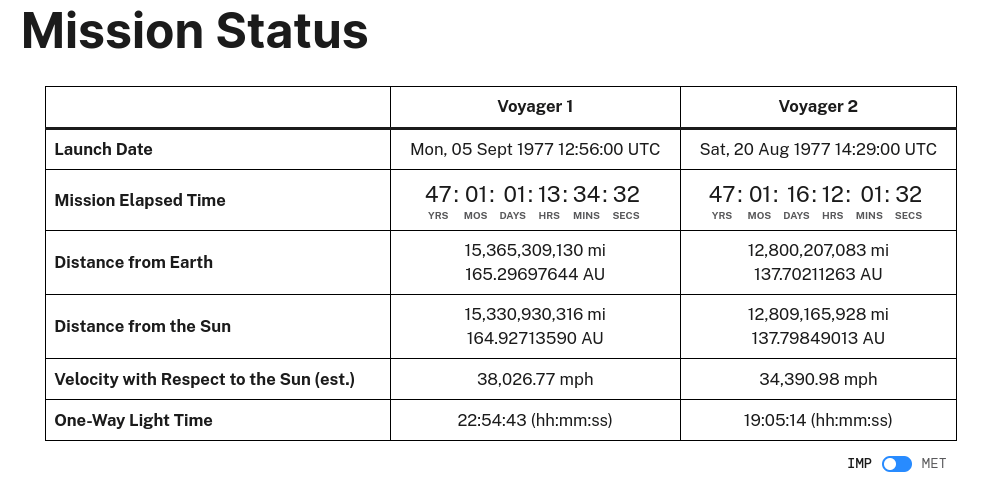
It is just amazing that the two Voyagers continue on their voyage beyond our solar system while sharing the experience with us. As of a few minutes ago, Voyager 1 was about 15.4 billion miles away (Voyager 2 is a little closer) and it took about 22 hours and 54 minutes for light to travel from the Voyager 1 spacecraft to Earth.
You can go to this NASA site to learn more about the mission as well as the status of the various scientific instruments.
Earlier this week, NASA issued an article on how astronauts on the International Space Station (ISS) can vote in the upcoming election. Yes, they need to make arrangements like anyone planning to be out of town, but we have a least two astronauts (from Boeing) who did not plan to be on the station during the election.
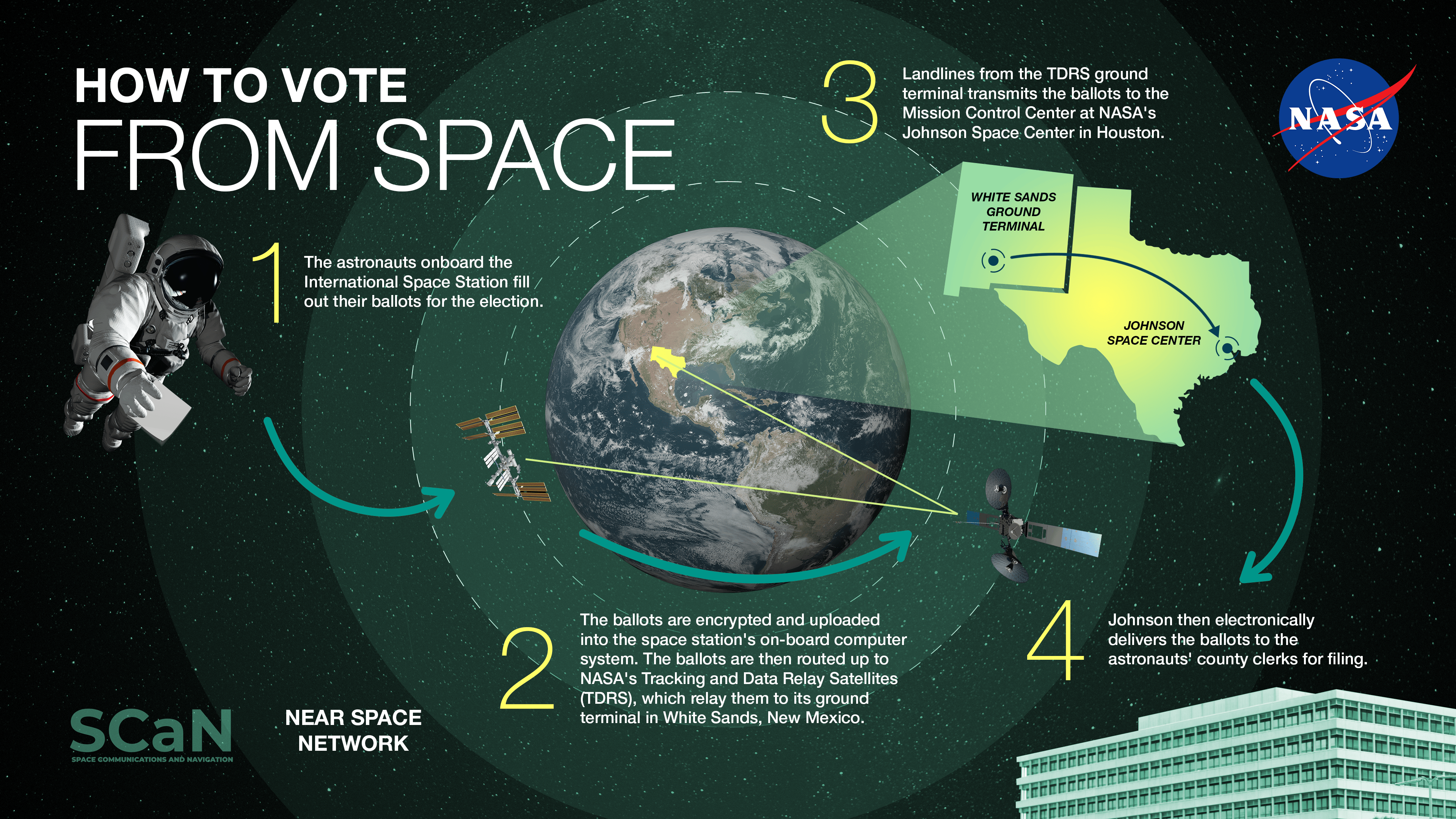
The process as explained by NASA (and shown below) is as follows:
Just like any other American away from home, astronauts may fill out a Federal Post Card Application to request an absentee ballot. After an astronaut fills out an electronic ballot aboard the orbiting laboratory, the document flows through NASA’s Tracking and Data Relay Satellite System to a ground antenna at the agency’s White Sands Test Facility in Las Cruces, New Mexico.
From New Mexico, NASA transfers the ballot to the Mission Control Center at NASA Johnson and then on to the county clerk responsible for casting the ballot. To preserve the vote’s integrity, the ballot is encrypted and accessible only by the astronaut and the clerk.
According to the Pew Research Center, about 66 percent of voting-eligible population cast a ballot in the 2020 election.
If astronauts can find a way to vote, the rest of us here on Earth have no excuse to miss the election.
As if things could not get more troublesome, the Heritage Foundation appears to be doing a lot of dirty work on behalf of the Trump campaign to obtain internal conversations by NASA employees. According to Reuters, the focus of the campaign against NASA appears to be looking for comments involving Donald Trump and Elon Musk.
The requests are likely to bog down the NASA’s employees while the Heritage Foundation pursues its agenda to eliminate any “disloyal” federal employees, all part of its earlier, now toxic, Project 2025 mission. You might think we were talking about the Soviet Union, but these are the tactics today of the far right.
SpaceX has done very well under the NASA program, but some may want to continue to tip the scales in his favor now that he has come out and supported Trump for president.
NASA is not alone. The Heritage Foundation has been sending tens of thousands of requests to federal agencies in the past two years building up a case against federal employees, most likely in the hope of putting its own selected staff into these same positions.
This is not the way to run a government or win a campaign. Whoever wins the presidential election will have amply opportunity to place its own managers in all of the federal agencies, including NASA. That in itself is tough enough, with a new president needing to fill more than 4,000 positions under normal circumstances, something the last Trump administration struggled to do.
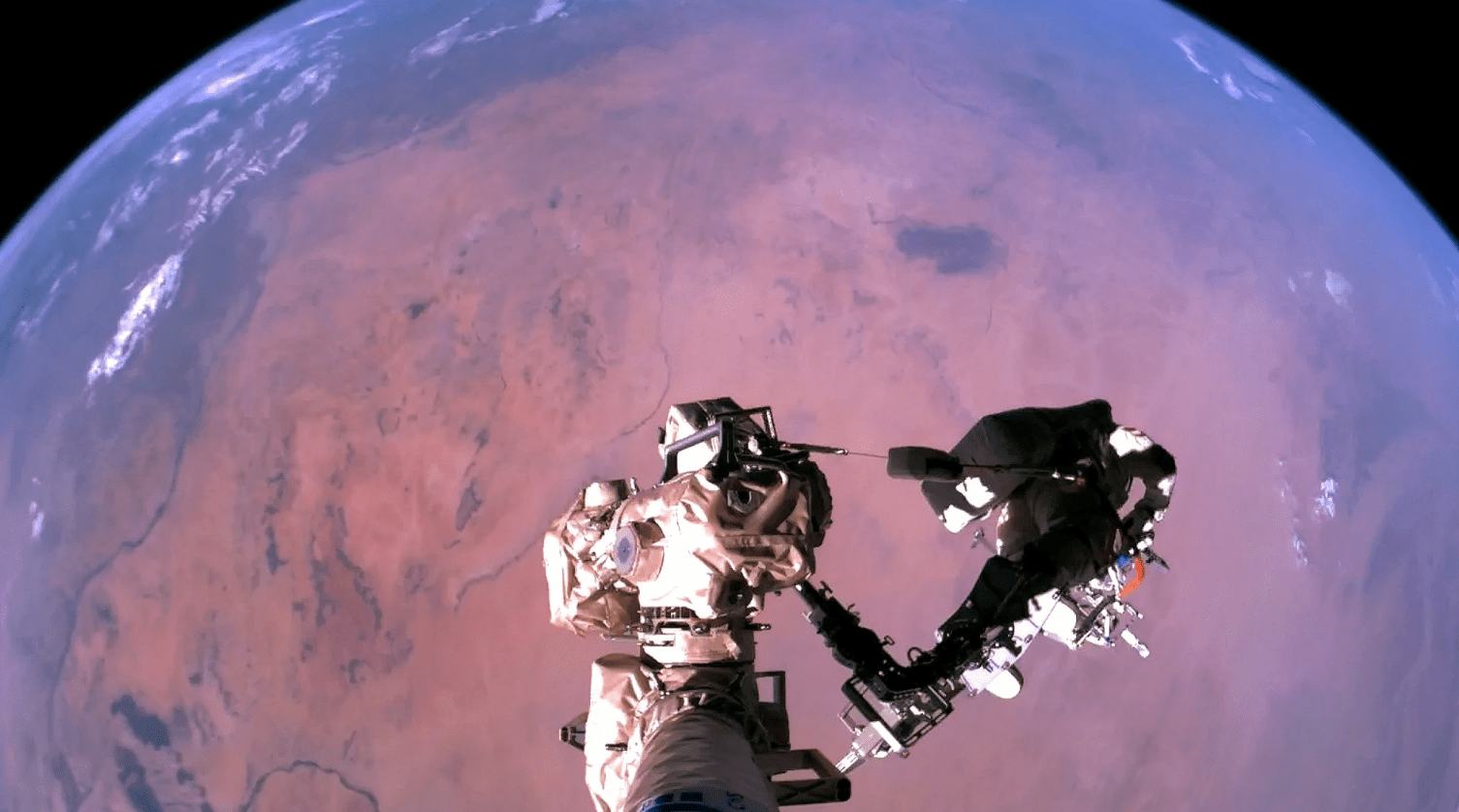
Image (Credit): Extravehicular activity on China’s Tiangong space station this past July. (CMSA)
This week’s image is from the China Manned Space Agency (CMSA). It shows taikonaut Li Cong on a spacewalk outside China’s Tiangong station on July 3, 2024.
The space station was first launched in April 2021 and has been permanently crewed since June 2022. The current crew, called Shenzhou 18, consists of Commander Ye Guangfu, Operator Li Cong, and System Operator Li Guangsu.
Charon, Pluto’s largest moon, has been extensively studied, with research focusing on its primitive composition and changes due to radiation and photolysis. However, spectral data have so far been limited to wavelengths below 2.5 μm, leaving key aspects unresolved. Here we present the detection of carbon dioxide (CO2) and hydrogen peroxide (H2O2) on the surface of Charon’s northern hemisphere, using JWST data. These detections add to the known chemical inventory that includes crystalline water ice, ammonia-bearing species, and tholin-like darkening constituents previously revealed by ground- and space-based observations. The H2O2 presence indicates active radiolytic/photolytic processing of the water ice-rich surface by solar ultraviolet and interplanetary medium Lyman-α photons, solar wind, and galactic cosmic rays. Through spectral modeling of the surface, we show that the CO2 is present in pure crystalline form and, possibly, in intimately mixed states on the surface. Endogenically sourced subsurface CO2 exposed on the surface is likely the primary source of this component, with possible contributions from irradiation of hydrocarbons mixed with water ice, interfacial radiolysis between carbon deposits and water ice, and the implantation of energetic carbon ions from the solar wind and solar energetic particles.
Citation: Protopapa, S., Raut, U., Wong, I. et al. Detection of carbon dioxide and hydrogen peroxide on the stratified surface of Charon with JWST. Nat Commun15, 8247 (2024). https://doi.org/10.1038/s41467-024-51826-4





 Our Awesome Universe