
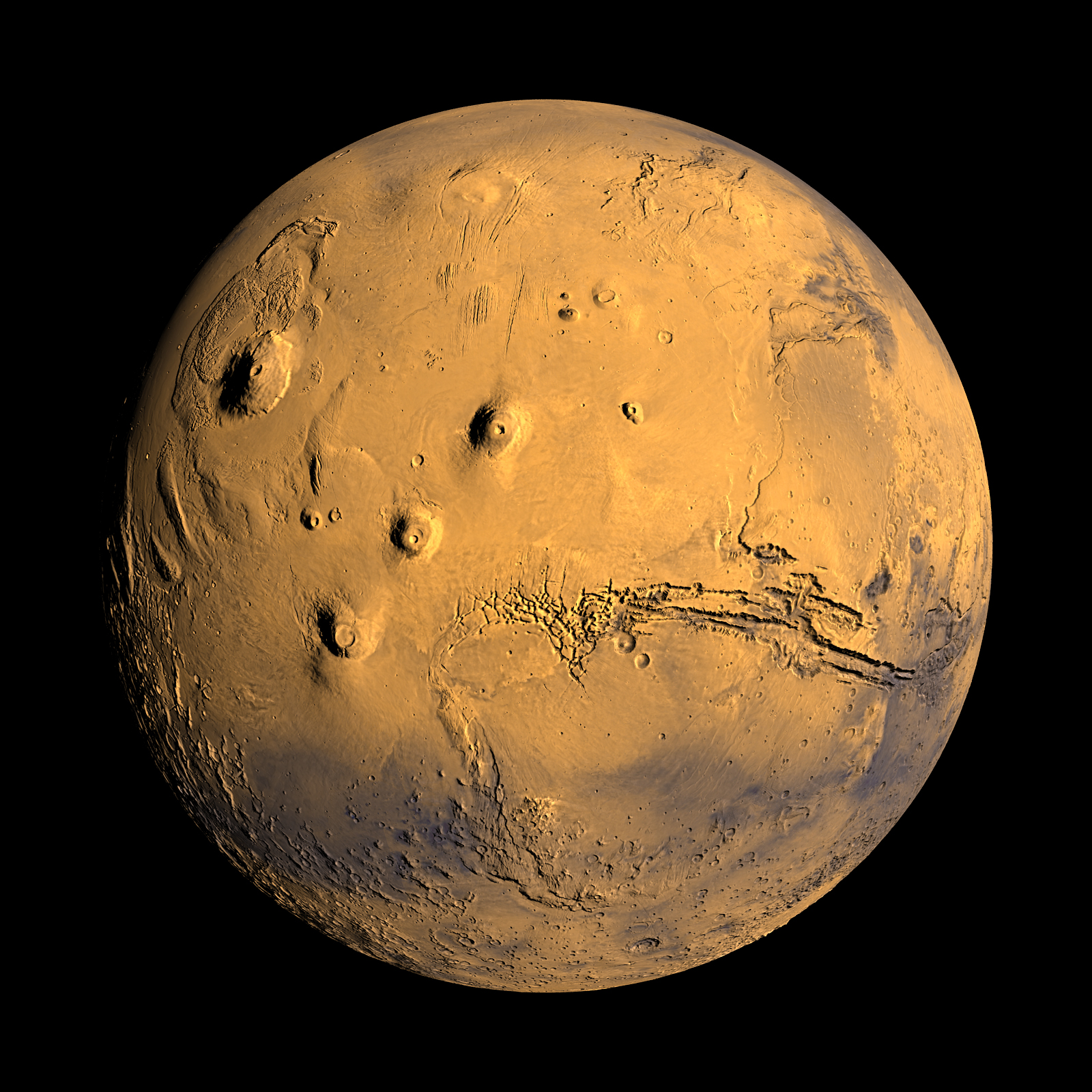
Here are some recent stories on Mars.
—Earth.com: “China’s Mars Zhurong Rover Finds an Ocean Shoreline on the Red Planet“
The Chinese Mars rover Zhurong is adding an exciting twist to the story and history of water on Mars. After landing in southern Utopia Planitia on Mars in May 2021, the now-defunct Zhurong rover went to work exploring the Martian surface, and its latest findings might just change the way we think about the Red Planet. Bo Wu and a team of researchers from Hong Kong Polytechnic University believe they’ve found compelling evidence of an ocean shoreline for a massive body of water that once covered Mars’ northern lowlands.
—New York Times: “An Asteroid’s Destruction May Have Given Mars Rings, Then Moons“
Something’s not quite right about the moons of Mars. They are too small — Phobos is 17 miles across, and Deimos is a mere nine miles in length. And they aren’t round, but lumpy, misshaped objects. Frankly, they don’t resemble moons at all…A study published Wednesday in the journal Icarus makes a case that the moons did indeed start out in asteroid form. But it’s not the genesis everyone was expecting. Using supercomputer-powered simulations, scientists describe a situation in which a large-enough asteroid was captured by Mars long ago and torn to shreds by the planet’s gravity, briefly forming a debris cloud — and possibly a ring system — around Mars that ultimately clumped together to form two moons.
—Astrobiology News: “Meteorite Contains Evidence Of Liquid Water On Mars 742 Million Years Ago“
An asteroid struck Mars 11 million years ago and sent pieces of the red planet hurtling through space. One of these chunks of Mars eventually crashed into the Earth somewhere near Purdue and is one of the few meteorites that can be traced directly to Mars. This meteorite was rediscovered in a drawer at Purdue University in 1931 and therefore named the Lafayette Meteorite. During early investigations of the Lafayette Meteorite, scientists discovered that it had interacted with liquid water while on Mars. Scientists have long wondered when that interaction with liquid water took place. An international collaboration of scientists including two from Purdue University’s College of Science have recently determined the age of the minerals in the Lafayette Meteorite that formed when there was liquid water. The team has published its findings in Geochemical Perspective Letters.
 Our Awesome Universe