Videos: Behind the Scenes Look at the Evil Empire

Image (Credit): Scene from season one of For the Empire. (AFK)

If the political news these days is a bit too much, I recommend you sit back and have some fun with a few Star Wars videos. The For the Empire series provides humorous behind-the-scene antics in the Empire. One of my favorite short films is The Battlefield where a storm trooper encounters a Jedi on the battlefield for the first time. Or try A Certain Point of View for commentary on the Empire’s foreign policy.

It reminds me of the Star Wars skits from Robot Chicken, which are worth a second viewing as well.

While none of this is Andor, it is a welcome respite from today’s news. We all need a laugh or two.

The For The Empire series on YouTube uses Epic Games’ Unreal Engine to produce these high quality videos. It it quite a few steps beyond the claymation of Robot Chicken. If this is the future of animation, then Hollywood had better watch its back.

Pic of the Week: The Red Monsters

Image (Credit): The “Red Monsters” as captured by the JWST. (NASA/CSA/ESA, M. Xiao & P. A. Oesch (University of Geneva), G. Brammer (Niels Bohr Institute), Dawn JWST Archive)

This week’s image from the James Webb Space Telescope (JWST) was highlighted by researchers at the University of Bath. It represents three ultra-massive galaxies about the size of our Milky Way from the first billion years of the universe following the Big Bang.

The researchers discuss this in their paper in Nature, Accelerated Formation of Ultra-massive Galaxies in the First Billion Years. The abstract is a bit too technical, but suffice it to say that this is a significant discovery.

As noted in Tech Exporist, Dr. Mengyuan Xiao, lead author of the new study and postdoctoral researcher in the Department of Astronomy at UNIGE Faculty of Science, stated:

These results indicate that galaxies in the early Universe could form stars with unexpected efficiency. As we study these galaxies in more depth, they will offer new insights into the conditions that shaped the Universe’s earliest epochs. The ‘Red Monsters’ are just the beginning of a new era in our exploration of the early Universe.

Space Quote: NASA Prepares for Outside “Help”

Credit: Image by Patrick Pascal Schauß from Pixabay

Elon’s interest in small government exceeds Elon’s interest in space architecture…The challenges, I think, NASA faces are much more organizational and cultural than they are technical.

Statement by Greg Autry, who is currently associate provost for space commercialization and strategy at the University of Central Florida, but earlier served on the first Trump administration’s NASA transition team. The comment was in reference to the recent announcement that Elon Musk was one of the individuals selected to head the new ‘Department of Government Efficiency’ in the Trump administration. Of course, given that Mr. Musk’s SpaceX provides the space architecture, I doubt personal enrichment will be far from his mind. I hope the first thing the new “department” does is set up an ethics office to ensure its members are not lining their own pockets while “reforming” government.

Another Employee Cut at JPL

Earlier today, NASA’s Jet Propulsion Laboratory (JPL) announced additional employee cuts:

While we have taken various measures to meet our current FY’25 budget allocation, we have reached the difficult decision to reduce the JPL workforce through layoffs. This reduction affects approximately 325 of our colleagues, an impact of about 5% of our workforce. The impacts are occurring across technical, business, and support areas of the Laboratory. These are painful but necessary adjustments that will enable us to adhere to our budget while continuing our important work for NASA and our nation.

You may recall that JPL laid off about 8 percent of its staff back in February due to budget issues associated with the Mars Sample Return, so this is the second hit this year.

Addressing these earlier cuts, Rep. Mike Garcia (R-CA) stated his concerns:

I worry that, when we make certain decisions, that we’re cutting to the bone and, in this case, potentially amputating JPL.

It appears the bone cutting continues, though JPL management stated, “…we will be well positioned for the work ahead.”

Let’s hope so.

Space Stories: Potential Life on Uranus, a Sick ISS Astronaut, and a Feasting Black Hole

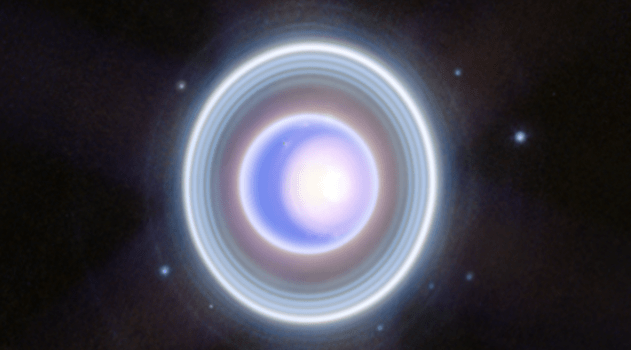
Image (Credit): Uranus captured the James Webb Telescope’s Near-Infrared Camera (NIRCam). This Webb image also shows 9 of the planet’s 27 moons. (NASA, ESA, CSA, STScI)

BBC: New Study on Moons of Uranus Raises Chance of Life

The Voyager 2 observations had suggested that its two largest moons — Titania and Oberon — often orbit outside the magnetosphere. However, the new study indicates they tend to stay inside the protective bubble, making it easier for scientists to magnetically detect potential subsurface oceans. “Both are thought to be prime candidates for hosting liquid water oceans in the Uranian system due to their large size relative to the other major moons,” Jet Propulsion Laboratory planetary scientist and study co-author Corey Cochrane said.

ScotsmanNasa Astronauts Tight-lipped on Who was Ill After Long Space Station Mission

Three Nasa astronauts whose prolonged space station mission ended with a trip to hospital last month have declined to say which one of them was sick. Astronauts Matthew Dominick, Michael Barratt and Jeanette Epps publicly discussed their spaceflight for the first time since returning from the International Space Station on October 25.

NOIRLabNSF NOIRLab Astronomers Discover the Fastest-Feeding Black Hole in the Early Universe

Supermassive black holes exist at the center of most galaxies, and modern telescopes continue to observe them at surprisingly early times in the Universe’s evolution. It’s difficult to understand how these black holes were able to grow so big so rapidly. But with the discovery of a low-mass supermassive black hole feasting on material at an extreme rate, seen just 1.5 billion years after the Big Bang, astronomers now have valuable new insights into the mechanisms of rapidly growing black holes in the early Universe.