
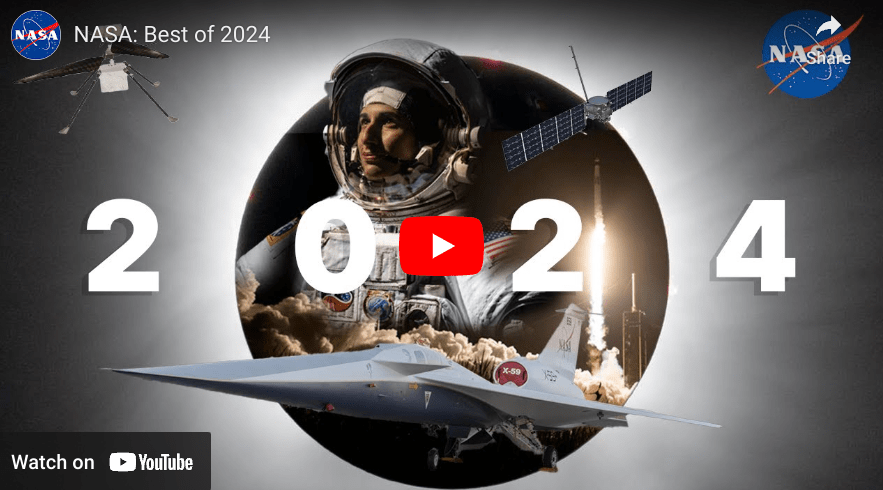
NASA has plenty of good news to share from 2024, as highlighted in its NASA: Best of 2024 video and accompanying press release.
Just a few of these accomplishments include:
- In February, the first Moon landing through the agency’s Commercial Lunar Payload Services initiative brought NASA science to the lunar surface on Intuitive Machines’ Nova-C lander successfully capturing data that will help us better understand the Moon’s environment and improve landing precision and safety.
- After launching into space in February, NASA’s Plankton, Aerosol, Cloud, ocean Ecosystem (PACE) satellite mission is successfully transmitting first-of-their-kind measurements of ocean health, air quality, and the effects of a changing climate.
- In June, NASA astronauts Butch Wilmore and Suni Williams safely arrived at the space station aboard Boeing’s Starliner spacecraft following launch of their flight test. With Starliner’s arrival, it was the first time in station history three different spacecraft that carried crew to station were docked at the same time. Starliner returned uncrewed in September following a decision by NASA. Wilmore and Williams, now serving as part of the agency’s Crew-9 mission, will return to Earth in February 2025.
- Deployed NASA’s Advanced Composite Solar Sail System in space, marking a successful test of its composite boom technology.
- Awarded nearly $45 million to 21 higher-education institutions to help build capacity for research, and announced the recipients of grants that will support scientific and technical research projects for more than 20 universities and organizations across the United States.
The long list from which this was taken is impressive. However, we also need to note a few of the problems this year. This includes troubled commercial missions to the Moon, a Boeing crew stranded on the International Space Station after a problematic Starliner test, delays in the SpaceX Starship rocket tests, a cancelled Moon rover, budget cuts at NASA as well as layoffs at JPL, cost overruns on the Mars Sample Return mission, and a delay in the Artemis II and III launch dates.
This does not override the accomplishments, but it puts them into context at a time of changing administrations in Washington. This will come with hard questions about the viability of current missions as well as the cost of future missions.
I agree 2024 has plenty of proud moments. That said, 2025 will be a very challenging year for NASA. The agency will need solid answers to hard questions, cost effective options for struggling missions, and plenty of public support to weather calls for additional budget cuts.
I have confidence NASA will come out of this even stronger, even if it is a bit bruised in the process.
 Our Awesome Universe