
Here are some recent stories of interest.
—Sky & Telescope: “Parker Solar Probe Swings By Sun in Closest Approach Yet“
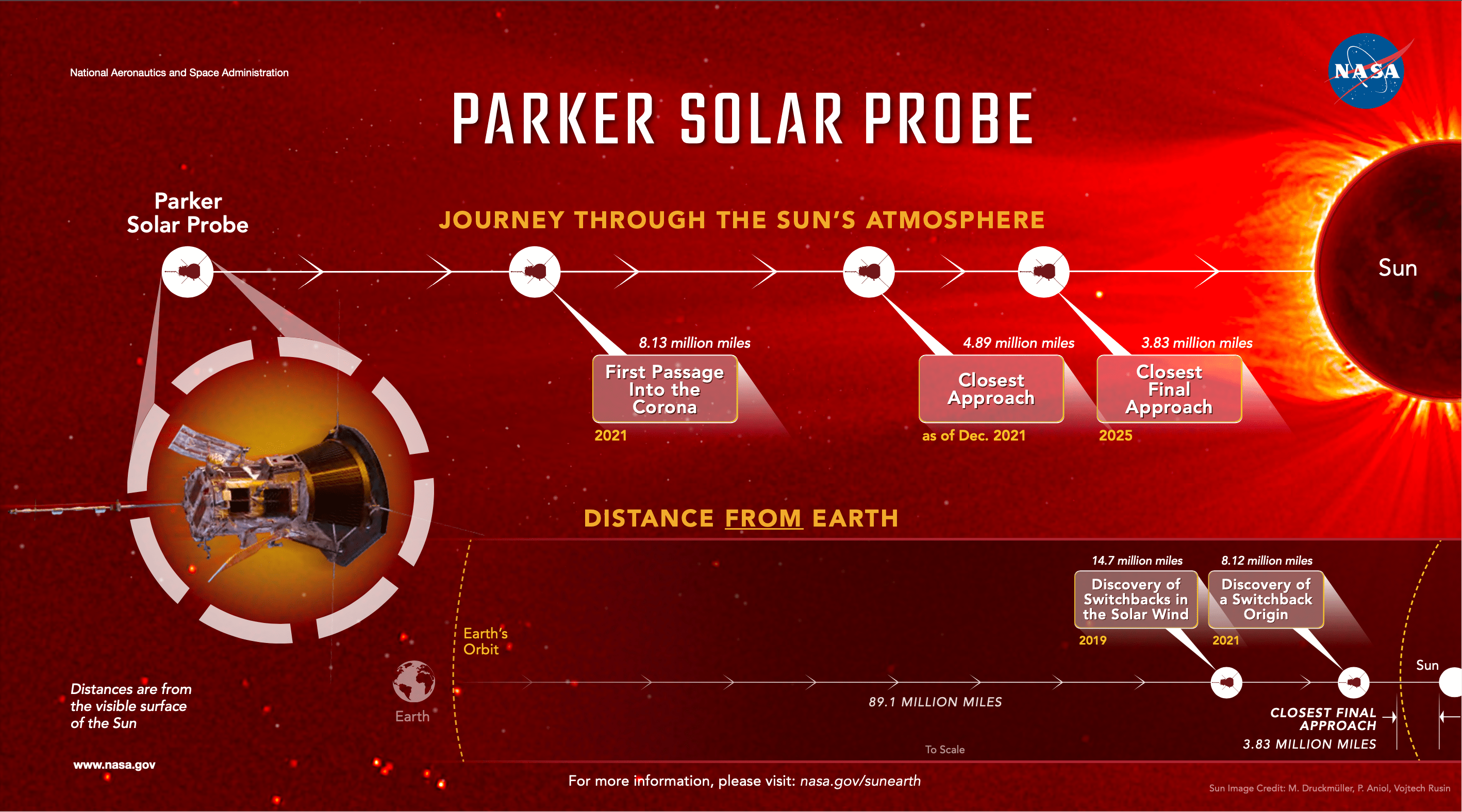
NASA’s Parker Solar Probe is about to go where no spacecraft has gone before. A final flyby of Venus last month has sped up Parker for the mission’s next solar perihelion, set to occur on December 24 at 6:40 EST / 11:40 UT. At just 6.2 million km (3.9 million miles) from the solar surface — about nine times the Sun’s radius — this perihelion will be the closest for the mission. Parker is breaking its own record to once again become the closest human-made object to ever approach the Sun…the mission is totally autonomous in taking measurements; it should start transmitting data back to Earth within a week after this pass, though it has the capability to carry out operations on its own for up to two months if needed.
—BRG: “Astronomers Say They Found a Tunnel Connecting Our Solar System to Other Stars“
Astronomers have made a startling discovery. Using data from the eRosita X-ray instrument, researchers say they’ve discovered a “cosmic tunnel” that connects our solar system to other stars. Scientists have long known that our solar system exists in a Local Hot Bubble. This bubble is believed to have formed following several supernovas over the past several million years and is estimated to be around 300 light-years across. Using data from the eRosita, researchers from the Max Planck Institute say they found evidence of a cosmic tunnel stretching from our solar system out toward the Centaurus constellation. The tunnel appears to move through the material that makes up the Local Hot Bubble
—Northwestern Now: “Young Exoplanet’s Atmosphere Unexpectedly Differs from its Birthplace“
Just as some children physically resemble their parents, many scientists have long thought that developing planets should resemble the swirling disk of gas and dust that births them. But, in a new study, a Northwestern University-led team of astrophysicists discovered the resemblance might be looser than previously thought. By studying a still-forming exoplanet and its surrounding natal disk using new instrumentation at W.M. Keck Observatory, the researchers uncovered a mismatched composition of gases in the planet’s atmosphere compared to gases within the disk. The surprising finding potentially confirms long-held skepticism that scientists’ current model of planet formation is too simplified.
 Our Awesome Universe