Image (Credit): JPL’s most likely scenario for the unsuccessful landing of NASAs Ingenuity Mars Helicopter on Jan. 18, 2024. (NASA/JPL-Caltech)
“When running an accident investigation from 100 million miles away, you don’t have any black boxes or eyewitnesses…While multiple scenarios are viable with the available data, we have one we believe is most likely: Lack of surface texture gave the navigation system too little information to work with.”
-Statement by Ingenuity’s first pilot, Håvard Grip of JPL, in a Jet Propulsion Laboratory (JPL) publication explaining the final flight of the Ingenuity Mars Helicopter on Jan. 18, 2024. The helicopter flew 72 times over the Martian surface, far surpassing NASA’s expectations.
Image (Credit): The Roman god Mars. (worldhistory.org)
While Elon Musk has talked endlessly about going to Mars with his Starship, it seems the U.S. Department of Defense (DOD) in the service of Mars, God of War, has other ideas for his rocket.
A recent Washington Post article, “Elon Musk’s Martian Dreams are a Boon to the U.S. military,” stated that DOD is looking to use the Starship for Earthbound battles, such as the quick deployment of soldiers and materiel into the Chinese theater. Sending rockets directly into the war zone with troops and supplies can turn a multi-week trip into a 90 minute trip. Another option is to keep key military supplies in Low-Earth Orbit so that they can be timely delivered when needed (in the way the DOD already pre-positions military equipment at sea and elsewhere).
The article states that the U.S. Air Force already has a five-year contract with SpaceX to make this rocket-based delivery possible. Space News reported on the $102 million contract award to SpaceX back in January 2022, which was to help “determine exactly what a rocket can achieve when used for cargo transport, what is the true capacity, speed, and cost of the integrated system.” A similar contract was awarded to Blue Origin in December 2021.
The space domain remains completely underdeveloped regarding providing terrestrial materiel support and offers an ideal platform to sustain smaller units of action within the joint force, which would otherwise divert aircraft or naval vessels that could be used to support larger formations…Space-based logistics can facilitate the delivery of blood, weapons, 3D-printed parts, power, and food to the joint force and has the potential for delivery time to be measured in minutes, not hours or days. The impetus for this idea can be traced to the Cold War.
The Army story makes reference to a separate 2022 The Journal of theJoint Forces Staff College article, “The World in 90 Minutes or Less: Rocket Logistics and Future Military Operations,” that discusses the pros and cons of this rocket-based approach. The article also cites numerous companies in addition to SpaceX that should be considered for this new approach, including United Launch Alliance (ULA), Rocket Lab, Northrop Grumman, and Blue Origin.
In terms of advantages, the journal article notes:
The most significant difference between Rocket Logistics and conventional methods is the speed of delivery; rockets are expected to transport tons of material across the planet in under ninety minutes by using an orbital trajectory to reduce transit time. This presents a variety of logistical options to deliver valuable cargo within tactically relevant timelines, as opposed to hours or days (e.g. fourteen hours of flight time for a plane traveling from New York City to Nairobi, Kenya). The second advantage of Rocket Logistics is that movement above 100 kilometers in altitude is not governed by national airspace regulations. This means that the rocket would only need permission to access the nation’s airspace from which it departed and the nation in which it will land.
Of course, there are some limitations, including limited launch facilities, specific fuel needs, long turnaround time, and G-forces that may limit the types of cargo carried. For instance, the journal article notes:
While cargo aircraft are relatively sedentary in their acceleration profiles, a rocket can produce more G-forces than fighter aircraft. NASA and civilian space companies recognize this and limit flight parameters for the protection of cargo. Despite acceleration limitations, G-forces must be considered when planning the operational usage of rocket cargo.
There is a lot of money to be made in wars, and potentially more ongoing demand than a risky mission to Mars. Is this the future of SpaceX? Will it become further wrapped into the military-industrial complex (with its Starlink and other assets) at the expense of missions off planet?
The planned review of NASA and other federal agencies by the Trump administration may have an answer. But one thing you can be sure of, particularly with Musk in the middle of the review, is that SpaceX will be making plenty of money whether its goal is landing on the Red Planet or defeating Red China.
Image (Credit): Wolf-Rayet 124 (WR 124), a hot star just about to go supernova, as captured by the James Webb Space Telescope. (NASA, ESA, CSA, STScI, Webb ERO Production Team)
Fast forward to now, and Zwicky’s namesake, the Zwicky Transient Facility (ZTF)—a National Science Foundation-funded sky survey that began operations in 2017 using the 48-inch telescope—has detected about a hundred thousand supernovae. These detections, in turn, have led to the spectroscopic classification and confirmation of more than 10,000 supernovae, making ZTF the largest supernova survey to date. “There are trillions of stars in the universe, and about every second, one of them explodes. Reaching 10,000 classifications is amazing, but what we truly should celebrate is the incredible progress we have made in our ability to browse the universe for transients, or objects that change in the sky, and the science our rich data will enable,” says Christoffer Fremling, a staff astronomer at Caltech. Fremling leads the Bright Transient Survey (BTS), ZTF project that discovers and classifies new supernovae.
Dry river channels and lake beds on Mars point to the long-ago presence of a liquid on the planet’s surface, and the minerals observed from orbit and from landers seem to many to prove that the liquid was ordinary water. Not so fast, the authors of a new Perspectives article in Nature Geoscience suggest. Water is only one of two possible liquids under what are thought to be the conditions present on ancient Mars. The other is liquid carbon dioxide (CO2), and it may actually have been easier for CO2 in the atmosphere to condense into a liquid under those conditions than for water ice to melt.
In the next decade, researchers will start probing the atmosphere of planets as small as Earth and Venus orbiting nearby stars. But although these two solar system planets are similar in size and bulk density—so that some call them “twins”—their atmospheres are nothing alike. Would scientists be able to set them apart if seen from light-years away?A team led by the Institute of Astrophysics and Space Sciences (IA) pretended Venus was faraway in another planetary system—an exoplanet—and asked what kind of information they could extract. The results were published in an article in the journal Atmosphere and prove that techniques being used to study large hot exoplanets can be effectively applied to those with a diameter 10 times smaller.
Image (Credit): NASA Administrator Bill Nelson discussing the Artemis program at a press conference last week. (NASA)
“Are they going to axe Artemis and insert the Starship? First of all, there is one human-rated spacecraft that is flying and has already flown beyond the moon, farther than any other human-rated spacecraft, and that’s the SLS combined with Orion.”
-Statement by NASA Administrator Bill Nelson at the agency’s press conference last week at the NASA Artemis Campaign Leadership News Conference. He was making reference to the SpaceX Starship replacing the Space Launch System (SLS) in the Artemis program. It was a solid answer to a question that many may have these days.
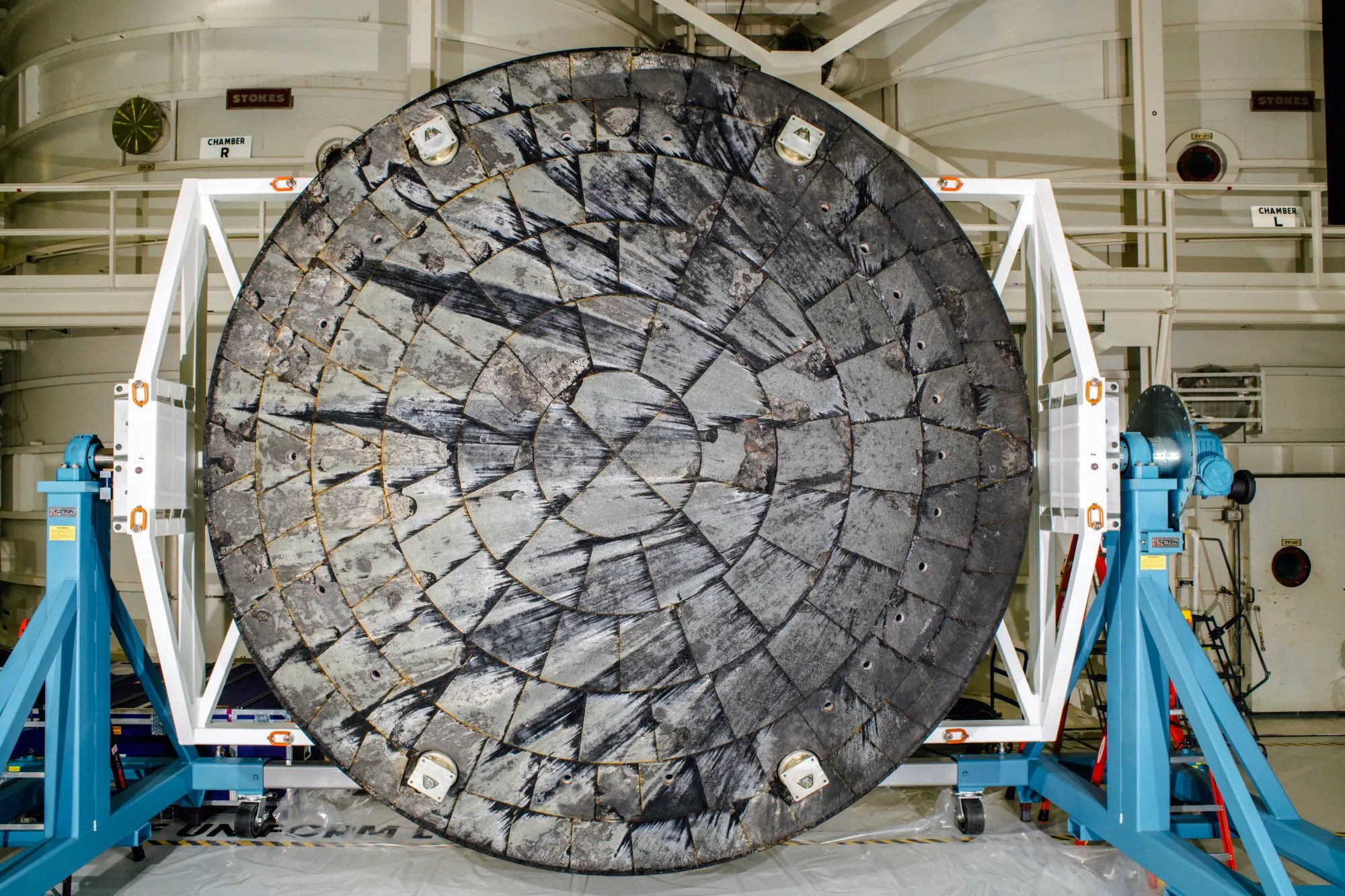
Image (Credit): The recovered Orion heat shield at NASA’s Kennedy Space Center in Florida. (NASA)
Orion heat shield issues have contributed to more delays with the Artemis II (crewed capsule around the Moon) and Artemis III (crewed capsule lands on the Moon) missions. The Artemis II launch has moved from September 2025 to April 2026, while the Artemis III launch has moved from 2026 to mid-2027.
NASA still has plenty of time to beat the China back to the Moon given that China is still aiming for a 2030 human landing on the lunar surface. Even so, this is not a good time to be highlighting the engineering weaknesses in the Artemis program. We know that the incoming administration is likely to ask a lot of questions.
You can watch the entire NASA news conference discussing the delays here.


 Our Awesome Universe