Podcast: The Future of NASA and the Space Industry

Credit: Planetary Radio

For a good summary of the current situation at NASA and the potential potholes ahead, I recommend you listen into The Planetary Society’s Planetary Radio podcast titled “Space Policy Edition: The Challenges of Change at NASA.”

You can hear host Casey Dreier, who is Chief of Space Policy for The Planetary Society, talk with Marcia Smith, the Founder and Editor for Space Policy Online. It is a candid conversation that spares no punches at NASA management for its secrecy related to delays with the Artemis program.

A few issues that stayed with me include:

  • Why all the criticism of the Space Launch System (SLS), as well as the accolades for the still unproven Starship, when the Starship was barely an idea at the time the SLS was being designed and built?
  • Elon Musk represents a “single point of failure” in the US space program.
  • The incentives of the space billionaires, which is generally curiosity and self-aggrandizing similar to climbing Mount Everest, cannot replace the dedication to national (and even international, in the case of Artemis) interests represented by the US astronauts.

I am sure you will have your own takeaways. It is a good way to spend an hour of your time.
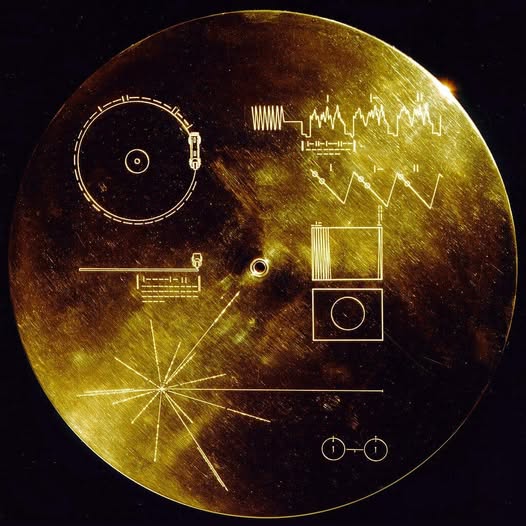
Space Quote: Message in a Bottle to the Universe

Image (Credit): Golden Record placed on Voyager I and II. (NASA)

“This Voyager spacecraft was constructed by the United States of America. We are a community of 240 million human beings among the more than 4 billion who inhabit the planet Earth. We human beings are still divided into nation states, but these states are rapidly becoming a single global civilization.

We cast this message into the cosmos. It is likely to survive a billion years into our future, when our civilization is profoundly altered and the surface of the Earth may be vastly changed. Of the 200 billion stars in the Milky Way galaxy, some–perhaps many–may have inhabited planets and spacefaring civilizations. If one such civilization intercepts Voyager and can understand these recorded contents, here is our message:

This is a present from a small distant world, a token of our sounds, our science, our images, our music, our thoughts, and our feelings. We are attempting to survive our time so we may live into yours. We hope someday, having solved the problems we face, to join a community of galactic civilizations. This record represents our hope and our determination, and our good will in a vast and awesome universe.”

Statement by then President Jimmy Carter in July 29, 1977 that was placed in both Voyager I and II, both of which are now barreling beyond our solar system. Voyager II was launched on August 20, 1977 followed by Voyager I on September 5, 1977.

Is Blue Origin Ready to Challenge SpaceX?

Image (Credit): Blue Origin’s New Glenn rocket. (Blue Origin)

Sometime next week, Blue Origin is expected to launch its New Glenn rocket, which could put it back in the running as a true challenger to SpaceX for space launches. I know, we already heard this story about Boeing’s Starliner challenging Space’s Dragon capsule, but this may be different.

Per the last posting on Blue Origin’s website on December 27, the rocket is ready to go:

New Glenn successfully completed an integrated launch vehicle hotfire test today, the final major milestone on our road to first flight. NG-1 will carry a Blue Ring Pathfinder as its first manifested payload and will launch from Launch Complex 36 in Cape Canaveral, FL.

The boosters on the 30-story New Glenn rocket are designed to land safely after the launch for future use. Sound familiar? In face, Blue Origin was the first company to successfully test a reusable rocket, so this is nothing new. The New Glenn also has a greater capacity than SpaceX’s Falcon 9.

Blue Origin has high hopes for it new rocket, including military satellite contracts, a new space station (Orbital Reef), and the launch of Amazon’s broadband satellite system (Project Kuiper).

NASA and the US space industry also have high hopes that the Blue Origin can increase the competition for launches and add some redundancy (you know, in case Mr. Musk really goes off the rails).

If commercial space is the future, then we need more capable players to keep it alive and vibrant. With that in mind, we can only hope for a very successful launch and increased competition down the road.

Looking Back at What Did Not Work in 2024

Image (Credit): NASA’s new Advanced Composite Solar Sail System. (NASA)

It is worthwhile reflecting on all of the space successes in 2024, though if we believe we learn from our mistakes then it would seem the mission shortcomings are worth highlighting as well.

Fortunately, Live Science has prepared a list for our review. Its article “10 Times Space Missions Went Very Wrong in 2024” includes well known stories, such as the stranded Starliner and SpaceX rocket woes, as well as less covered items, such as:

  • Tumbling Solar Sail – the failure of NASA’s new Advanced Composite Solar Sail System (ACS3);
  • Shattering Spacecraft – multiple cases of new space debris and close calls that could have impacted other space missions; and
  • Multiple Voyager Issues – the continued decline of the two Voyager probes as they reach further into space.

Check out the story for a full list of issues.

Note: This website has also covered a number of flubs, including:

Pic of the Week: Spiral Galaxy NGC 2566

Image (Credit): Spiral galaxy NGC. (ESA/NASA)

This week’s image is from the Hubble Space Telescope. It shows the bright and colorful spiral galaxy NGC 2566, which is about 76 million light-years away.

Here is a little more about the image from NASA:

A prominent bar of stars stretches across the center of this galaxy, and spiral arms emerge from each end of the bar. Because NGC 2566 appears tilted from our perspective, its disk takes on an almond shape, giving the galaxy the appearance of a cosmic eye.

As NGC 2566 appears to gaze at us, astronomers gaze right back, using Hubble to survey the galaxy’s star clusters and star-forming regions. The Hubble data are especially valuable for studying stars that are just a few million years old; these stars are bright at the ultraviolet and visible wavelengths to which Hubble is sensitive. Using these data, researchers can measure the ages of NGC 2566’s stars, which helps piece together the timeline of the galaxy’s star formation and the exchange of gas between star-forming clouds and the stars themselves.