
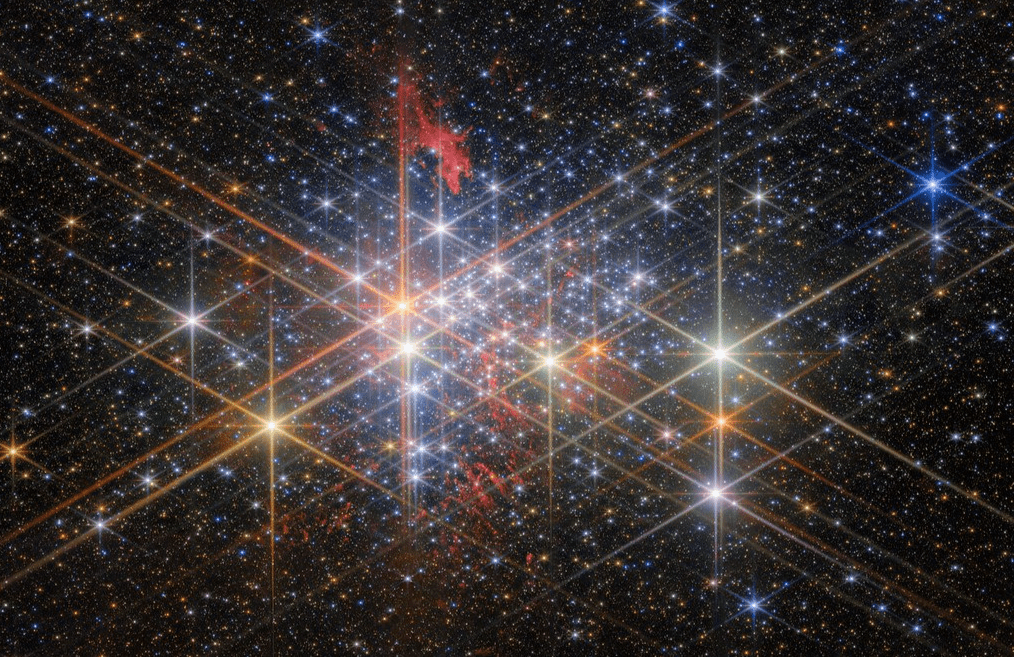
This week’s image from the James Webb Space Telescope was released late last year. It shows Westerlund 1, a colorful “super star” cluster.
Here is the description of what you are seeing from NASA:
Super star clusters are young and contain more than 10,000 times the mass of the Sun packed into a small volume. Westerlund 1 is the most massive yet identified in our galaxy, with 50,000 to 100,000 times the mass of the Sun contained within a region less than six light-years across. Still considered an open cluster now, someday it will evolve into a globular cluster – a roughly spherical, tightly packed collection of old stars bound together by gravity.
Super star clusters are one of the most extreme environments in which stars and planets can form. Because our galaxy is past its peak of star formation, and because stars live relatively short lives, only a few of these clusters still exist to give us clues to that past era.
Westerlund 1 has a large, dense, and diverse population of evolved, massive stars. It contains so many massive stars that in a timespan of less than 40 million years, it’ll be the site of more than 1500 supernovas. This cluster is a natural laboratory for the study of extreme stellar physics, helping us learn how the most massive stars in our galaxy live and die, and how stellar winds, supernovae, and other ejected material affect star formation within their environment.
 Our Awesome Universe