Podcast: The Future of Human Mars Exploration

The Mars Society’s Red Planet Live Podcast will be joined by Dr. Robert Zubrin on March 4th for a discussion about the future of human Mars exploration, what it will take to get boots on the Red Planet, and how we can build our first off-world settlement.

Dr. Zubrin is the Founder and President of The Mars Society, as well as the author of numerous books on Mars and other space-related topics. One of his latest books is The New World on Mars: What We Can Create on the Red Planet, which was issued in February 2024. As short summary of the book from the publisher’s site is provided below. It should be a useful primer for the upcoming discussion.

SpaceX, Blue Origin, and Virgin Galactic are building fleets of space vehicles to make interplanetary travel as affordable as Old-World passage to America. We will settle on Mars, and with our knowledge of the planet, analyzed in depth by Dr. Zubrin, we will utilize the resources and tackle the challenges that await us. What we will we build? Populous Martian city-states producing air, water, food, power, and more. Zubrin’s Martian economy will pay for necessary imports and generate income from varied enterprises, such as real estate sales—homes that are airtight and protect against cosmic space radiation, with fish-farm aquariums positioned overhead, letting in sunlight and blocking cosmic rays while providing fascinating views. Zubrin even predicts the Red Planet customs, social relations, and government—of the people, by the people, for the people, with inalienable individual rights—that will overcome traditional forms of oppression to draw Earth immigrants. After all, Mars needs talent.

You can find the list of past Red Planet podcast episodes on YouTube.

Credit: Diversion Books.

Space Quote: More on the ISS “Stranded” Story

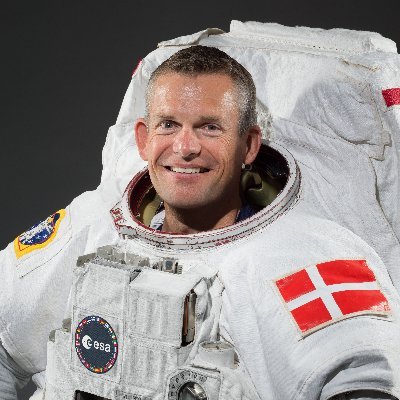
Image (Credit): European Space Agency astronaut Andreas Mogensen (Twitter/X)

“You know as well as I do, that Butch and Suni are returning with Crew-9, as has been the plan since last September. Even now, you are not sending up a rescue ship to bring them home. They are returning on the Dragon capsule that has been on ISS since last September.”

Comments by Andreas Mogensen, a Danish astronaut who commanded the ISS between September 2023 to early 2024, in response to Elon Musk’s constant tweets about his efforts to “rescue” the two Starliner astronauts on the International Space Station (ISS). NASA already resolved the issue, yet Mr. Musk seems to need the attention given that otherwise the media keeps ignoring his actions (such as harassing federal employees, including those at NASA).

China is Building Its Own James Webb Space Telescope

Image (Credit): Artist’s rendering of the China Space Station Telescope called Xuntian. (Changchun Institute of Optics, Fine Mechanics and Physics)

Just as we have competition with China for the next human to visit the Moon, we now have competition for the James Webb Space Telescope (JWST).

China has stated it plans to launch the China Space Station Telescope (CSST) in 2026, which should be as powerful as the JWST while having the extra benefit of remaining in Earth orbit. As a result, when compared to the JWST, the CSST will be easier to maintain as well as upgrade.

A Chinese paper on the new telescope noted the following regarding its potential:

It can simultaneously perform multi-band imaging and slitless spectroscopic wide- and deep-field surveys in ten years and an ultra-deep field (UDF) survey in two years, which are suitable for cosmological studies. Here we review several CSST cosmological probes, such as weak gravitational lensing, two-dimensional (2D) and three-dimensional (3D) galaxy clustering, galaxy cluster abundance, cosmic void, Type Ia supernovae (SNe Ia), and baryonic acoustic oscillations (BAO), and explore their capabilities and prospects in discovering new physics and opportunities in cosmology. We find that CSST will measure the matter distribution from small to large scales and the expansion history of the Universe with extremely high accuracy, which can provide percent-level stringent constraints on the property of dark energy and dark matter and precisely test the theories of gravity.

Of course, there is nothing wrong with a little competition. Let’s just hope NASA can get back on track after its latest budget problems as well as its current unstructured reorganization under the new White House. While the agency has other powerful telescopes under development, it doesn’t take much to throw things out of balance.

Congressional Letter: Concerns About DOGE at NASA

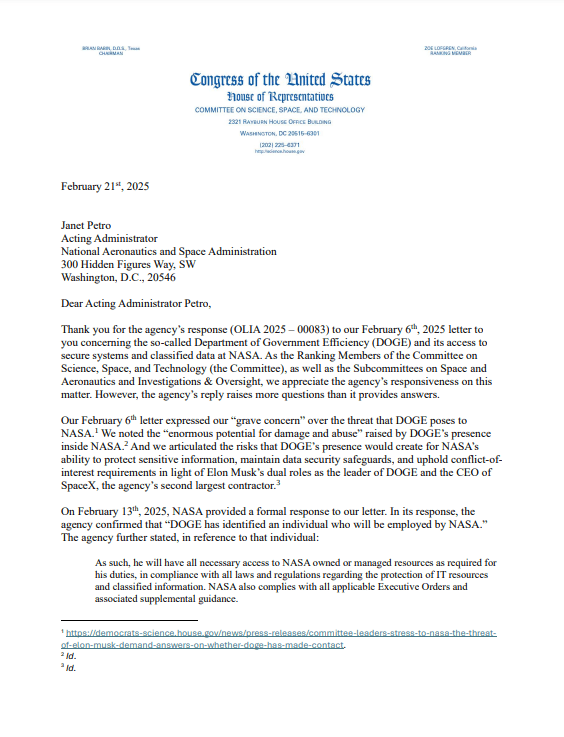
Three Democratic Ranking Members of Congress wrote a letter to NASA’s acting Commissioner earlier today about the role of the “so called” Department of Government Efficiency (DOGE) at NASA. This letter followed a February 6th letter on the same issue, which received a less than open NASA response.

The letter expressed strong concerns about the activities of DOGE, including Elon Musk’s conflict of interest with the agency, and asked several questions it needed answered to feel more confident. This quote provides the general tenor of the letter:

While we appreciate the agency’s confirmation that a DOGE-affiliated individual (“DOGE Agent”) will be embedded inside NASA, that fact only sharpens our fears regarding DOGE’s potential to inflict harm – intentionally or unintentionally – on the agency and its mission. We must reiterate our deep alarm at this situation. Given DOGE’s destructive seizure of power throughout the federal government and the unique conflicts-of-interest that Elon Musk possesses with NASA, DOGE’s presence at the agency creates an unprecedented threat from within NASA’s own house. We are thus compelled to demand further explanation on a number of points related to DOGE’s relationship and activities with NASA. Complete transparency on the part of the agency is required. NASA must fully disclose the nature of its interactions with DOGE so the Committee can assess the full extent of the danger.

This does not sound like a normal conversation about a standard audit, which is already regularly done by the agency’s Inspector General. No, phrases such as “inflict harm,” “unprecedented threat,” and “full extent of the danger” shows we are dealing with a completely different situation.

Secret audits administered by a billionaire and his band of teenagers should not give anyone any sense of comfort or any confidence that the work will be above board. We appear to be going the route of Russia, but given the condition of its space program we may want to reconsider.

Let’s hope Congress keeps on pushing, even if half of the Congress remains asleep while the DOGE destruction continues.

Pic of the Week: Super Star Cluster Westerlund 1

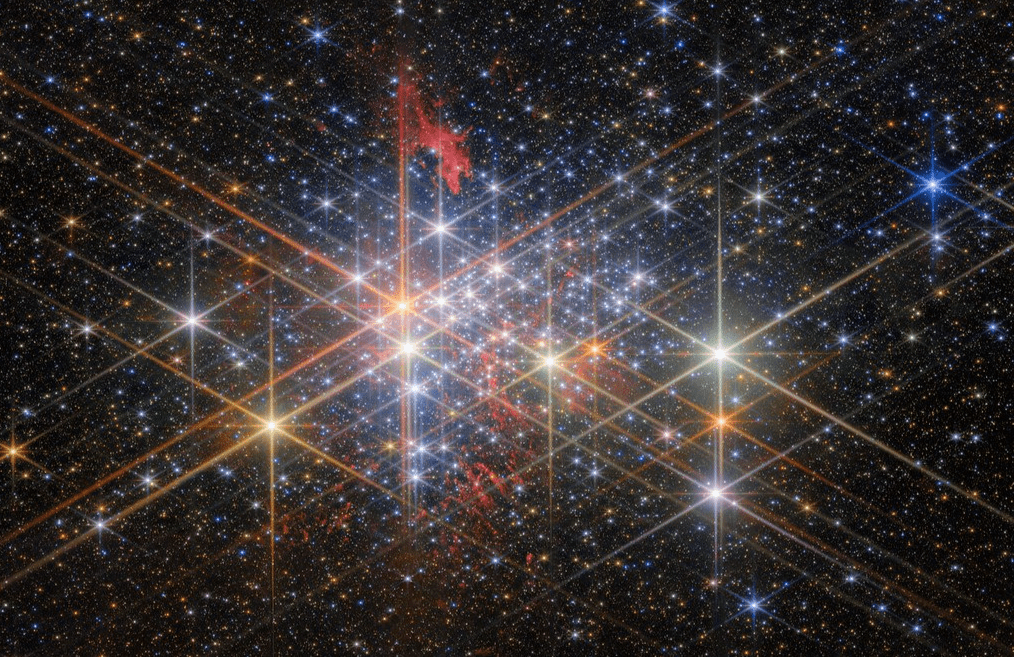
Image (Credit): Super star cluster Westerlund 1. (ESA/Webb, NASA & CSA, M. Zamani (ESA/Webb), M. G. Guarcello (INAF-OAPA) and the EWOCS team)

This week’s image from the James Webb Space Telescope was released late last year. It shows Westerlund 1, a colorful “super star” cluster.  

Here is the description of what you are seeing from NASA:

Super star clusters are young and contain more than 10,000 times the mass of the Sun packed into a small volume. Westerlund 1 is the most massive yet identified in our galaxy, with 50,000 to 100,000 times the mass of the Sun contained within a region less than six light-years across. Still considered an open cluster now, someday it will evolve into a globular cluster – a roughly spherical, tightly packed collection of old stars bound together by gravity.

Super star clusters are one of the most extreme environments in which stars and planets can form. Because our galaxy is past its peak of star formation, and because stars live relatively short lives, only a few of these clusters still exist to give us clues to that past era.

Westerlund 1 has a large, dense, and diverse population of evolved, massive stars. It contains so many massive stars that in a timespan of less than 40 million years, it’ll be the site of more than 1500 supernovas. This cluster is a natural laboratory for the study of extreme stellar physics, helping us learn how the most massive stars in our galaxy live and die, and how stellar winds, supernovae, and other ejected material affect star formation within their environment.