Upcoming Event: Stories from the Archaeology of a Space Station

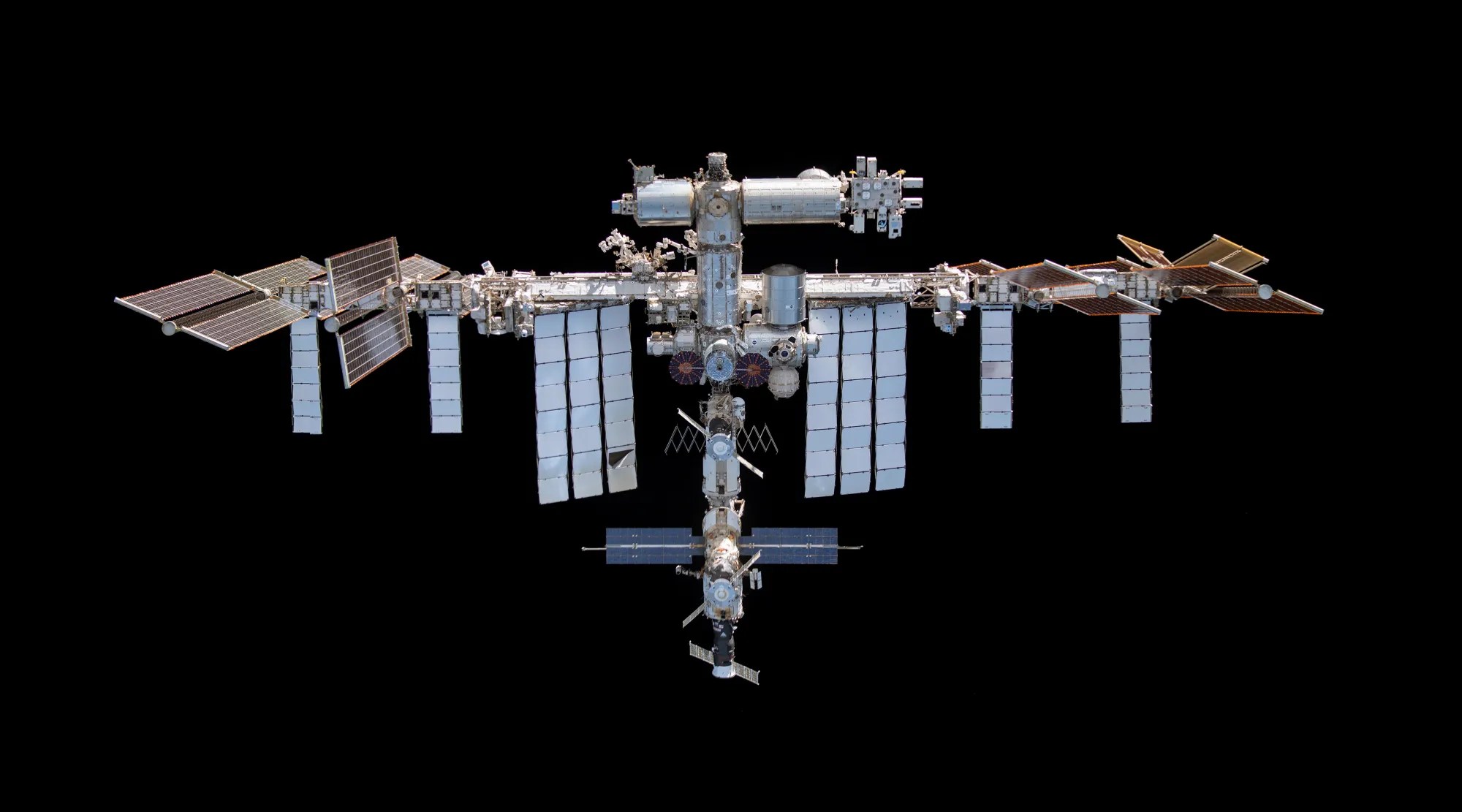
Image (Credit): The International Space Station. (NASA)

On February 27th, the Archaeological Institute of America’s (AIA) Washington DC Society will be sponsoring an archaeological talk titled “The Past of the Future / The Future of the Past: Stories from the Archaeology of a Space Station.”

Professor Justin Walsh from Chapman University and the University of South Carolina has co-directed the first full-scale archaeological investigation of a site in space, in this case the International Space Station (ISS). He will share aspects of this work as well as discuss how social science disciplines like archaeology can be useless tool for improving life on Earth and in space.

It is nice to see scientific discussions about NASA programs are still underway in this uncertain environment. We are lucky to have so many private groups like AIA to encourage and host such events.

The event starts at 7pm at the University of Maryland. It is free and open to the public. You can learn more about the event at this link.

You can also read more about the ISS archaeology program at this link.
Posted in ISS

Space Stories: Solar Orbiter Encounters Venus, White Dwarf Exoplanets, and the End of Gaia

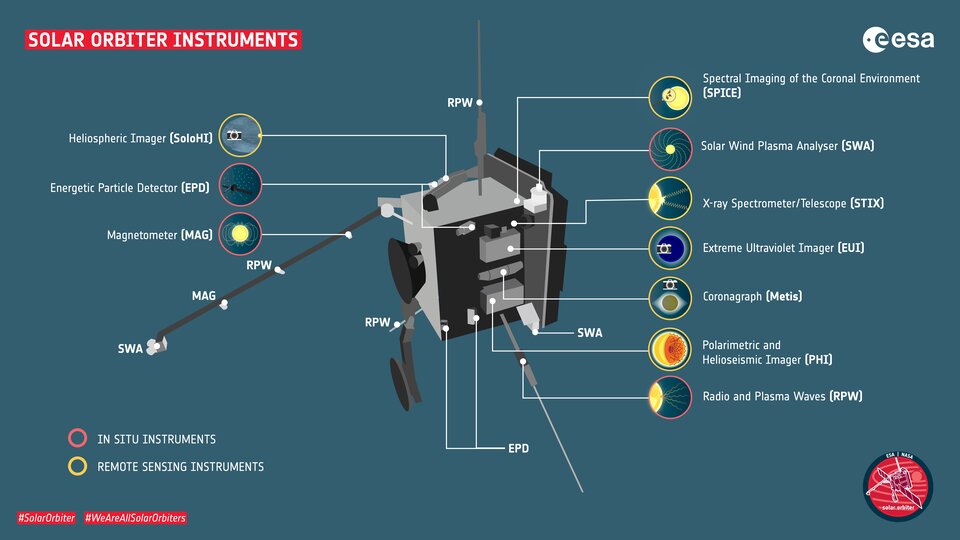
Credit: ESA

Here are some recent stories of interest..

European Space Agency: Solar Orbiter Ready for Close Encounter with Venus’“

The European Space Agency (ESA) is ready to guide the ESA/NASA Solar Orbiter spacecraft through its closest encounter with Venus so far. Today’s flyby will be the first to significantly ‘tilt’ the spacecraft’s orbit and allow it to see the Sun’s polar regions, which cannot be seen from Earth. Studying the Sun’s poles will improve our understanding of solar activity, space weather, and the Sun-Earth connection.

UC Irvine News: UC Irvine Astronomers Gauge Livability of Exoplanets Orbiting White Dwarf Stars’“

Among the roughly 10 billion white dwarf stars in the Milky Way galaxy, a greater number than previously expected could provide a stellar environment hospitable to life-supporting exoplanets, according to astronomers at the University of California, Irvine. In a paper published recently in The Astrophysical Journal, a research team led by Aomawa Shields, UC Irvine associate professor of physics and astronomy, share the results of a study comparing the climates of exoplanets at two different stars. One is a hypothetical white dwarf that’s passed through much of its life cycle and is on a slow path to stellar death. The other subject is Kepler-62, a “main sequence” star at a similar phase in its evolution as our sun.

Uppsala University: Mission Accomplished for Space Telescope Gaia’“

The space telescope Gaia has created the largest three-dimensional map of the Milky Way ever. On January 15, 2025, Gaia shut down after 11 years in space. But the research on data Gaia collected will continue for many years to come. Gaia is a space telescope onboard a satellite that has orbited the sun for 11 years. With the help of astrometry, which is a technique to measure the positions, distances and movements of stars and other heavenly bodies, Gaia has been able to measure distances and luminosities for up to 2 billion stars, which is about 1% of all stars in the Milky Way.

Space Quotes: Are NASA’s Missions Already Threatened?

Image (Credit): Testing of the James Webb Space Telescope at NASA’s Johnson Space Center, Houston, Texas. (European Space Agency)

“NASA is about to lose a ton of experienced people who, up until now, have been considered a national asset.”

“Our immensely successful research enterprise is under attack.”

-Statement in a Washington Post article titled “Under Trump, NASA Meetings are On Hold and Missions are Up in the Air” pertaining to disruptions at NASA related to White House reforms (or general chaos if “reform” is too technical). The first quote is from an experienced engineer at NASA’s Goddard Space Flight Center. The second quote is from Garth Illingworth, who is an astrophysicist at the University of California at Santa Cruz. He is also one of the scientists who brought us the amazing James Webb Space Telescope.

U.S. Postal Service Stamps Highlight JWST Images

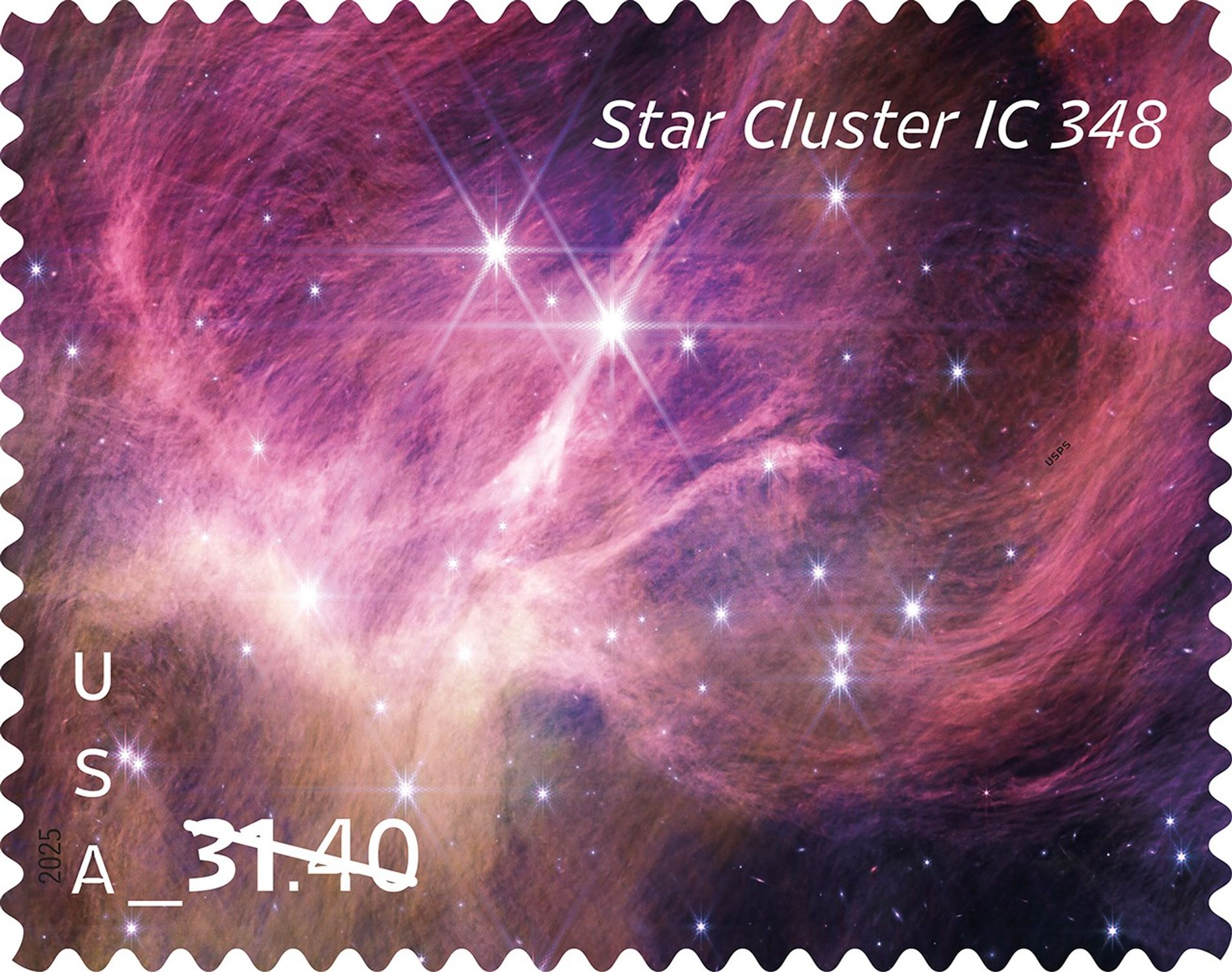
Image (Credit): The U.S. Postal Service stamp featuring an image of star cluster IC 348 from NASA’s James Webb Space Telescope. (U.S. Postal Service)

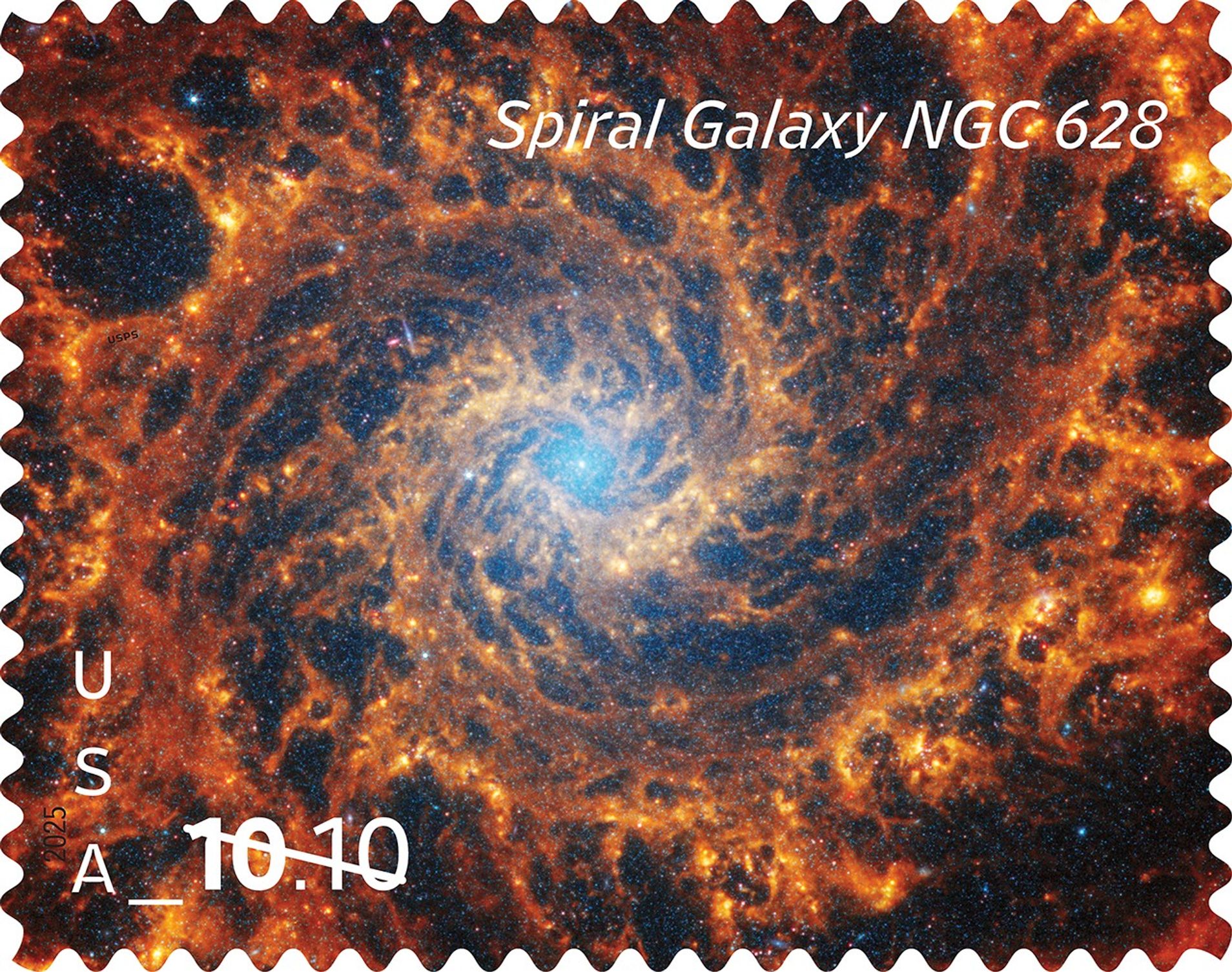
The U.S. Postal Service is honoring NASA again with a set of stamps highlighting images captured by the James Webb Space Telescope (JWST) – star cluster IC 348 (above) and spiral galaxy NGC 628 (below).

Regarding star cluster IC 348, NASA notes:

The wispy curtains filling the image are interstellar material reflecting the light from the cluster’s stars – what is known as a reflection nebula. This scene is located 1,000 light-years from Earth in the constellation Perseus.

Regarding spiral galaxy NGC 628, NASA explains:

Webb’s observations combine near- and mid-infrared light to reveal glowing gas and dust in stark shades of orange and red, as well as finer spiral shapes with the appearance of jagged edges. This galaxy is located 32 million light-years away in the constellation Pisces. 

I would have preferred these stamps were regular first class forever stamps so that they would grace personal letters and birthday cards traveling to every corner of this country, but this is a nice gesture however you look at it.

Image (Credit): The U.S. Postal Service stamp highlighting an image of the spiral galaxy NGC 628 from NASA’s James Webb Space Telescope. (U.S. Postal Service)

Astronomy Questions: Something Fun to Keep You Guessing

Credit: NASA/JPL

If you are looking for something to take your mind off of politics for a little while, you may want to try your skill at some astronomy quizzes. For instance, here is one of the questions:

For every evening star you can see from Earth, how many more stars in the Milky Way Galaxy remain unseen?

  • about 20 million
  • about 3,000
  • about 40

Here are three quizzes you might want to try:

Have fun!

Note: The answer to the question above is 20 million unseen stars for every star you can see in our galaxy.