A Short Test Flight for a German Rocket in Norway

Image (Credit): The launch of the Spectrum rocket from Andøya, Norway where Isar Aerospace has its own launch pad. ( Isar Aerospace)

Elon Musk is not the only one losing rockets these days. Yesterday the German firm Isar Aerospace launched its Spectrum rocket from a spaceport in northern Norway, but the mission ended in less than a minute.

Pointing out that Isar Aerospace is the first European commercial space company to launch an orbital rocket from Continental Europe, a company press release also cited the company’s CEO and co-founder Daniel Metzler, who stated:

Our first test flight met all our expectations, achieving a great success. We had a clean liftoff, 30 seconds of flight and even got to validate our Flight Termination System. We demonstrated that we can not only design and build but also launch rockets. I could not be prouder of our entire team for working so hard over the past seven years to reach this important milestone. Today, we laid the foundation to cater to the rising global demand for flexible satellite launch services. Now it’s time to analyze all data, learn, iterate and be back on the launch pad as soon as possible.

Like the U.S., Europe has a number of rocket start-ups that should eventually offer alternatives for future European space missions and commercial businesses. In this vein, the same press release had a hopeful message:

As a company with European roots, we are proud to have shown that Europe has an enduring capacity for bold thinking and grand achievements. We have all resources to create globally competitive technology leaders. With our services, we will be able to serve customers from around the world to bring their satellites into space and to help Europe solve a major blind spot in its security architecture: access to space.

The company is already making more rockets, allowing it build upon what was learned from this test flight.

Is Russia Making a Separate Peace with Russia?

Image (Credit): The planet Mars. (NASA)

While the current White House discussions with Russia regarding its invasion of Ukraine has already raised some eyebrows, the Ukrainian newspaper The Kyiv Independent has reported that Russia appears to be making a separate offer to Elon Musk.

The newspaper reports that Russia has offered Mr. Musk a “small-sized nuclear power plant” for a future mission to Mars. Kirill Dmitriev, head of the Russian Direct Investment Fund, called Mr. Musk a “great visionary.”

The newspaper also notes that Mr. Dmitriev has plans for a set of separate talks with Mr. Musk, stating:

Russia seeks cooperation with Musk’s SpaceX company in developing Russia’s space agency, Roscosmos, and state-run nuclear energy company Rosatom.

Given that both President Trump and Mr. Musk need constant praise, it seems the Russians know who to push the buttons of both men. Of course, the Starlink system assisting the Ukranian military has been a Russian irritant from the very beginning, so you can assume any offer to Mr. Musk will come with a price tag.

Of course, maybe it makes sense to send Mr. Musk and his DOGE team to Russia now to assist with the restructuring of Roscosmos. That may be the best way to save NASA from his “vision” while ensuring Russia will not be a competitor for a very long time.

2025 International Mars Society Convention

It is time to mark your calendar for the Mars Society’s 2025 International Mars Society Convention scheduled for October 9–11 at the University of Southern California in Los Angeles. The theme this year is “Mars: The Time Has Come!”

If you want to learn more about past conventions to see if this is something for you, check out this link.

Some of the guests at last year’s convention included:

  • Tiffany M. Morgan, Deputy Director of the Mars Exploration Program in NASA’s Science Directorate, who will give an address about “Exploring Mars Together, DRAFT Plan for a Sustainable Future for Science at Mars.”
  • Howard Hu, the Orion Program Director at NASA, who will give an address about “NASA’s Artemis plans for returning to the Moon and beyond,”
  • Brig. General (Ret.) Dr. S. Pete Worden, Chairman of the Breakthrough Prize Foundation, who will give an address about “Life in the Universe and Private Sector Space Science Initiatives.”
  • Dr. Alan Stern, a renowned planetary scientist and commercial astronaut, who will give an address about “The Other Red Planet” focusing on Pluto.

If you are interested, you can register for this year’s convention here.

Also, if you have any ideas for the design of this promotional poster for the 2025 convention visit this site for more information.

Space Quote: More on the DEI Issue and Artemis

Image (Credit): Artemis II crew members greeting a crowd in April 2023. From left to right is Canadian Space Agency astronaut Jeremy Hansen and NASA astronauts Victor Glover, Reid Wiseman, and Christina. (NASA)

“[I]t is important to note that the change in language does not indicate a change in crew assignments.”

-Statement by a NASA spokesperson to Space.com regarding the recent removal of “DEI” language from the Artemis mission page. The scheduled crew for the upcoming Artemis II mission includes one woman, one person of color, and one international astronaut, as stated earlier on NASA’s website.

Pic of the Week: Deep Field South

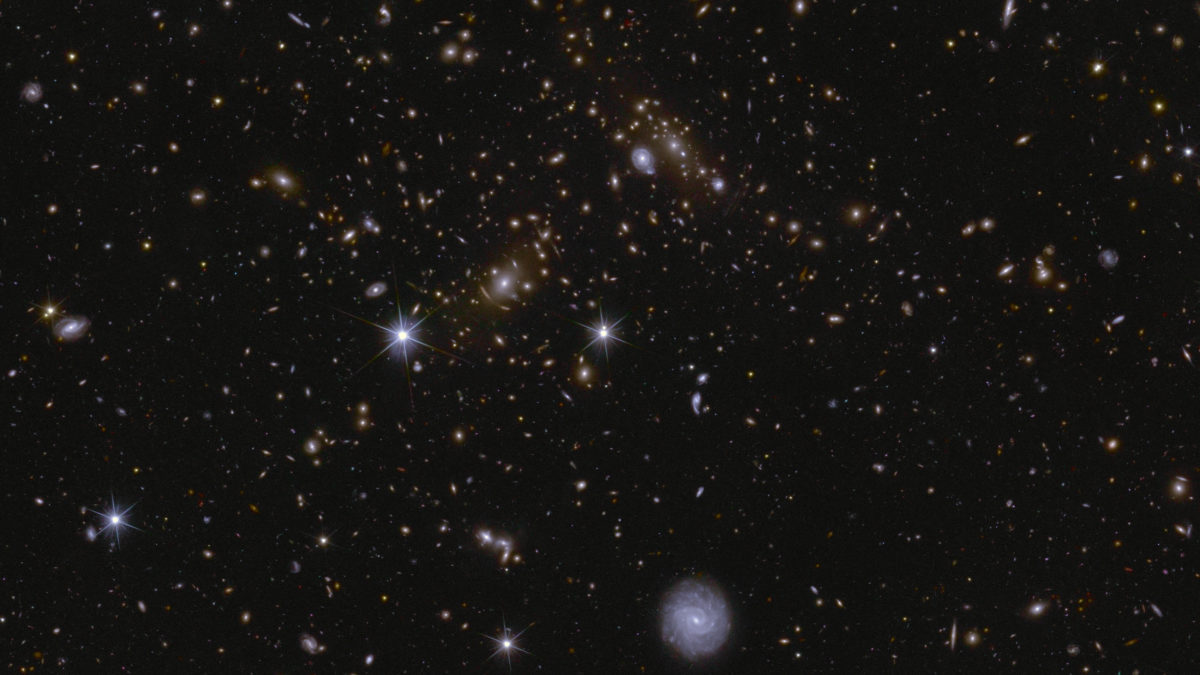
Image (Credit): The Deep Field South captured by the ESA’s Euclid space telescope. (ESA/Euclid/Euclid Consortium/NASA, image processing by J.-C. Cuillandre, E. Bertin, G. Anselmi/Handout via REUTERS)

Last week, the European Space Agency released images from the Euclid space telescope, which was launched on July 1, 2023. The goal of the space telescope’s mission is to catalog more than 1.5 billion galaxies over a six year period.

The image above shows a part of the sky called the Deep Field South. One of the galaxy clusters near the center of the image is located almost 6 billion light-years away. At the center bottom of the image you can also clearly see a beautiful spiral galaxy.