
Here are some recent stories of interest related to exoplanets.
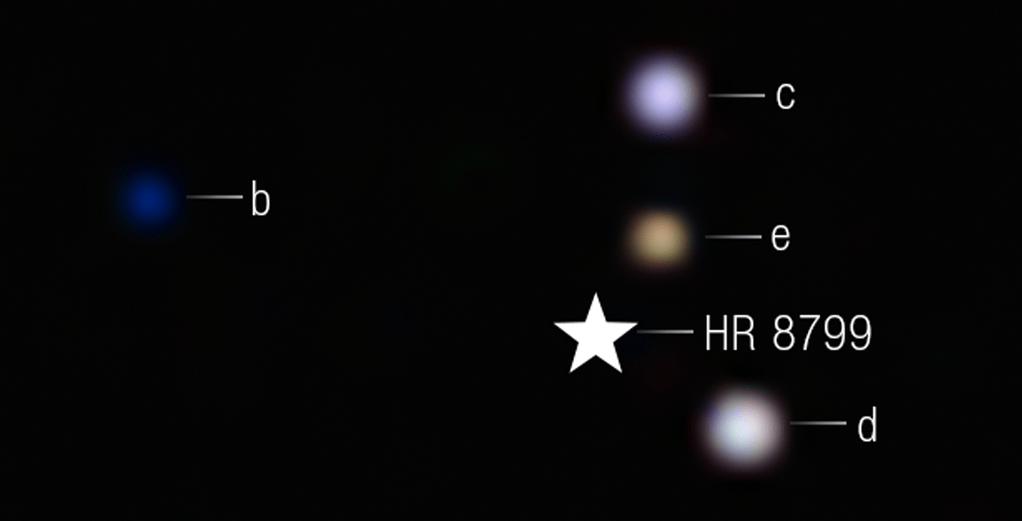
—Webbtelescope.org: “NASA’s Webb Images Young, Giant Exoplanets, Detects Carbon Dioxide“
The first planet outside our solar system was discovered in the 1990’s, but it wasn’t until more than a decade later astronomers actually obtained a direct image of one. It’s extremely difficult to image an exoplanet, as stars in other planetary systems can be thousands of times brighter and bigger than their planets. NASA’s James Webb Space Telescope is equipped with a highly sensitive coronagraph, a tiny mask that blocks the light of the star, allowing Webb to image exoplanets. Webb’s new images of two iconic systems, HR 8799 and 51 Eridani, and their planets have stunned researchers, and provided additional information into the chemical make-up of the young gas giants.
—ABC News: “Several Planets Found Orbiting Star Less Than 6 light-years Away“
Astronomers have confirmed the existence of four planets orbiting a star less than 6 light-years away with help from some of the world’s most powerful telescopes. Research published in October 2024 revealed that one planet was rotating around Barnard’s Star, the second-closest single star system to Earth. But a combination of telescopes all over the world confirmed the presence of four small exoplanets, according to a study published last week in The Astrophysical Journal Letters.
—Universe Today: “Astronomers Think They’ve Found a Reliable Biosignature. But There’s a Catch“
The search for life has become one of the holy grails of science. With the increasing number of exoplanet discoveries, astronomers are hunting for a chemical that can only be present in the atmosphere of a planet with life! A new paper suggests that methyl halides, which contain one carbon and three hydrogen atoms, may just do the trick. Here on Earth they are produced by bacteria, algae, fungi and some plants but not by any abiotic, non biological processes. There is a hitch, detecting these chemicals is beyond the reach of current telescopes.
 Our Awesome Universe