Space Stories: Cygnus Spacecraft Damaged, AI & Astronomy, and Toxic Martian Dust

Image (Credit): The Cygnus cargo shit at the International Space Station. (Northrup Grumman)

Here are some recent stories of interest.

Ars Technica: After a Spacecraft was Damaged en route to Launch, NASA Says it Won’t Launch

Three weeks ago, NASA revealed that a shipping container protecting a Cygnus spacecraft sustained “damage” while traveling to the launch site in Florida. Built by Northrop Grumman, Cygnus is one of two Western spacecraft currently capable of delivering food, water, experiments, and other supplies to the International Space Station. This particular Cygnus mission, NG-22, had been scheduled for June. As part of its statement in early March, the space agency said it was evaluating the NG-22 Cygnus cargo supply mission along with Northrop.

Intelligent Computing: AI Reshapes How We Observe the Stars

AI tools are transforming how we observe the world around us—and even the stars beyond. Recently, an international team proved that deep learning techniques and large language models can help astronomers classify stars with high accuracy and efficiency. Their study, “Deep Learning and Methods Based on Large Language Models Applied to Stellar Light Curve Classification,” was published Feb. 26 in Intelligent Computing.

CNN: Toxic Dust on Mars Would Present Serious Hazard for Astronauts

Toxic dust on Mars would make a future mission to the red planet extremely hazardous for astronauts and require significant countermeasures, new research suggests. Substances such as silica, gypsum, perchlorates and nanophase iron oxides contained in Martian dust could have life-threatening effects on members of a potential Mars mission, according to a study published in the journal GeoHealth last month.

Space Quote: The Cutting Continues at NASA

Credit: Image by David Yonatan González from Pixabay

“Good work by @NASA this week:
-Eliminated their unused Purchasing Cards (~80%)
-Terminated ~$420M in unneeded contracts, including $45M ($15M each) to three separate consultants, all for “Change Management Support Services””

-Statement on Twitter/X by the Department of Government Efficiency (DOGE). The specific “unneeded” contacts being cut beyond the three provided contracts is unclear. What is the chance that any of the cuts will impact SpaceX or other Musk interests? Probably zero at this point. We will need to wait for more transparency once the dust settles.

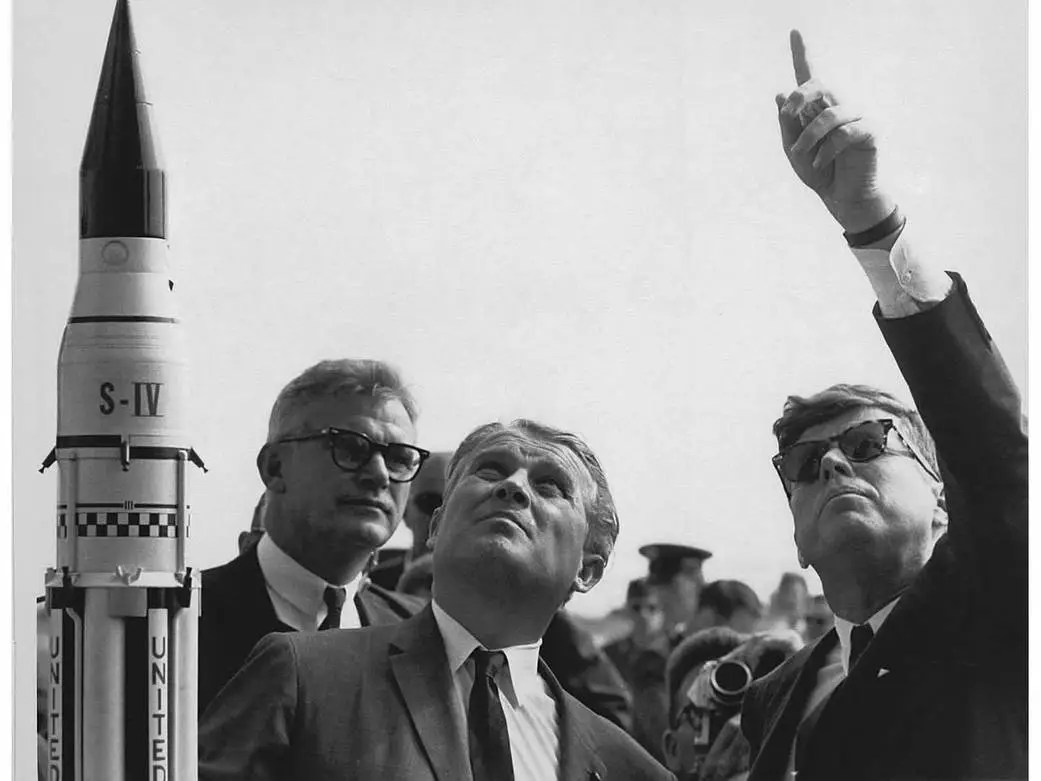
A Day in Astronomy: Birth of Wernher von Braun

Image (Credit): Wernher von Braun (center) with President John F. Kennedy discussing the Saturn Launch System. (NASA)

On this day in 1912, Wernher Magnus Maximilian, Freiherr von Braun was born in Wyrzysk (once German, now Polish). He became an aerospace engineer for both the Germans during World War II as well as the Americans following the war.

Wernher von Braun designed the V-2 rocket that terrorized Great Britain during the war. He used that knowledge to assist NASA with the Saturn V rocket that became the backbone of the Apollo Moon missions.

In a speech on the eve of the Apollo 11 launch, he stated:

If our intention had been merely to bring back a handful of soil and rocks from the lunar gravel pit and then forget the whole thing, we would certainly be history’s biggest fools. But that is not our intention now—it never will be. What we are seeking in tomorrow’s [Apollo 11] trip is indeed that key to our future on earth. We are expanding the mind of man. We are extending this God-given brain and these God-given hands to their outermost limits and in so doing all mankind will benefit. All mankind will reap the harvest…. What we will have attained when Neil Armstrong steps down upon the moon is a completely new step in the evolution of man.

This was only 24 years after the end of World War II. He came a long way from his days of bombing his fellow citizens in Europe.

More than 50 after the last Apollo launch we are still trying to “reap the harvest” started by those earlier missions.

You Knew It Was Coming – NASA Modifies Artemis Language

Credit: Image by Zoltán Szűcs from Pixabay.

As I had noted earlier, the Trump administration’s deconstruction of DEI was bound to lead to a change in the Artemis mission language.

Here is the old language from the NASA site (from the time of the first Trump administration):

And now the new language on today’s page:

See any differences? That last sentence discussing the first woman, the first person of color, and the first international partner astronaut has been zapped, as noted by the media.

Was it human intervention or AI intervention? We will probably never know, but the types of items being remove from the federal web pages, such as the Enola Gay, is pretty dumb.

Any space-faring civilization will be wise to avoid us for now. We do not really meet the definition of “intelligent life” at the moment.