Image (Credit): Athena approaching the Moon on March 6, 2025. (NASA)
This week’s image is from earlier today when Intuitive Machines’ Athena lunar lander was approaching the Moon’s South Pole. The good news is that the lander made it safely to the surface. However, the lunar lander may have landed in an odd way, creating solar generating issues similar to the company’s first attempt at landing this time last year.
NASA and Intuitive Machines are still trying to determine the status of the lander as well as its exact location. The lander’s goal was to land in Mons Mouton, a lunar plateau near the Moon’s South Pole. NASA’s Lunar Reconnaissance Orbiter should help to pinpoint the lander’s location and orientation in the next few days.
Hopefully, some if not all of the planned experiments are still possible. But for now it’s just a matter of waiting for more news on the mission.
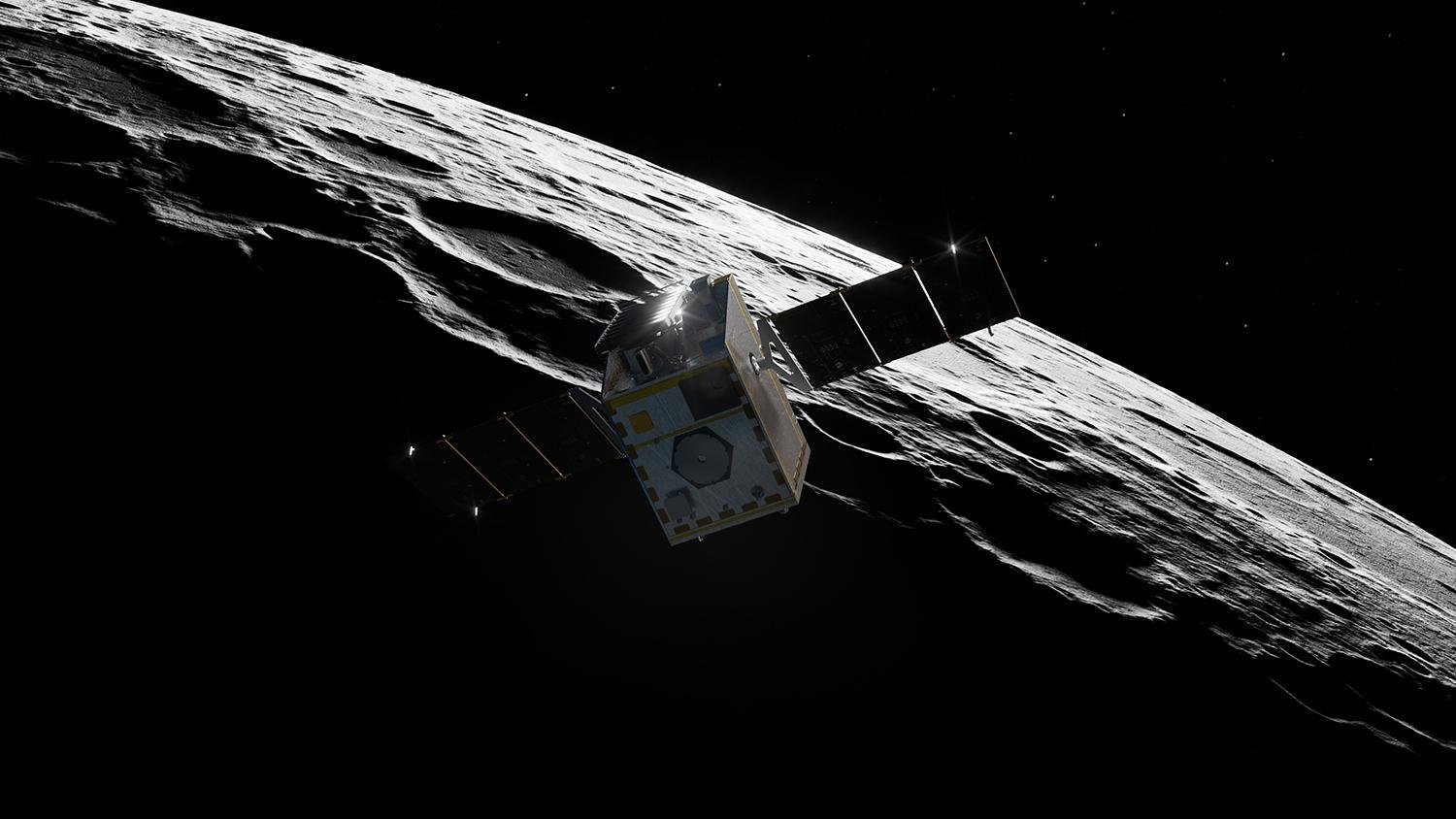
Image (Credit): Artist’s rendering of NASA’s Lunar Trailblazer orbiting the Moon. (NASA)
“The Lunar Trailblazer team has been working around the clock to re-establish communications with the spacecraft…NASA sends up high-risk, high-reward missions like Lunar Trailblazer to do incredible science at a lower cost, and the team truly encapsulates the NASA innovative spirit — if anyone can bring Lunar Trailblazer back, it is them.”
-Statement by Nicky Fox, the associate administrator of the NASA Science Mission Directorate, as quoted by CNET. The Lunar Trailblazer was launched with Intuitive Machines’ Athena lunar lander on March 26th. The satellite was designed to orbit about 60 miles above the Moon’s surface as it mapped potential water on the lunar surface.
On 29 January 2025, the European Space Agency (ESA)’s Director of Science, Carole Mundell; ESA’s Director of Space Transportation, Toni Tolker-Nielsen; and Arianespace’s Chief Commercial Officer, Steven Rutgers, signed the launch contract for the ESA PLATO science mission...PLATO stands for PLAnetary Transits and Oscillations of stars…PLATO’s goal is to detect Earth-like planets that orbit Sun-like stars in the Milky Way and may even have conditions suitable for life.
The first generation of stars in the universe could have produced significant amounts of water upon their deaths, just 100 million to 200 million years after the Big Bang. Signatures of water have previously been observed some 780 million years after the Big Bang. But now, computer simulations suggest that this essential condition for life existed far earlier than astronomers thought, researchers report March 3 in Nature Astronomy.
An international team of astronomers reports the discovery of a new dwarf galaxy, which they have named Pegasus VII. The newfound galaxy, which lies about 2.4 million light years away, was identified in the Ultraviolet Near-Infrared Optical Northern Survey (UNIONS). The discovery was detailed in a research paper published Feb. 13 on the arXiv preprint server.Dwarf galaxies are low-luminosity and low-mass stellar systems, usually containing a few billion stars. Their formation and activity are thought to be heavily influenced by interactions with larger galaxies.
Image (Credit): NASA’s SPHEREx and PUNCH satellites being prepared for launch inside the Astrotech Space Operations facility at Vandenberg Space Force Base in California, on Thursday, February 27, 2025. (NASA)
While NASA’s Spectro-Photometer for the History of the Universe, Epoch of Reionization and Ices Explorer (SPHEREx) and Polarimeter to Unify the Corona and Heliosphere (PUNCH) missions were expected to launch last weekend, they have been delayed until Thursday, March 6th. The launch will take place from the Vandenberg Space Force Base in California.
SPHEREx will spend two years collecting data on the origins of the universe by studying more than 450 million galaxies as well as more than 100 million stars in the Milky Way. You can learn more about the satellite’s mission by watching this Jet Propulsion Laboratory video.
PUNCH will be focused on events here in our own solar system. Consisting of four small satellites in low Earth orbit, the mission will study the entire inner heliosphere to learn how the Sun’s corona becomes the solar wind. You can learn more about the mission by watching this NASA video.
Image (Credit): Blue Ghost completed a precision landing in Mare Crisium at 2:34 a.m. CST on March 2 , touching down within its 100-meter landing target next to a volcanic feature called Mons Latreille. (Firefly Aerospace)
Above is the first image shared by the Blue Ghost lunar lander as it touched down on the Moon. Being the first attempt by Firefly Aerospace to land on the Moon, it is an impressive feat. The lunar lander will spend the next 14 days conducting planned experiments on the Moon using the various NASA instruments it is carrying.
In a press release, Jason Kim, CEO of Firefly Aerospace, stated:
Firefly is literally and figuratively over the Moon…Our Blue Ghost lunar lander now has a permanent home on the lunar surface with 10 NASA payloads and a plaque with every Firefly employee’s name. This bold, unstoppable team has proven we’re well equipped to deliver reliable, affordable access to the Moon, and we won’t stop there. With annual lunar missions, Firefly is paving the way for a lasting lunar presence that will help unlock access to the rest of the solar system for our nation, our partners, and the world.
It is a bold statement by a bold company, and hopefully the start of many more such missions down the road. NASA should also be thrilled with what appears to be a solid success for its Commercial Lunar Payload Services program.
This incredible achievement demonstrates how NASA and American companies are leading the way in space exploration for the benefit of all…We have already learned many lessons – and the technological and science demonstrations onboard Firefly’s Blue Ghost Mission 1 will improve our ability to not only discover more science, but to ensure the safety of our spacecraft instruments for future human exploration – both in the short term and long term.




 Our Awesome Universe