Go behind the scenes with the dedicated NASA team and its partners to uncover the untold story of the James Webb Space Telescope. “Cosmic Dawn” unveils the immense challenges, groundbreaking innovations, and extraordinary efforts behind humanity’s most powerful eye on our universe, from its complex development to its nail-biting deployment a million miles away.
This is what it takes to explore our universe, and I only hope we can continue to maintain the stamina, skills, and public support to maintain the JWST and initiate similar programs.
It may be time to write to Congress and let them know that America needs more of this grit and determination, not less.
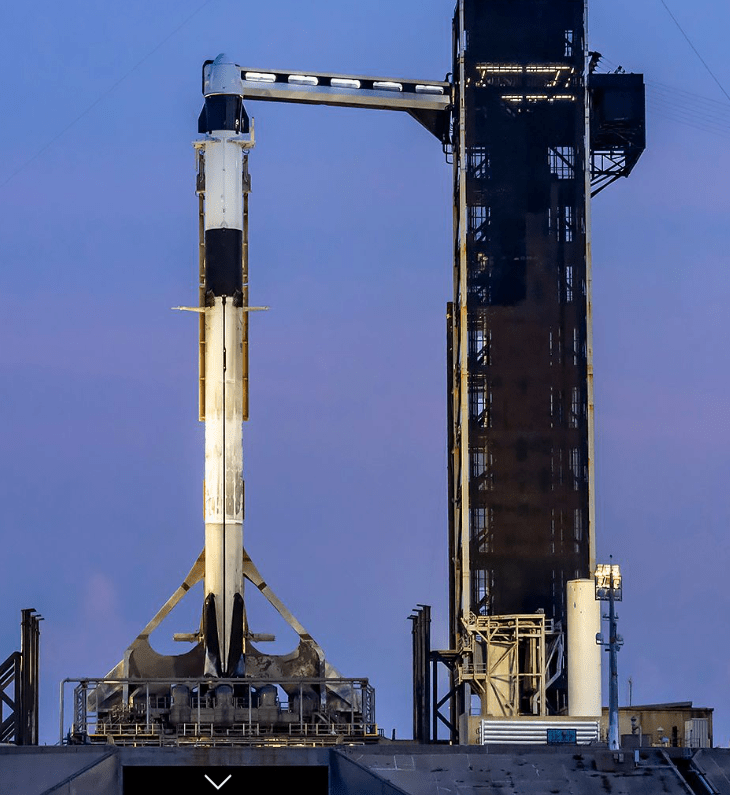
Image (Credit): Falcon 9 rocket on the lauch pad with Axiom Space’s Axiom Mission 4. (SpaceX)
“NASA and Axiom Space are postponing the launch of Axiom Mission 4 to the International Space Station. As part of an ongoing investigation, NASA is working with Roscosmos to understand a new pressure signature, after the recent post-repair effort in the aft most segment of the International Space Station’s Zvezda service module.”
–Statement by NASA regarding an leak in the Russian section of the International Space Station (ISS) that has yet to be resolved. This may slow down some of the space tourism to the site, such as the already delayed Axiom Mission, but it is more important to get this right rather than risk additional lives on the station. Axiom Space stated that the launch of the mission will be no earlier than June 19.
Image (Credit): A radiance map of the sun’s south pole as recorded by the Solar Orbiter spacecraft. (ESA & NASA/Solar Orbiter/PHI Team, J. Hirzberger (MPS))
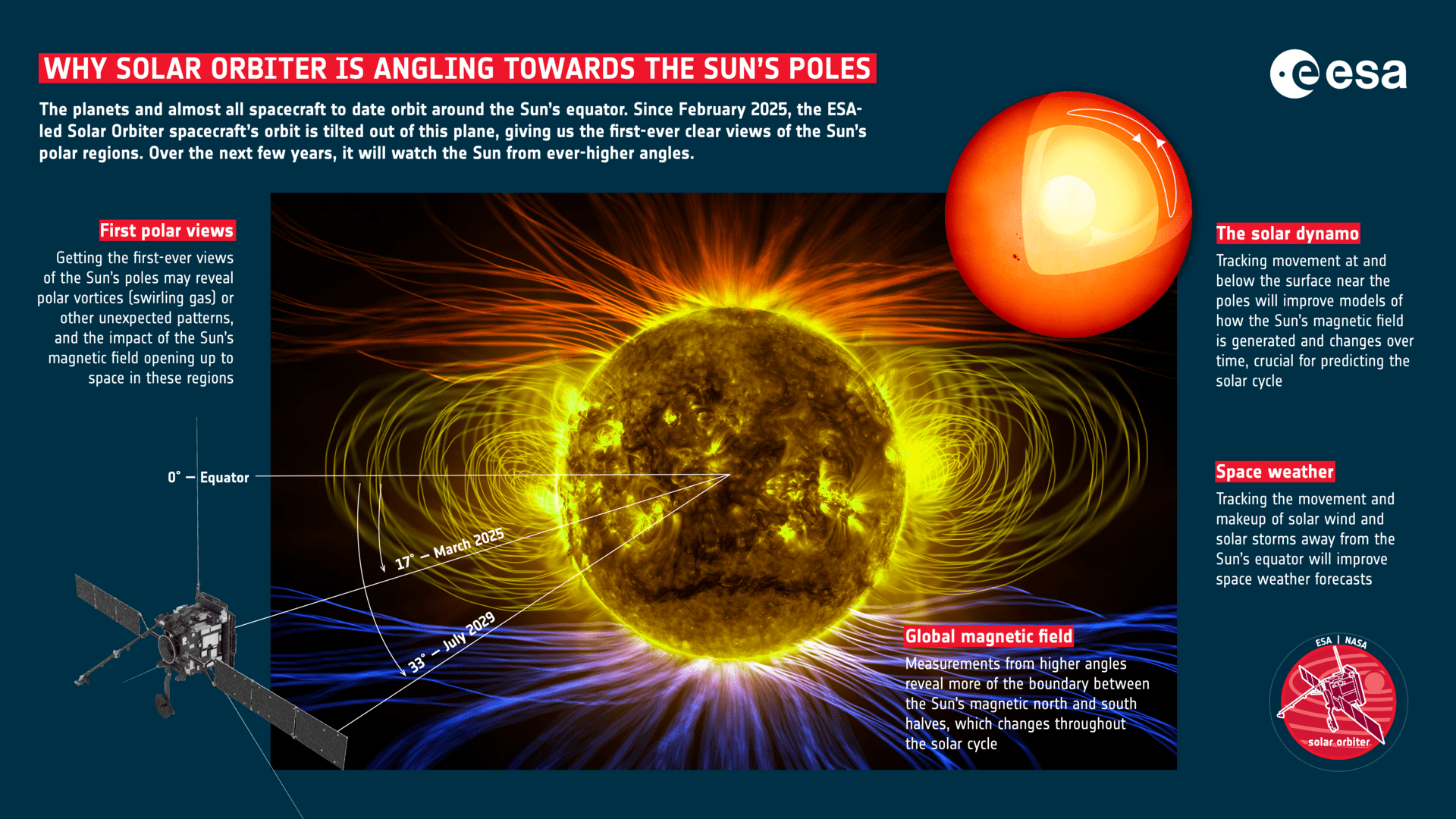
While NASA is going crazy over budget cuts, the European Space Agency (ESA) is focused on new images from the Solar Orbiter spacecraft showing the sun’s south pole from a distance of about 40 million miles (shown above).
Launched in February 2020, Solar Orbiter is an ESA-led cooperative mission with NASA designed to answer a number of questions:
What drives the Sun’s 11-year cycle of rising and subsiding magnetic activity?
What heats up the upper layer of its atmosphere, the corona, to millions of degrees Celsius?
How does solar wind form, and what accelerates it to speeds of hundreds of kilometres per second?
How does it all affect our planet?
Professor Carole Mundell, ESA’s Director of Science, stated:
Today we reveal humankind’s first-ever views of the Sun’s pole…The Sun is our nearest star, giver of life and potential disruptor of modern space and ground power systems, so it is imperative that we understand how it works and learn to predict its behaviour. These new unique views from our Solar Orbiter mission are the beginning of a new era of solar science.
We all need a diversion from the ongoing budget news, so it is good to read about ongoing science and a successful mission.
Image (Credit): William Shatner and Neil deGrasse Tyson on TheLate Show with Stephen Colbert. (CBS)
This week’s image comes from an episode of TheLate Show with Stephen Colbert, which aired earlier this week. Mr. Colbert was interviewing William Shatner and Neil deGrasse Tyson about the absurdities on Earth and in the galaxy.
In an odd twist, Dr. Tyson was generally quiet on the sofa while Mr. Shatner carried the show with his antics. The image above shows one of the few times Dr. Tyson had a chance to explain a point. It is worth watching.
Shatner and Tyson will soon be on the road together with their own show. It is a live stage event on Wednesday, June 18, called ROCKING: The Universe is Absurd.
Scientists have long assumed the Oort Cloud, one of the most mysterious structures in our solar system, to be spherical. But during the pre-production of their new space show, “Encounters in the Milky Way,” they noticed a strange spiral pattern in the middle of the cloud. The show, which premiered on Monday at New York City’s Hayden Planetarium, featured a computer-generated visualisation of the Oort Cloud on the dome. The team was reviewing the animation when they noticed what appeared to be a spiral structure inside the typically spherical cloud shape.
The ‘city killer’ asteroid 2024 YR4 may not be on a collision course with Earth anymore. But NASA has raised the odds of it hitting the moon in just seven years’ time. According to the space agency, there’s now a 4.3 per cent chance that 2024 YR4 will smash into the moon on December 22, 2032…The impact event would be the first time scientists could watch a known asteroid create a lunar crater in real-time.
SpaceX’s Starlink satellites are leaking radio waves to such an extent that it could threaten our ability to study and understand the early universe, say astronomers. Interference from the thousands of Starlink satellites in orbit, where they provide a global internet service, has been a continuing concern for astronomers, who say that the radio emissions from the craft could affect sensitive telescopes that observe distant, and faint, radio sources. SpaceX has worked with astronomers to try to prevent this interference, by switching off their internet-transmitting beams when they fly over key telescopes, but it turns out that this isn’t enough.




 Our Awesome Universe