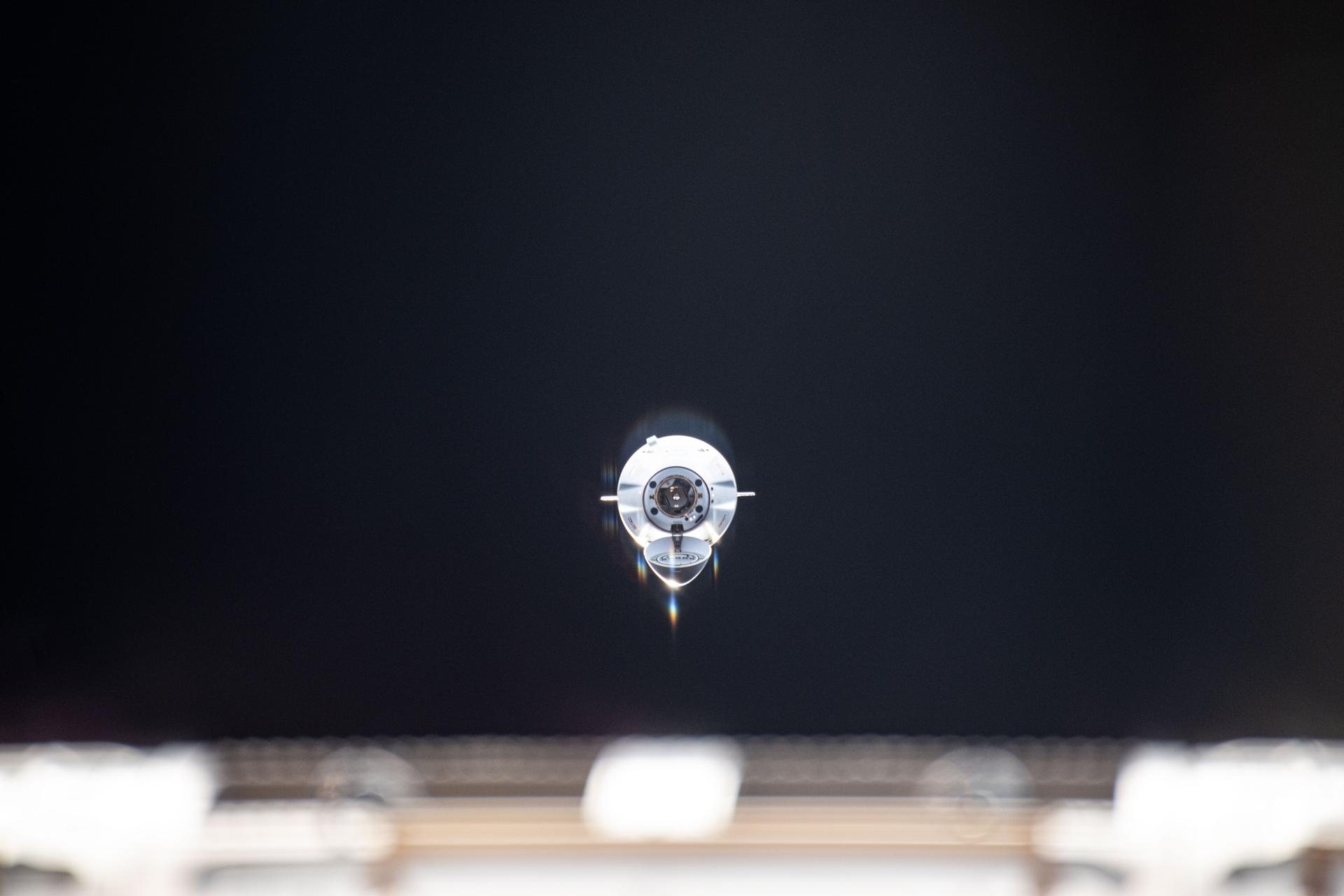
Pic of the Week: The Last SpaceX Dragon Approaching the ISS?

Image (Credit): The SpaceX Dragon cargo craft, nosecone open, preparing to dock with the ISS on April 22, 2025. (NASA)

This week’s image shows the latest, but hopefully not last, docking of the SpaceX Dragon with the International Space Station (ISS) back in April.

Future flights of the Dragon to the ISS are now in question due to an ongoing feud between Elon Musk and Donald Trump, presumably over a bloated House budget bill. However, the issues also involve budget bill cuts to EV programs, the dropping of Musk’s friend as NASA administrator, and Musk’s departure from Washington after a less than sensational attempt to cut government programs.

In a tweet earlier today, Musk stated:

In light of the President’s statement about cancellation of my government contracts, @SpaceX will begin decommissioning its Dragon spacecraft immediately.

Oh yeah, Trump also threatened to end all SpaceX contracts, so I guess the Dragon would go anyway.

This is serious stuff, particularly after Musk and Trump attached Boeing earlier this year for “abandoning NASA astronauts on the ISS,” which was not true. Who is doing the abandoning now?

It appears Musk is already backing down, but the damage is done. He is demonstrating how NASA’s programs are under the control of this one, erratic man. Can things really go back to normal?

Stay tuned for more. I really just wanted to post a pic, but I had to say more today.

Space Stories: Dozens of Space Missions Cancelled, NASA Climate Cuts Impact Industry, and Budget Cuts Hurt Huntsville

Credit: Image by Mohamed Hassan from Pixabay.

Here are some recent stories about the planned budget cuts at NASA.

USA Today: Dozens of NASA space missions could be axed under Trump’s budget: Here’s a look at 6

A total of 41 science projects would get the ax under the proposal, which would be NASA’s biggest single-year cut in the agency’s history, according to the Planetary Society. Many of the science missions President Donald Trump looks to cancel are still in development, while others are extended operations with uncrewed vehicles already deployed to orbit. Here’s a look at six different types of space missions, from Mars exploration to future moon landings, that could be under threat if Trump’s budget were to go into effect.

Politico: The Domino Effect of Trump’s NASA Climate Cuts

President Donald Trump wants to decimate NASA’s climate research capacity. That could ultimately disrupt multiple sectors of the economy, writes Scott Waldman. In the White House budget documents released last week, Trump proposed slashing a quarter of NASA’s funding, specifically targeting the agency’s research on climate change. But many of NASA’s instruments that track human-caused climate change provide other critical data. The agriculture industry, for example, relies on satellites and instruments that not only track climate change but also keep tabs on shifts in climatic zones that affect plant growth. Trump wants to eliminate funding that keeps those tools operational.

Advance Local: Trump’s Budget Puts Huntsville-made Spacecraft on the Chopping Block

NASA is being directed to phase out multibillion-dollar programs, managed from its flagship center in Huntsville, that are designed to ferry people to and from the moon…Eliminating SLS and Orion will, “[pave] the way for more cost-effective, next-generation commercial systems that will support subsequent NASA lunar missions,” according to budget documents. Both are key programs for Marshall Space Flight Center, one of the largest of NASA’s 10 field centers, which employs nearly 7,000 federal workers and contractors in Huntsville and manages a multibillion-dollar budget related to human spaceflight.

Study Findings: No Certainty of a Milky Way–Andromeda Collision

Image (Credit): The Andromeda galaxy, or M31, spans 260,000 light-years across. (NASA/JPL-Caltech)

Nature Astronomy abstract of the study findings:

It is commonly believed that our own Milky Way is on a collision course with the neighbouring Andromeda galaxy. As a result of their merger, predicted in around 5 billion years, the two large spiral galaxies that define the present Local Group would form a new elliptical galaxy. Here we consider the latest and most accurate observations by the Gaia and Hubble space telescopes, along with recent consensus mass estimates, to derive possible future scenarios and identify the main sources of uncertainty in the evolution of the Local Group over the next 10 billion years. We found that the next most massive Local Group member galaxies—namely, M33 and the Large Magellanic Cloud—distinctly and radically affect the Milky Way–Andromeda orbit. Although including M33 increases the merger probability, the orbit of the Large Magellanic Cloud runs perpendicular to the Milky Way–Andromeda orbit and makes their merger less probable. In the full system, we found that uncertainties in the present positions, motions and masses of all galaxies leave room for drastically different outcomes and a probability of close to 50% that there will be no Milky Way–Andromeda merger during the next 10 billion years. Based on the best available data, the fate of our Galaxy is still completely open.

Citation: Sawala, T., Delhomelle, J., Deason, A.J. et al. No certainty of a Milky Way–Andromeda collision. Nat Astron (2025).
https://doi.org/10.1038/s41550-025-02563-1

Study-related stories:

PBS

National Geographic

Daily Finland

Television: Season Three of Foundation is Coming Soon

Credit: Apple TV+

While our own local empires struggle, we need to turn our eyes to the galactic empire in Foundation, soon to return for a third season on Apple TV+. Mark your calendar for the appearance of the season premiere on July 11.

The trailer for season three indicates there will be no shortage of death-defying adventures. It looks like Mission Impossible in space. The first two seasons did not disappoint, so I am eager to see where this season takes us.

Here is the set up for season three from Apple TV+ Press:

Set 152 years after the events of season two, The Foundation has become increasingly established far beyond its humble beginnings while the Cleonic Dynasty’s Empire has dwindled. As both of these galactic powers forge an uneasy alliance, a threat to the entire galaxy appears in the fearsome form of a warlord known as “The Mule,” whose sights are set on ruling the universe by use of physical and military force as well as mind control. It’s anyone’s guess who will win, who will lose, who will live and who will die as Hari Seldon, Gaal Dornick, the Cleons and Demerzel play a potentially deadly game of intergalactic chess.

This is a show where you do not want to get too attached to the characters. They tend to disappear as often as those in the Game of Thrones.

If you are new to the series, I would not necessarily recommend the season recaps you can find on YouTube. The story line is too disjointed for an easy summary. Also, I do not know why you would want to miss these amazing earlier episodes. This is not Star Trek. Instead, it’s a long movie, where every episode builds on the earlier one.

I recommend you sit through all of the first two seasons to become immersed in this galaxy. You owe it to yourself, and you will not be disappointed.

The Atlantic Council Likes Space Robots

Credit: Image by Christopher White from Pixabay.

If you have not heard of the Atlantic Council you are not alone.

The Atlantic Council defines itself defines itself as a nonpartisan organization that is “…an essential forum for navigating the dramatic economic and political changes defining the twenty-first century by informing and galvanizing its uniquely influential network of global leaders.”

So what does it have to say about the current state of the US space program? It seems to want more robots, artificial intelligence, and virtual reality. It also claims China is moving in this direction.

In a recent article, the Atlantic Council proposed the following to improve the space program for this century:

  • Modernize NASA’s organizational structure by integrating the robotic and human initiatives;
  • Reformulate NASA’s Artemis campaign by changing its plan so that early flights are robotic, with work and preparations being performed by intelligent machines ahead of crewed missions; and
  • Equip lunar robots with virtual reality so intelligent space exploration machines could enable scientists, engineers, and others on Earth to become active participants in the exploration of the Moon, distant planets, and beyond.

Fortunately, the article is not recommending the removal of humans from space flight, but rather the use of technology to enhance these missions, reduce overall costs, and broaden public and scientific support. This would include the expansion of private sector involvement. It’s not a bad idea as NASA struggles with the Artemis mission and potentially other missions due to budget cuts.

Of course, the amazing telescopes that we are trying to maintain and expand upon are already top of the line technology that have expanded public support for astronomy, but this has come at great cost (exceeding cost projections) and has not been protected from budget cuts.

A mix of approaches sounds fine, but a reliable flow of funds with clear expectations also sound nice. We are not going to get that with this White House based upon what we have seen so far. Just finding a leader for NASA that is palatable to the White House is proving impossible.

New ideas should always be welcome, but what is really essential at the moment is stable leadership. Without that all other efforts will go nowhere.