This week’s image comes from Ireland’s DIAS Reach for the Stars 2025 astronomy photo competition. The 2025 winners have yet to be announced, but the photos are available for the public to view (and vote on until last week).
This shortlisted entry by photographer Felix Sproll is titled “Another World.” It was taken in Dun Laoghaire located in Dublin, Ireland.
This is the story about the image from its creator:
Full moon rising behind Baily Lighthouse on Howth 9km away looking like another planet. I happened to be in Dun Laoghaire when I saw that the full Moon was set to rise on the opposite side of Dublin bay so I ligned it up with Baily Lighthouse at the end of Howth. I calculated the position to get the moon in the centre of the lighthouse when it reached the lighthouse using the photopills app. Nikon Z7ii and tamron 100-400 at 400mm, 1/5sec, ISO 6400, F6.3, minor adjustments in LR.
You can find many other fun images on the competition website. Winners will be announced next month.
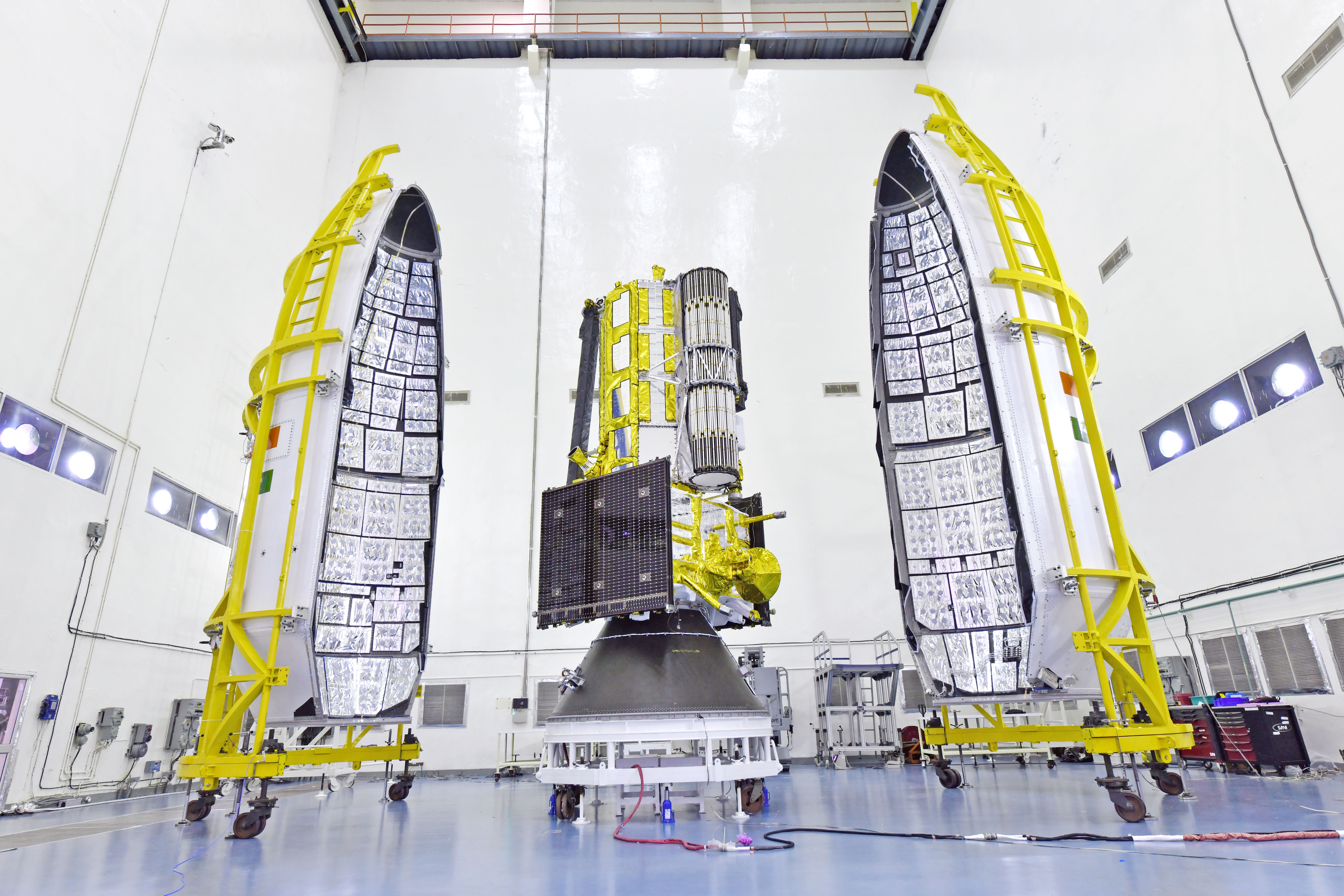
Image (Credit): The NISAR satellite and its casing. (ISRO)
Earlier today the NASA-ISRO Synthetic Aperture Radar (NISAR) satellite was successfully launched from India’s Satish Dhawan Space Centre. ISRO stands for the Indian Space Research Organisation, which is India’s national space agency.
This first of its kind mission between NASA and India puts into orbit the NISAR satellite that can see the Earth in a new way, detecting the smallest of changes in the Earth’s surface from its 464 mile high orbit, including ground deformation, ice sheet movement, and vegetation dynamics. The addition list of satellite capabilities on the ISRO site include:
…sea ice classification, ship detection, shoreline monitoring, storm characterization, changes in soil moisture, mapping & monitoring of surface water resources and disaster response.
NASA’s Earth Science division director, Karen St. Germain, stated:
Observations from NISAR will provide new knowledge and tangible benefits for communities both in the U.S. and around the world…This launch marks the beginning of a new way of seeing the surface of our planet so that we can understand and foresee natural disasters and other changes in our Earth system that affect lives and property.
This will be useful information given that we run the risk of reverse-terraforming our Earth.
We live in a time of conspiracies, as the newspapers demonstrate everyday.
One conspiracy from the World War II era related to Hitler maintaining a secret base in Antarctica. While that story has been debunked, have you heard the one about the secret U.S. base hidden beneath the ice?
Last May, Newsweek told this story in an article titled “Map Shows US Nuclear Base Hidden Under Greenland’s Ice Since Cold War.” It discusses a NASA “discovery” last year during the test of new radar equipment – the (Uninhabited Aerial Vehicle Synthetic Aperture Radar (UAVSAR) – to peer beneath the ice.
The NASA team rediscovered Camp Century, a secret U.S. base constructed in the late 1950s during the Cold War. The U.S. was testing the idea of building nuclear-missile launch sites beneath the ice. The effort proved fruitless, causing the abandonment of the secret base in 1967.
While Greenland is again on the tip of many tongues, the idea of joint military operations between the U.S. and Greenland is nothing new. The U.S. signed a treaty with Denmark back in 1951 that permitted U.S. military facilities throughout Greenland. The story notes that the U.S. has as many as 17 military bases in Greenland hosting close to 10,000 troops. Today, the U.S. has only one military base left with about 150 Air Force personnel.
Camp Century is not really a big secret today, and you can find many articles about it over the years, but it was an interesting discovery for NASA, and proved the value of the new radar equipment.
Maybe NASA needs to make a pass over Antarctica next just to put to rest any remaining rumors about that Nazi base. Better yet, we can check out some sites on the Moon to be certain the Nazis did not build a base there as well.
Note: This Newsweek story was originally reported in The Wall Street Journal, but the newspaper’s firewall would have prevented many from reading the story. You can find another good summary of NASA’s Camp Century encounter in this Smithsonian magazine article.
NASA and its partners have supported humans continuously living and working in space since November 2000. A truly global endeavor, the International Space Station has been visited by more than 280 people from 23 countries and a variety of international and commercial spacecraft. The unique microgravity laboratory has hosted more than 4,000 experiments from more than 5,000 researchers in more than 110 countries. The space station also is facilitating the growth of a commercial market in low Earth orbit for research, technology development, and crew and cargo transportation.
Using the Atacama Large Millimeter/submillimeter Array (ALMA), a team of astronomers led by Abubakar Fadul from the Max Planck Institute for Astronomy (MPIA) has discovered complex organic molecules – including the first tentative detection of ethylene glycol and glycolonitrile – in the protoplanetary disc of the outbursting protostar V883 Orionis. These compounds are considered precursors to the building blocks of life. Comparing different cosmic environments reveals that the abundance and complexity of such molecules increase from star-forming regions to fully evolved planetary systems. This suggests that the seeds of life are assembled in space and widespread.
Curtin University researchers have undertaken the world’s biggest survey of low frequency satellite radio emissions, finding Starlink satellites are significantly interfering with radio astronomy observations, potentially impacting discovery and research. Unintended signals from satellites – leaked from onboard electronics – can drown out the faint radio waves astronomers use to study the universe.
The problem with a poorly-planned downsizing of an organization is that you may lose too many people in key positions and the disarray demotivates those who remain. Hence, it should be no surprise that this is what we are seeing at NASA as well as other agencies.
NASA is now looking at losing about 20 percent of its workforce, or about 4,000 employees, who have been harassed and prodded towards the door. That represents the loss of an amazing amount of talent. Of course, the White House doesn’t seem to care given its proposed budget cutting NASA’s 2026 budget by about 24 percent.
It will not be long before we have a blame game about “Who lost the Moon?” once China surpasses us in the race to the Moon. We may even be asking “Who lost Mars” now that we have abandoned retrieving a Mars soil sample while China and Japan have plans to bring back Martian soil. All of this is foreseeable to the average person, but for some reason no light seems to penetrate the persistent fog in Washington, DC.
We already read stories about whether Boeing even knows how to build a new airplane, Will we soon have stories about that nation that once put men on the Moon but lost its way?
The United States was behind the Soviets in the space race when it found the will to dream big. I am seeing no signs of dreaming in this nightmarish dismantling of science in this country. We have to work hard to remain ahead of this latest space race, and should we stumble there are plenty of other countries waiting to fill the void.
We are making the same mistake that Russia did when it invaded Ukraine and put its space hopes on hold. The difference here is that we have trained the guns on our own space and science programs.





 Our Awesome Universe