
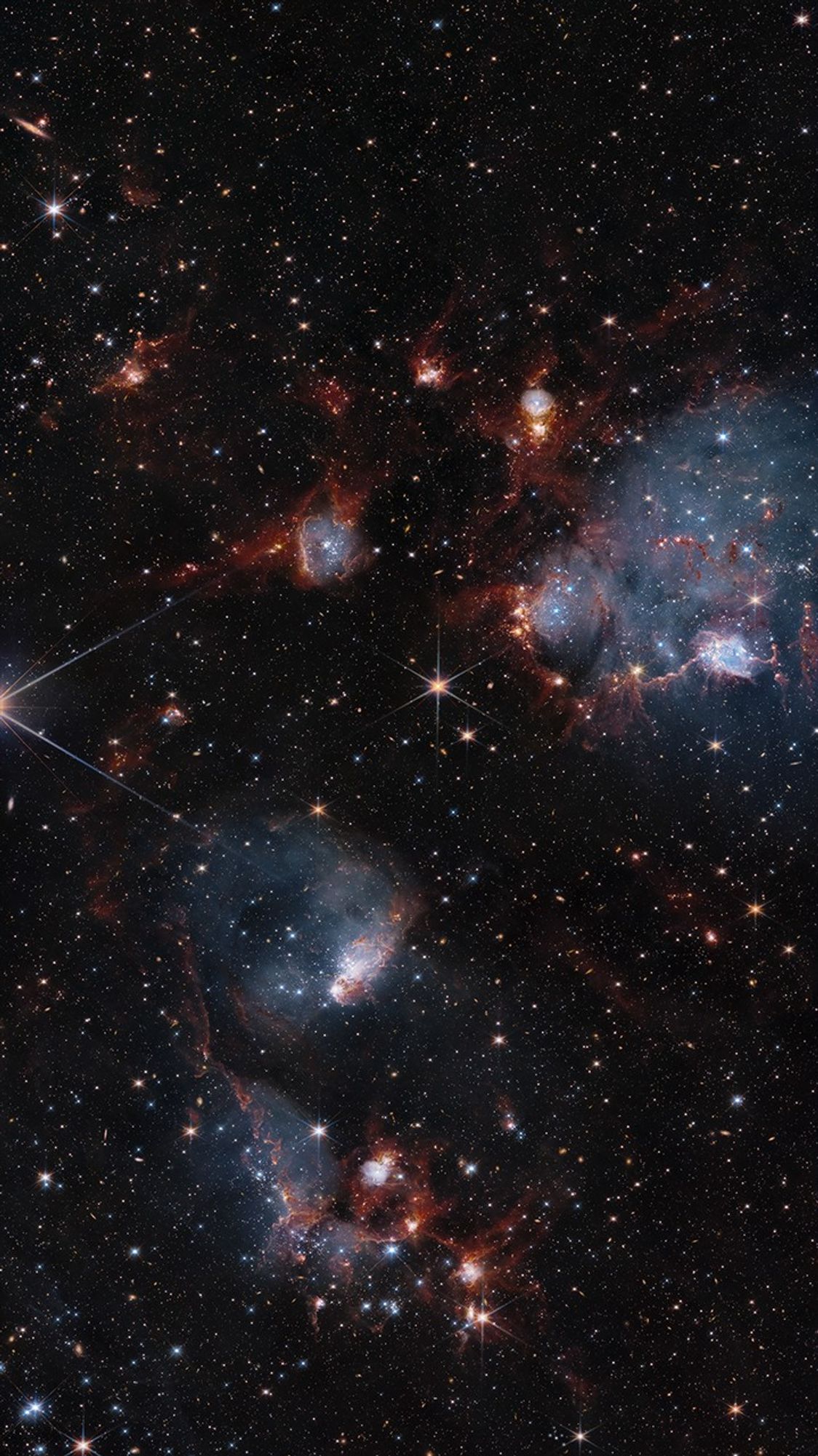
This week’s image combines images from the James Webb Space Telescope (JWST) and the Hubble Space Telescope to create a compressive view of open clusters NGC 460 and NGC 456, which are located within the Small Magellanic Cloud orbiting the Milky Way. If you go to the NASA website hosting this image, you can see the original JWST and Hubble images that were combined to create that you see above.
Here is a little more from NASA explaining what you are seeing:
A riotous expanse of gas, dust, and stars stake out the dazzling territory of a duo of star clusters in this combined image from NASA’s Hubble and Webb space telescopes.
Open clusters NGC 460 and NGC 456 reside in the Small Magellanic Cloud, a dwarf galaxy orbiting the Milky Way. Open clusters consist of anywhere from a few dozen to a few thousand young stars loosely bound together by gravity. These particular clusters are part of an extensive complex of star clusters and nebulae that are likely linked to one another. As clouds of gas collapse, stars are born. These young, hot stars expel intense stellar winds that shape the nebulae around them, carving out the clouds and triggering other collapses, which in turn give rise to more stars.
In these images, Hubble’s view captures the glowing, ionized gas as stellar radiation blows “bubbles” in the clouds of gas and dust (blue), while Webb’s infrared vision highlights the clumps and delicate filamentary structures of dust (red). In Hubble images, dust is often seen silhouetted against and blocking light, but in Webb’s view, the dust – warmed by starlight – shines with its own infrared glow. This mixture of gas and dust between the universe’s stars is known as the interstellar medium.
 Our Awesome Universe