
Here are some recent space-related stories of interest.
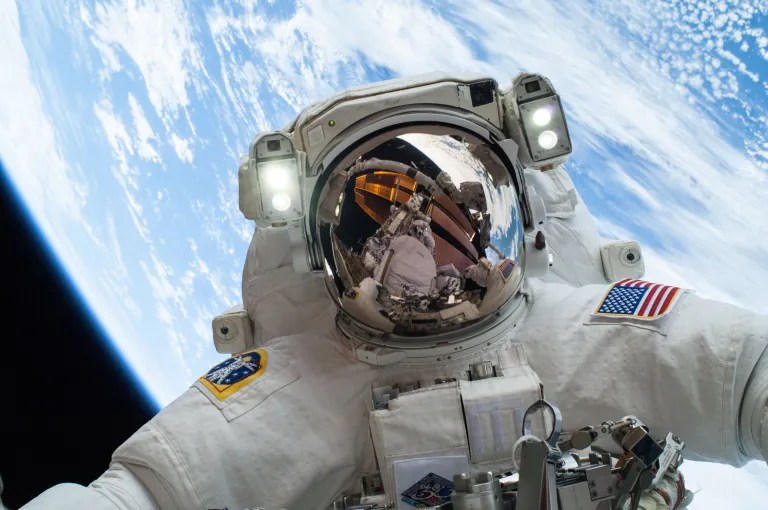
—NASA: “Celebrating 25 Years of Continuous Human Presence Aboard the International Space Station “
NASA and its partners have supported humans continuously living and working in space since November 2000. A truly global endeavor, the International Space Station has been visited by more than 280 people from 23 countries and a variety of international and commercial spacecraft. The unique microgravity laboratory has hosted more than 4,000 experiments from more than 5,000 researchers in more than 110 countries. The space station also is facilitating the growth of a commercial market in low Earth orbit for research, technology development, and crew and cargo transportation.
—Max Planck Institute: “The Evolution of Life May Have Its Origins in Outer Space“
Using the Atacama Large Millimeter/submillimeter Array (ALMA), a team of astronomers led by Abubakar Fadul from the Max Planck Institute for Astronomy (MPIA) has discovered complex organic molecules – including the first tentative detection of ethylene glycol and glycolonitrile – in the protoplanetary disc of the outbursting protostar V883 Orionis. These compounds are considered precursors to the building blocks of life. Comparing different cosmic environments reveals that the abundance and complexity of such molecules increase from star-forming regions to fully evolved planetary systems. This suggests that the seeds of life are assembled in space and widespread.
—Curtin University: “Interference to Astronomy the Unintended Consequence of Faster Internet“
Curtin University researchers have undertaken the world’s biggest survey of low frequency satellite radio emissions, finding Starlink satellites are significantly interfering with radio astronomy observations, potentially impacting discovery and research. Unintended signals from satellites – leaked from onboard electronics – can drown out the faint radio waves astronomers use to study the universe.
 Our Awesome Universe