Podcast: Winter is Coming? I Hope Not

If you missed this podcast three years ago, you will want to catch it now. I listened to it again and enjoyed it just as much as last time.

The Startalk podcast episode it titled “Nuclear Winter with Ann Druyan and Brian Toon” was first broadcast on August 9, 2022, but it was shared again this past July 4th.

Here is a summary of what you will hear:

Are advanced civilizations doomed to destroy themselves? On this episode, Neil deGrasse Tyson and co-host Chuck Nice explore the Cold War, The Drake Equation, and Carl Sagan’s work on the nuclear winter hypothesis with producer of Cosmos and Carl Sagan’s widow Ann Druyan and atmospheric scientist Brian Toon.

Learn about the Future of Life award (details here) and how scientists came up with the nuclear winter hypothesis. How close to annihilation were we? Ann tells us about working with Carl Sagan on Cosmos and his research on this world and others. Find out how Carl Sagan’s research on the climate of Venus inspired work on the runaway greenhouse effect in our own atmosphere. Are scientists always supposed to be dispassionate?

What are the long-term consequences of nuclear war? How did they discover nuclear winter? Find out about volcanic eruptions and how the asteroid that killed the dinosaurs helped spark the idea of a nuclear winter. What happened after the US dropped atomic bombs on Hiroshima and Nagasaki? We learn about what smoke does to the atmosphere and what a post-nuclear world would look like. Why haven’t we seen any other advanced civilizations in the universe? Where are they? We talk about the Drake Equation, the fate of the Earth, and the current state of weapons of mass destruction. How much food would be needed to save up to survive a nuclear winter? Is there anywhere that would be safe?

What was the public’s reaction to nuclear winter? How did it impact geopolitics? Discover how Carl Sagan publicized the hypothesis to US and Russian politicians. Has the global amount of nuclear weapons gone down? We discuss the role of science communication and the concerning instability in the world today. Finally, are we safe?

I don’t want to repeat myself here, so you can read my comments in my earlier post.

Given the continued nasty war between Ukraine and Russia, as well as the recent bombing of nuclear sites in Iran, this episode is still sadly relevant. The discussion about the Reagan administration trying to block scientific inquiry also seems all too familiar today as the Trump administration guts our science programs, including NASA.

I just hope we are in a better place three years from now, both domestically and overseas.
Pic of the Week: Open Clusters NGC 460 and NGC 456

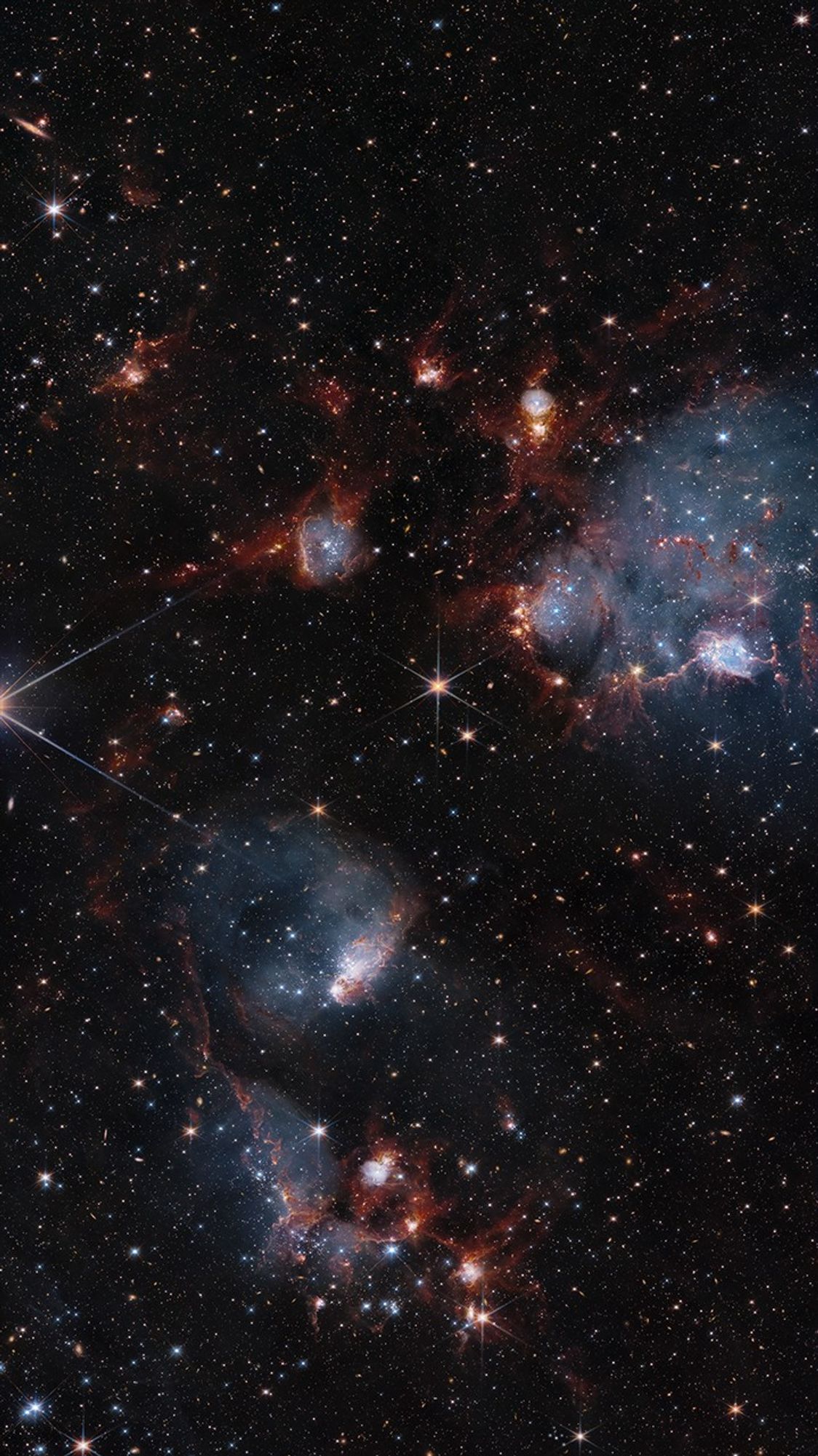
Image (Credit): Open clusters NGC 460 and NGC 456 within the Small Magellanic Cloud, a dwarf galaxy orbiting the Milky Way. (NASA, ESA, and C. Lindberg (The Johns Hopkins University); Processing: Gladys Kober (NASA/Catholic University of America))

This week’s image combines images from the James Webb Space Telescope (JWST) and the Hubble Space Telescope to create a compressive view of open clusters NGC 460 and NGC 456, which are located within the Small Magellanic Cloud orbiting the Milky Way. If you go to the NASA website hosting this image, you can see the original JWST and Hubble images that were combined to create that you see above.

Here is a little more from NASA explaining what you are seeing:

A riotous expanse of gas, dust, and stars stake out the dazzling territory of a duo of star clusters in this combined image from NASA’s Hubble and Webb space telescopes.

Open clusters NGC 460 and NGC 456 reside in the Small Magellanic Cloud, a dwarf galaxy orbiting the Milky Way. Open clusters consist of anywhere from a few dozen to a few thousand young stars loosely bound together by gravity. These particular clusters are part of an extensive complex of star clusters and nebulae that are likely linked to one another. As clouds of gas collapse, stars are born. These young, hot stars expel intense stellar winds that shape the nebulae around them, carving out the clouds and triggering other collapses, which in turn give rise to more stars.

In these images, Hubble’s view captures the glowing, ionized gas as stellar radiation blows “bubbles” in the clouds of gas and dust (blue), while Webb’s infrared vision highlights the clumps and delicate filamentary structures of dust (red). In Hubble images, dust is often seen silhouetted against and blocking light, but in Webb’s view, the dust – warmed by starlight – shines with its own infrared glow. This mixture of gas and dust between the universe’s stars is known as the interstellar medium.

Temporary NASA Administrator Announced

Earlier today President Trump announced that Secretary of Transportation Sean Duffy will now be performing double duties as he takes on the temporary leadership of NASA. This follows the dropping of Jared Isaacman as the next NASA administrator earlier this year.

This is not good news for NASA given that (1) a permanent leader seems to be farther away now and (2) Secretary Duffy will be busy with two roles, thereby giving only half his attention to NASA. NASA deserves better as it faces big decisions regarding budget cuts. Fortunately, some of the proposed cuts were reversed in the budget bill signed last week.

Is Duffy the right guy at the moment? Some wonder how he even became Secretary of Transportation, with one editorial noting:

what should be a concern is that Duffy’s resume doesn’t include experience relevant for running an organization as large as the U.S. Department of Transportation, which has with 55,000 employees, or for overseeing the nation’s roads, airfields, rail system and shipping ports.

The editorial goes on to state that Duffy’s main quantification appeared to his “visibility on Fox News.”

Great. We know how well that is going for the Department of Defense.

Is Musk Taking a Chainsaw to SpaceX?

Credit: Image by Mostafa Elturkey from Pixabay.

The press is all abuzz about Elon Musk’s latest statements regarding his establishment a new political party called the America Party. Some of the stories also relate to his continued inattention to his companies, particularly Tesla. Fortune magazine quoted one security tech analyst who stated:

Very simply Musk diving deeper into politics and now trying to take on the Beltway establishment is exactly the opposite direction that Tesla investors/shareholders want him to take during this crucial period for the Tesla story.

The same concerns exist with SpaceX, even it if is a private company. Elon Musk has been distracted by politics for too long as his companies take a back seat. His budget-cutting work for President Trump tanked Tesla sales around the world while his recent divorce with the White House caused President Trump to ask whether the government needed to cut off contracts to SpaceX. Throughout, it has been a roller coaster for his customers and investors.

Surprisingly, even Treasury Secretary Scott Bessent commented on the board of directors at Tesla and SpaceX during CNN’s State of the Union, noting:

I imagine that those boards of directors did not like this announcement yesterday (Saturday) and will be encouraging him to focus on his business activities, not his political activities.

AInvest also ssued this warning over the weekend:

Musk’s political pivot is a gamble with no clear playbook. While his companies’ technological prowess and market dominance provide a cushion, the interplay of regulatory risks, political spending, and third-party uncertainty demands vigilance.

It also doesn’t help that some of President Trump’s friends are now calling for the nationalization of SpaceX. For example, Trump advisor Steve Bannon has already suggested the White House should consider using the Defense Production Act to take control SpaceX. That would be an extremely serious step.

Mr. Musk does seem to have trouble keeping focus on his businesses, so maybe it makes sense for him to hand over more control to other managers while he goes off and plays with politics. He is a man who is no longer driven by Mars the planet but instead by Mars the god or war, in this case political wars.

His many distractions are not good for NASA, the space industry, or SpaceX investors.

Space Stories: Mystery on Saturn, an Interstellar Visitor, and Hunting a Rogue Planet

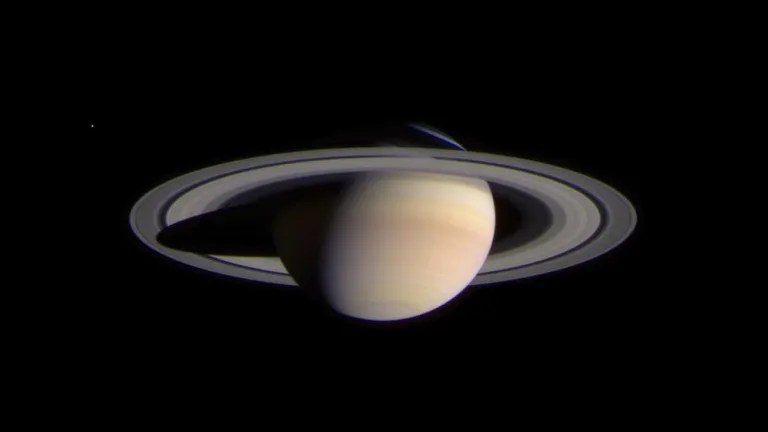
Image (Credit): Saturn as captured by NASA’s Cassini spacecraft on February 9, 2004 (NASA/JPL/Space Science Institute)

Here are some recent space-related stories of interest.

New Scientist: Did Something Just Hit Saturn? Astronomers Are Racing to Find Out

Something may have just hit Saturn – and, if so, an amateur astronomer could hold the key to confirming the event, which would be the first ever recorded on the gas giant. About seven asteroids or comets are estimated to impact Saturn every year, but no such event has ever been caught on camera. Now, NASA employee and amateur astronomer Mario Rana has recorded images that appear to show just that.

Astronomy.com: Astronomers Race to Learn More About Third Interstellar Visitor

Astronomers have spotted an object from outside our solar system bolting toward the Sun at around 150,000 mph (240,000 km/h). The big, frozen ball of ice and dust presents a rare chance to study an object that formed around an alien solar system, and potentially much earlier in the Milky Way’s history. The object named 3I/ATLAS — “3I” because it’s the third interstellar object detected so far, and “ATLAS” in honor of the system of telescopes that revealed it, the Asteroid Terrestrial-impact Last Alert System. Because the object is also showing tentative signs of cometary activity, it has also been designated C/2025 N1 (ATLAS).

Universe Today: Old Hubble Space Telescope Photos Unlock the Secret of a Rogue Planet

Astronomers have achieved a first in exoplanet hunting by using the Hubble Space Telescope images to investigate a mysterious event that could reveal the existence of a “rogue planet” drifting through space without a host star. The discovery centers on a brief astronomical phenomenon with the catchy name OGLE-2023-BLG-0524, detected in May 2023 by ground-based telescopes. The event lasted just eight hours and was caused by gravitational microlensing, an effect predicted by Einstein where a massive object acts like a magnifying glass in space, briefly brightening the light from a more distant object as it passes in front.