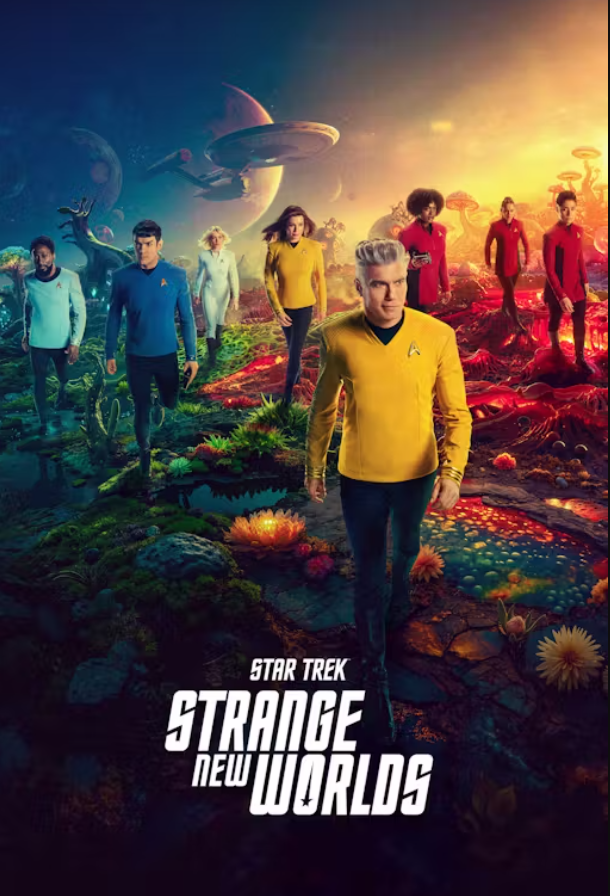
Television: Star Trek’s Strange New Worlds Returns

Credit: Paramount+

Season three of Star Trek: Strange New Worlds returns on July 17. It is the only remaining Star Trek series on television, so fans will not want to miss it. Fortunately, the series will be around for a little while now that it’s been approved for a total of six seasons, which should give the series plenty of time to wrap up the Captain Pike storyline.

So what is the plot of season three? Here is what Paramount+ is sharing:

In Season 3, when we reconnect with the crew of the U.S.S. Enterprise, still under the command of Captain Pike, they face the conclusion of Season 2’s harrowing encounter with the Gorn. But new life and civilizations await, including a villain that will test our characters’ grit and resolve. An exciting twist on classic Star Trek, Season 3 takes characters both new and beloved to new heights, and dives into thrilling adventures of faith, duty, romance, comedy, and mystery, with varying genres never before seen on any other Star Trek.

You can see the season three trailers here and here. While I did not observe any singing, it still appears that this season will have plenty of fun twists as well.

I am also looking forward to the upcoming Star Trek: Starfleet Academy television series starring Holly Hunter and Paul Giamatti, among many others. It is expected to premiere next year, thereby keeping the franchise alive and well with a whole new storyline.

So far, I have more faith in Star Trek‘s longevity on television than that of the Star Wars‘ television series. Of course, Star Trek already has a 10 year lead, but it has also been more consistent with the quality of its shows. This may be in part because it started on television, unlike Star Wars, so it did not need to reinvent itself. Whatever its secret, I hope it continues.

Study Findings: Carbonate Formation and Fluctuating Habitability on Mars

Image (Credit): Mars as captured by NASA Mars Global Surveyor MOC wide angle cameras. (NASA/JPL/MSSS)

Nature abstract of the study findings:

The cause of Mars’s loss of surface habitability is unclear, with isotopic data suggesting a ‘missing sink’ of carbonate. Past climates with surface and shallow-subsurface liquid water are recorded by Mars’s sedimentary rocks, including strata in the approximately 4-km-thick record at Gale Crater. Those waters were intermittent, spatially patchy and discontinuous, and continued remarkably late in Mars’s history—attributes that can be understood if, as on Earth, sedimentary-rock formation sequestered carbon dioxide as abundant carbonate (recently confirmed in situ at Gale). Here we show that a negative feedback among solar luminosity, liquid water and carbonate formation can explain the existence of intermittent Martian oases. In our model, increasing solar luminosity promoted the stability of liquid water, which in turn formed carbonate, reduced the partial pressure of atmospheric carbon dioxide and limited liquid water. Chaotic orbital forcing modulated wet–dry cycles. The negative feedback restricted liquid water to oases and Mars self-regulated as a desert planet. We model snowmelt as the water source, but the feedback can also work with groundwater as the water source. Model output suggests that Gale faithfully records the expected primary episodes of liquid water stability in the surface and near-surface environment. Eventually, atmospheric thickness approaches water’s triple point, curtailing the sustained stability of liquid water and thus habitability in the surface environment. We assume that the carbonate content found at Gale is representative, and as a result we present a testable idea rather than definitive evidence.

Citation: Kite, E.S., Tutolo, B.M., Turner, M.L. et al. Carbonate formation and fluctuating habitability on Mars. Nature 643, 60–66 (2025).

https://doi.org/10.1038/s41586-025-09161-1

Study-related stories:

University of Chicago – “Was Mars Doomed to be a Desert? Study Proposes New Explanation”

Science Alert – “NASA Discovery Could Explain Why We’ve Never Found Life on Mars”

The Register – “Mars Was Once a Desert with Intermittent Oases, Curiosity Data Suggests”

Russian Delivery Heading to ISS

Image (Credit): Launch of the Progress 92 cargo craft from the Baikonur Cosmodrome in Kazakhstan. (NASA)

Russia launched another cargo mission to the International Space Station ((SS) yesterday. A Soyuz rocket launched the Progress 92 spacecraft towards the space station at 3:32 pm ET from the Baikonur Cosmodrome in Kazakhstan. The spacecraft will dock with the ISS tomorrow afternoon, ensuring critical supplies are available to the crew member.

In the meantime, you can watch a Fourth of July message from NASA’s Expedition 73 Flight Engineers Anne McClain, Nichole Ayers, and Jonny Kim.

Happy Fourth of July to everyone.

Pic of the Week: Spiral Galaxy UGC 11397

Image (Credit): The spiral galaxy UGC 11397 as captured by the Hubble Space Telescope. (ESA/Hubble & NASA, M. J. Koss, A. J. Barth)

This week’s image is from the Hubble Space Telescope. It is an image of the spiral galaxy UGC 11397, which is located about 250 million years light-years away.

At the time the light we are now seeing left UGC 11397, the Earth was a very different place. It was dealing with the Permian–Triassic mass extinction, also called the Great Dying. During this period about 94 percent of marine species and 70 percent of terrestrial vertebrate families disappeared from the planet.

Anyway, getting back to the image itself, here is a little more information from NASA to explain what you are seeing:

What sets UGC 11397 apart from a typical spiral lies at its center, where a supermassive black hole containing 174 million times the mass of our Sun grows. As a black hole ensnares gas, dust, and even entire stars from its vicinity, this doomed matter heats up and puts on a fantastic cosmic light show.

Material trapped by the black hole emits light from gamma rays to radio waves, and can brighten and fade without warning. But in some galaxies, including UGC 11397, thick clouds of dust hide much of this energetic activity from view in optical light. Despite this, UGC 11397’s actively growing black hole was revealed through its bright X-ray emission — high-energy light that can pierce the surrounding dust. This led astronomers to classify it as a Type 2 Seyfert galaxy, a category used for active galaxies whose central regions are hidden from view in visible light by a donut-shaped cloud of dust and gas.

Space Quote: Maybe We Will See Another Astronaut in the Senate

Image (Credit): NASA Astronaut Terry Virts. (NASA)

It is a disaster. You know, NASA’s budget overall is cut by a quarter — this is proposed — and the science budget is cut by half. Here in Houston — you know, I’m from Houston — it’s going to be a disaster. Thousands and thousands of people are going to lose their jobs. They’re already having profoundly negative effects on the space station’s science ability — the ability to do science on the International Space Station that I helped build and commanded. They are going to cut important space probes. I saw there’s going to be 41 space missions that are canceled. There’s over a dozen space missions that are currently in operation, things like New Horizons, Juno and others that are costing pennies on the dollar. These things are super cheap. We’ve already paid all the expense. We should just keep them operating, and they’re going to cancel those. It’s just a disaster.

-Statement by former NASA astronaut Terry Virts, who last week announced his plans to run the U.S. Senate in Texas to replace incumbent Senator John Cornyn. He made this statement after being asked “What is your take on the White House’s proposed NASA budget?” during an interview with Space.com.