Pew Study Reports on NASA’s Support Among the Public

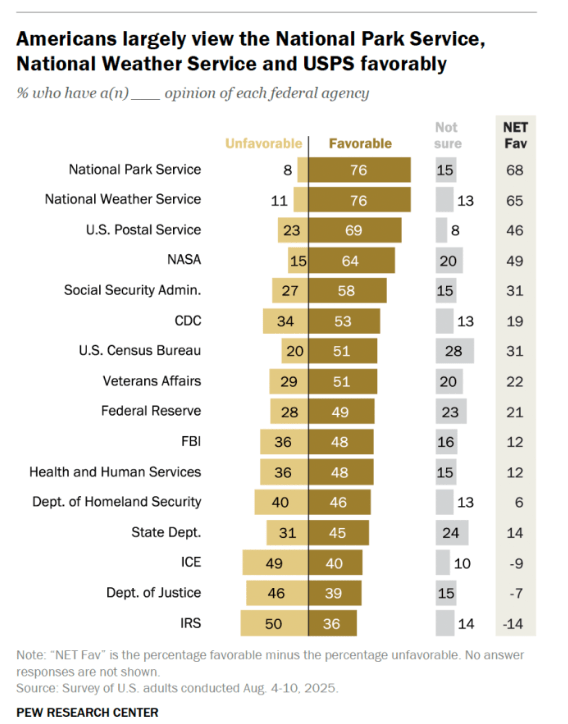
A recent Pew Research Center report titled Republicans’ Views of Justice Department, FBI Rebound as Democrats’ Views Shift More Negative found that NASA was among the fourth most favorably viewed federal agency from among 16 agencies. Not surprisingly, the IRS placed last. However, it was joined at the bottom by ICE and the Department of Justice.

As shown in the graphic above, 64 percent of the American interviewed had a positive view of NASA, 15 percent did not, and 20 percent were not sure about what they thought about NASA. In another graphic, we learn that the 64 percent figure comes from 61 percent of Republicans and 71 percent of Democrats.

This comes at a time of planned deep cuts at the space agency. So what troubles the Republicans most about NASA?

According to Acting NASA Administrator Sean Duffy, one of the problems at NASA is the climate science focus. Mr. Duffy recently stated:

All the climate science and all of the other priorities that the last administration had at NASA we’re going to move aside, and all of the science that we do is going to be directed towards exploration, which is the mission of NASA.

Is that consistent with what the public says it wants in terms of priorities? Not at all. In fact, the public has the opposite view according to another Pew Research Center report from 2023, Americans’ Views of Space: U.S. Role, NASA Priorities and Impact of Private Companies, where monitoring the Earth’s climate was a much higher priority to Americans than sending astronauts to the Moon or Mars (see graphic below).

So the current White House is cutting a favored program and shifting the remaining resources in a direction that is inconsistent with the pubic’s stated preferences. This does not sound like a winning strategy for the White House or, more importantly, the American public paying the bills.

Space Quote: Happy Labor Day, NASA

Credit: Image by Mohamed Hassan from Pixabay.

“The agencies and agency subdivisions set forth in section 2 of this order are hereby determined to have as a primary function intelligence, counterintelligence, investigative, or national security work. It is also hereby determined that Chapter 71 of title 5, United States Code, cannot be applied to these agencies and agency subdivisions in a manner consistent with national security requirements and considerations.”

-Wording in an executive order, signed on Thursday, that eliminates the workers’ union at NASA. While NASA was set up as a civilian agency completely separate from the U.S. Air Force and U.S. Space Command, which have national security functions, that was not enough to protect it from expansive White House interpretations targeting federal workers. Other federal agencies had their unions removed earlier this year, and other joined NASA in this latest executive order, such as the National Weather Service. One might wonder why these civilian agencies are being decimated by the same White House given that they are so critical to national security, but logic has little to do with government operations these days.

The Few, The Proud, The Moon Watchers

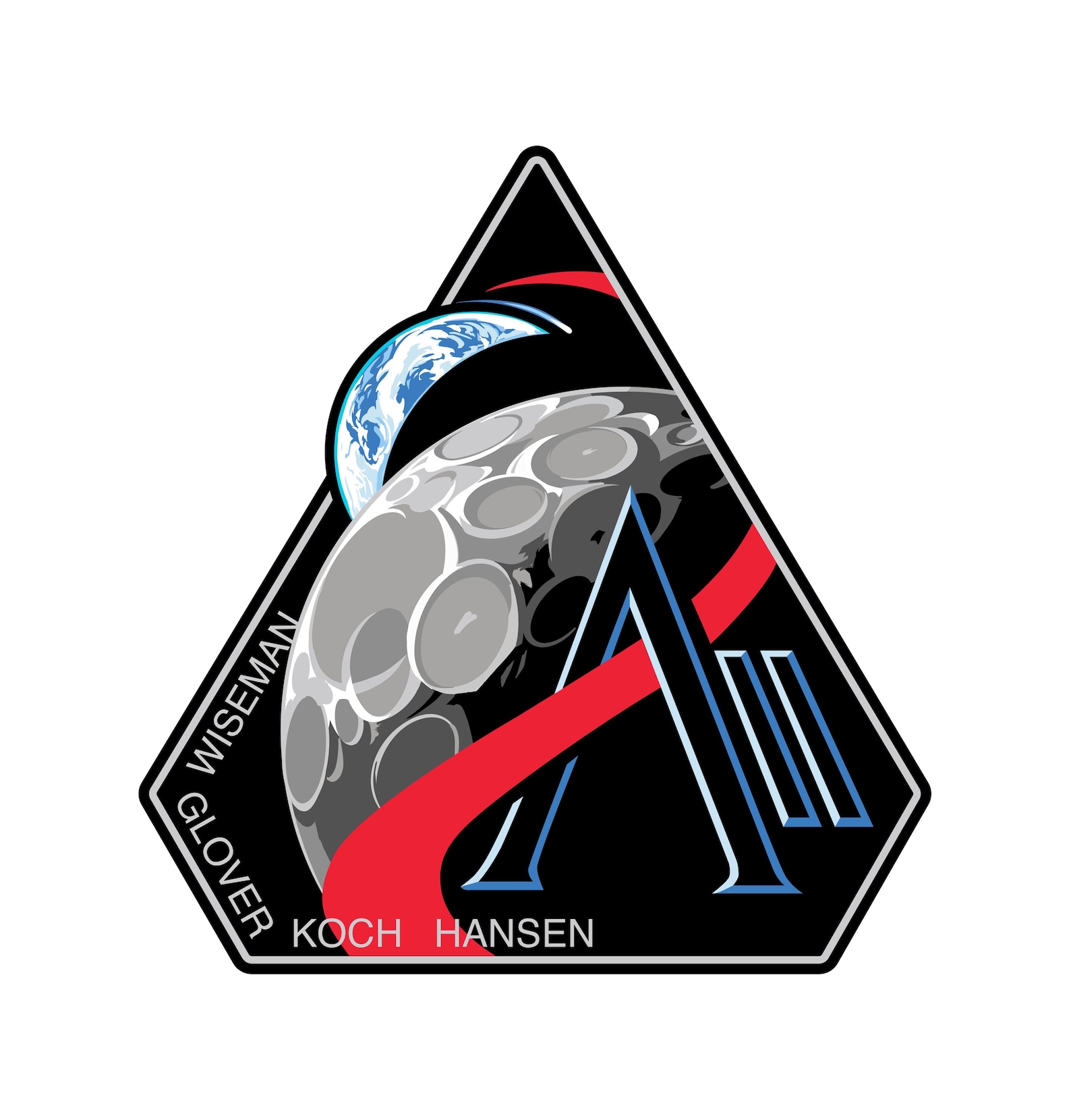
Image (Credit): Artemis II mission crew patch. (NASA)

NASA is looking for volunteers to assist next year’s Artemis II mission, which is expected to take place in April 2026. The volunteers will help track of the Artemis II Orion crewed spacecraft as it travels around the Moon.

The volunteers will monitor Orion’s signal using their respective ground antennas to help track and measure changes in the radio waves transmitted by the spacecraft. Volunteers similarly assisted with uncrewed Orion tracking during Artemis I.

This is a unique opportunity for international space agencies, academic institutions, commercial companies, nonprofit entities, and even private citizens to be part of the Artemis II mission.

Give it some thought and, if you are interested, read through NASA’s Artemis II Orion One-Way Doppler Measurements Tracking solicitation. You have until October 27th to apply.

Note: Below is a list of the 18 volunteers that assisted with the Artemis I mission:

Government Space Agencies

  • Canadian Space Agency, Canada
  • Centre National d’Etudes Spatiales (CNES), France
  • German Aerospace Center (Deutsches Zentrum für Luft- und Raumfahrt), Germany
  • Korea Aerospace Research Institute (KARI), Republic of Korea
  • National Space Centre, Elfordstown Earthstation, Ireland

Commercial Companies

  • Clearbox Systems Pty Ltd., Australia
  • Goonhilly Earth Station Ltd., United Kingdom
  • Intuitive Machines, USA
  • Kongsberg Satellite Services (U.S. office), USA
  • Leaf Space LLC, USA
  • Swedish Space Corporation (U.S. office), USA
  • Telespazio, Italy
  • Vambrace Inc., USA
  • Viasat, USA

Non-profit

  • CAMRAS, Netherlands

Academic Institutions

  • Space Systems Design Laboratory, Georgia Tech Research Institute, USA

Private Citizens

  • Scott Chapman, USA
  • Scott Tilley, Canada

Pic of the Week: “Blood Moon Rising Behind the City Skyscrapers”

Image (Credit): Shortlisted image “Blood Moon Rising Behind the City Skyscrapers.” (Tianyao Yang)

ZWO’s annual Astronomy Photographer of the Year Contest recently highlighted its 2025 shortlisted images, such as the image above from photographer Tianyao Yang titled “Blood Moon Rising Behind the City Skyscrapers.”

Here is the photographer’s description of the photo:

This photograph captures a red Full Moon rising beside Shanghai’s tallest skyscrapers in Lujiazui. Taken from a distance of 26.5 km (16.5 miles) from the skyscrapers in a single exposure, this image’s alignment took five years of planning. The Full Moon appears perfectly positioned next to the illuminated skyline, creating a striking contrast. 

Check out many other images at the contest site. The winning images will be announced at a ceremony on September 11, 2025.

Starship: The 10th Try Was a Success

Image (Credit): Artist’s rendering of a Starship human lander to the Moon’s surface. (SpaceX)

On Tuesday, Starlink finally launched its 10th test flight after a rough patch of three bad launches. Regarding this tenth test, SpaceX stated:

Every major objective was met, providing critical data to inform designs of the next generation Starship and Super Heavy.

Everything from the booster splash landing in the Gulf of Mexico shortly after ascending from Starbase, Texas, to the rocket itself splash landing in the Indian Ocean was a positive sign that things are back on track for the company and its rocket.

Now maybe talk can begin again about NASA’s Artemis program and the role of the Starship to bring humans back to the Moon. It is not clear how many tests will be required before the rocket is ready, but the Artemis program is already suffering from delays.

Hopefully, this successful test is a sign that things are getting back on track.