
Is Ukraine Suggesting an End to US-Russian Cooperation in Space?

In a recent Washington Post editorial titled “How to Shut Down Putin’s War Machine,” Andriy Yermak, who is the head of the presidential office of Ukraine, states that Roscosmos should not be considered as a “neutral civilian institution.” He notes that the space agency helps to guide Russian missile strikes, so it is just another part of the military-industrial complex.

Mr. Yermak goes on to state that Roscosmos “…must be sanctioned in full and banned from cooperating with Western scientific and academic institutions.”

So how would this apply to the International Space Station (ISS), which is clearly a scientific endeavor?

Russia has already threatened to leave the ISS many times, so its departure is something that has been contemplated by the US and Russia. But here we are talking about about pushing them off the station. Will they take their components and head home? Is a partial station solely dependent on the whims of Elon Musk better than a fully-functional station with the Russians?

Of course, a hot war with Russia is something else. Recent threats by both Russia and the US regarding nuclear weapons has not been helpful, but little has really changed on the ground since the initial Russian invasion (much to President Putin’s chagrin).

It is not only Ukraine questioning the Russian presence on the station. Retired NASA astronaut Terry Virts, who served as a commander on the ISS, recently said this to Radio Free Europe:

Cooperating with the Russians on the ISS is like going on an Antarctic expedition with Nazis in 1943…It’s just morally reprehensible.

So far both nations have decided that the current arrangement is working, but that may not last forever if the current spat between the former Russian president and the current American president continue. That would be unfortunate with Russia’s program limping along and the US space program looking at drastic cuts.

The last thing we need is an empty space station orbiting the Earth as a memorial to our foolishness here on the ground.

Space Stories: White House Destroys Satellite, US Nuclear Reactor Proposed for the Moon, and the End of the Lunar Trailblazer Mission

Here are some recent space-related stories of interest.

Oregon Public Radio: Why a NASA Satellite that Scientists and Farmers Rely On May Be Destroyed on Purpose

The Trump administration has asked NASA employees to draw up plans to end at least two major satellite missions, according to current and former NASA staffers. If the plans are carried out, one of the missions would be permanently terminated, because the satellite would burn up in the atmosphere. The data the two missions collect is widely used, including by scientists, oil and gas companies and farmers who need detailed information about carbon dioxide and crop health. They are the only two federal satellite missions that were designed and built specifically to monitor planet-warming greenhouse gases.

CNN: NASA Wants US to be the First Nation to Put Nuclear Reactor on the Moon

Acting NASA Administrator Sean Duffy has directed the agency to fast-track plans to put a nuclear reactor on the moon. Expediting work to place a reactor on the lunar surface to help power moon exploration efforts would keep the United States ahead of China and Russia, both of which have “announced on at least three occasions” a joint effort to develop such a project by the mid-2030s, according to a directive dated July 31 and obtained by CNN.

NASA: NASA’s Lunar Trailblazer Moon Mission Ends

NASA’s Lunar Trailblazer ended its mission to the Moon on July 31. Despite extensive efforts, mission operators were unable to establish two-way communications after losing contact with the spacecraft the day following its Feb. 26 launch. The mission aimed to produce high-resolution maps of water on the Moon’s surface and determine what form the water is in, how much is there, and how it changes over time. The maps would have supported future robotic and human exploration of the Moon as well as commercial interests while also contributing to the understanding of water cycles on airless bodies throughout the solar system.

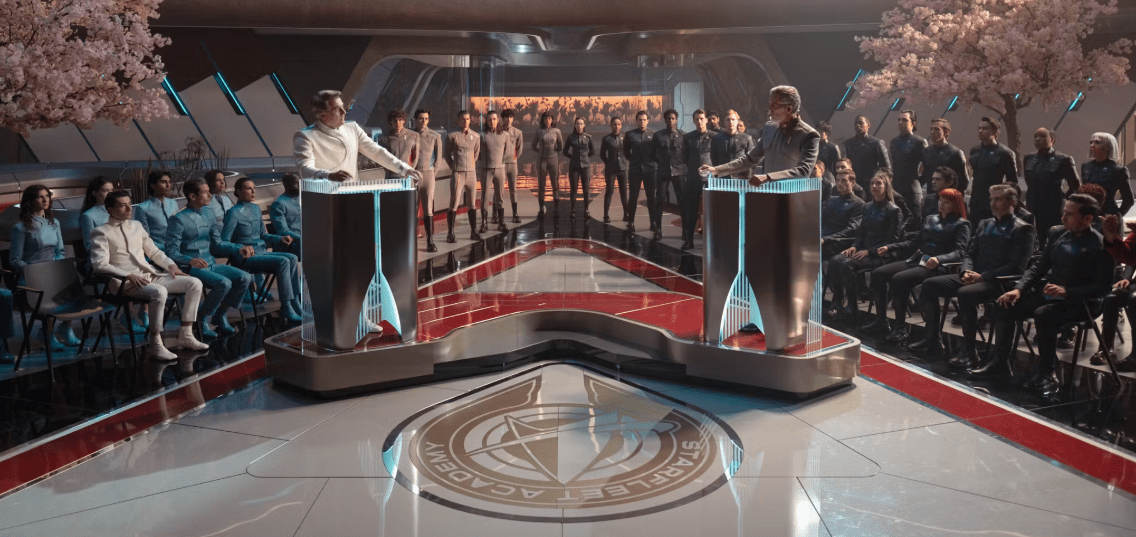
Television: A Look at the New Series Star Trek: Starfleet Academy

Image (Credit): A scene from Star Trek: Starfleet Academy. (Startrek.com)

Now that the Comic Con 2025 events are over, all we can do now is await the showing of the new Star Trek series Star Trek: Starfleet Academy, slated to premiere early next year. We can also rewatch the first look teaser trailer a few times.

So what can be shared about the new series? Startrek.com provided a helpful summary of the new crew members of the U.S.S. Athena, which will be the location of much of the action. You might also remember a few actors rejoining the series, including Robert Picardo as The Doctor and Tig Notaro as Jett Reno. Finally, Holly Hunter will be playing captain of the U.S.S. Athena while a new half-Klingon villian will be played by Paul Giamatti.

Another familiar face behind the series is Rod Roddenberry, son of Star Trek creator Gene Roddenberry, who is the executive producer on other familiar Star Trek series, including Star Trek: Discovery, Star Trek: Picard, Star Trek: Lower Decks, Star Trek: Prodigy, and Star Trek: Strange New Worlds.

And what is the setting for this new series? While earlier discussions about a Starfleet Academy series looked to an earlier era, this version is set in the 32nd century after some rough times for the Federation (see the Star Trek: Discovery series to understand that mess). Co-creator of the series Alex Kurtzman explained it in this way to the Los Angeles Times:

As the father of a 17-year-old boy, I see what my son is feeling as he looks at the world and to his future. I see the uncertainty; I see all the things we took for granted as given are not certainties for him. I see him recognizing he’s inheriting an enormous mess to clean up and it’s going to be on his generation to figure out how to do that, and that’s a lot to ask of a kid. My thinking was, if we set “Starfleet Academy” in the halcyon days of the Federation where everything was fine, it’s not going to speak to what kids are going through right now.

So this is really a show for the Gen Z viewers out there who need to put this world back on track. I can understand the desire to be relevant to a new generation, as Star Trek was when it came out in the confusing and troubling 1960s. Though whether or not one is part of Gen Z, I believe we can all take something away from the new series, as we have with all of those that preceded it.

Credit: Startrek.com.

Space Quote: Senators Question NASA Cuts

Credit: NASA/JPL.

“Although Congress has not completed the appropriations process for FY 2026, the White House Office of Management and Budget (OMB) has already disregarded Congress’s constitutional authority to direct government spending, unlawfully impounding congressionally appropriated NASA FY 2025 funds. Before Congress had approved a single appropriations bill, the Trump Administration and OMB Director Russell Vought directed federal agencies to freeze over $100 million in appropriated funds for science initiatives at NASA. Amidst the threat of looming cuts, NASA has already lost over 2,000 senior-level employees at NASA centers in Maryland, Texas, Florida, Virginia, Alabama, and Ohio. These losses will deprive NASA of key expertise on science, human space flight, and mission support. In blatant violation of law and complete disregard for the authority of Congress, the President’s budget request has already done significant damage to American space exploration and innovation.”

-A statement in an August 1, 2025 letter from six Democratic US Senators to the acting NASA Administrator Sean Duffy pertaining to ongoing and planned cuts at the agency. The Senators requested responses to six questions, including “How does NASA intend to accomplish its mission of leading in space when the proposed funding cuts will gut world-renowned missions like Mar Sample Return (MSR) and trigger the mass layoff of employees with decades of institutional expertise and knowledge?” A good question.

Study Findings: The Case for Mars Terraforming Research

Image (Credit): NASA infographic highlighting NASA’s twin robot geologists, the Mars Exploration Rovers (MER) Spirit and Opportunity. (NASA/JPL-Caltech)

Nature Astronomy abstract of the study findings:

Terraforming Mars has long captured the imagination but has received surprisingly little rigorous study. Progress in Mars science, climate science, launch capabilities and bioscience motivates a fresh look at Mars terraforming research. Since Sagan’s time, it has been understood that terraforming Mars would involve warming to enable oxygenic photosynthesis by engineered microbes, followed by slow oxygen build-up enabling more complex life. Before we can assess whether warming Mars is worthwhile, relative to the alternative of leaving Mars as a pristine wilderness, we must confront the practical requirements, cost and possible risks. Here we discuss what we know about Mars’s volatile inventories and soil composition, and possible approaches to warm Mars and increase atmospheric O2. New techniques have emerged that could raise Mars’s average global temperature by tens of degrees within a few decades. Research priorities include focusing on understanding fundamental physical, chemical and biological constraints that will shape any future decisions about Mars. Such research would drive advances in Mars exploration, bioscience and climate modelling.

Citation: DeBenedictis, E.A., Kite, E.S., Wordsworth, R.D. et al. The case for Mars terraforming research. Nat Astron 9, 634–639 (2025).

https://doi.org/10.1038/s41550-025-02548-0

Study-related stories:

Sci.News – “Can We Make Mars Habitable through Terraforming?”

SciTechDaily – “Terraforming Mars: Scientists Reveal the 3-Step Plan to Breathe Life Into a Dead Planet”

Los Alamos National Laboratories – “Is Terraforming Mars Possible?”