
Here are some recent space-related stories of interest.
—McGill University: “CHORD Will Be a Huge Leap Forward for Canadian Radio Astronomy“
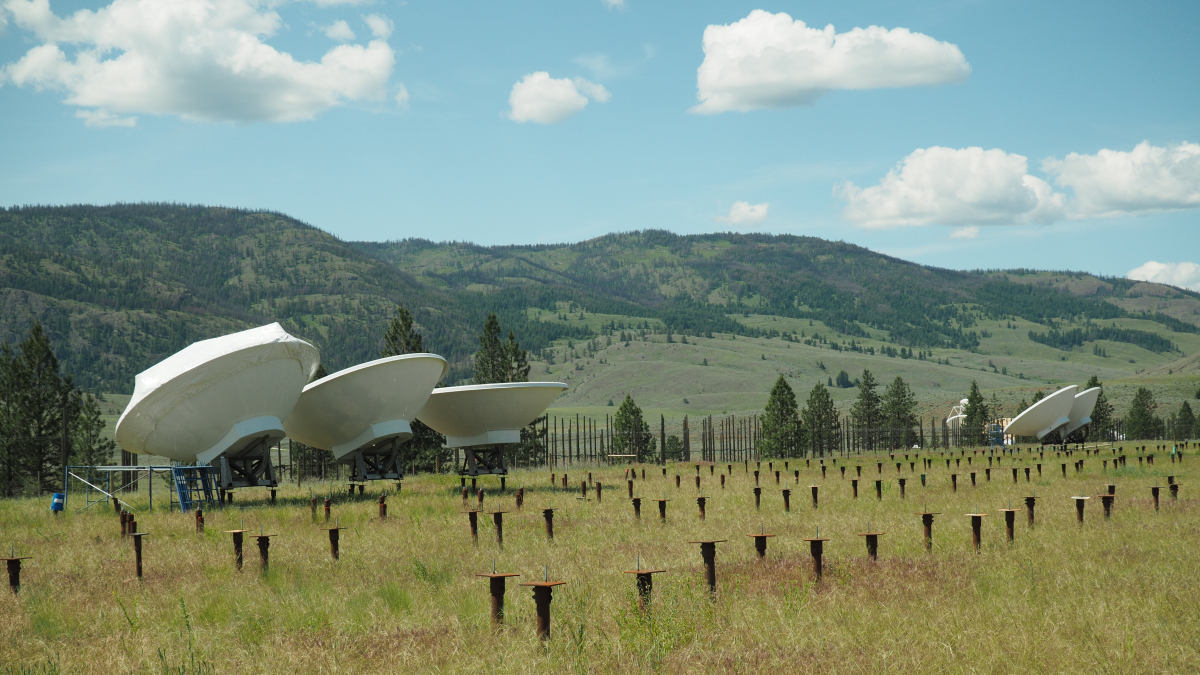
Construction is underway of CHORD, the most ambitious radio telescope project ever built on Canadian soil. Short for the Canadian Hydrogen Observatory and Radio-transient Detector, CHORD will give astronomers an unprecedented opportunity to explore some of the most exciting and mysterious questions in astrophysics and cosmology, from Fast Radio Bursts (FRBs) and dark energy to the measurements of fundamental particles, and beyond.
—BBC Sky at Night Magazine: “Earth Could Be Sitting in the Centre of a Giant Cosmic Void, According to Astronomers“
It’s human to feel alarmed by the sheer emptiness of space. Now, astronomers from the University of Portsmouth in the UK suggest this unsettling vastness may be worse than we thought. They reckon Earth, our entire Solar System and even our entire Milky Way sits inside a mysterious giant hole. This void, they believe, may cause the cosmos to expand more quickly in our local environment than in other parts of the Universe.
—University of Bern: “No Collision, No Life: Earth Probably Needed Supplies from Space“
After the formation of the Solar System, it took a maximum of three million years for the chemical composition of the Earth’s precursor to be completed. This is shown by a new study by the Institute of Geological Sciences at the University of Bern. At this time, however, there were hardly any elements necessary for life such as water or carbon compounds on the young planet. Only a later planetary collision probably brought water to Earth, paving the way for life.
 Our Awesome Universe