Space Quote: SpaceX Delays May Sink Efforts to Beat China to the Moon

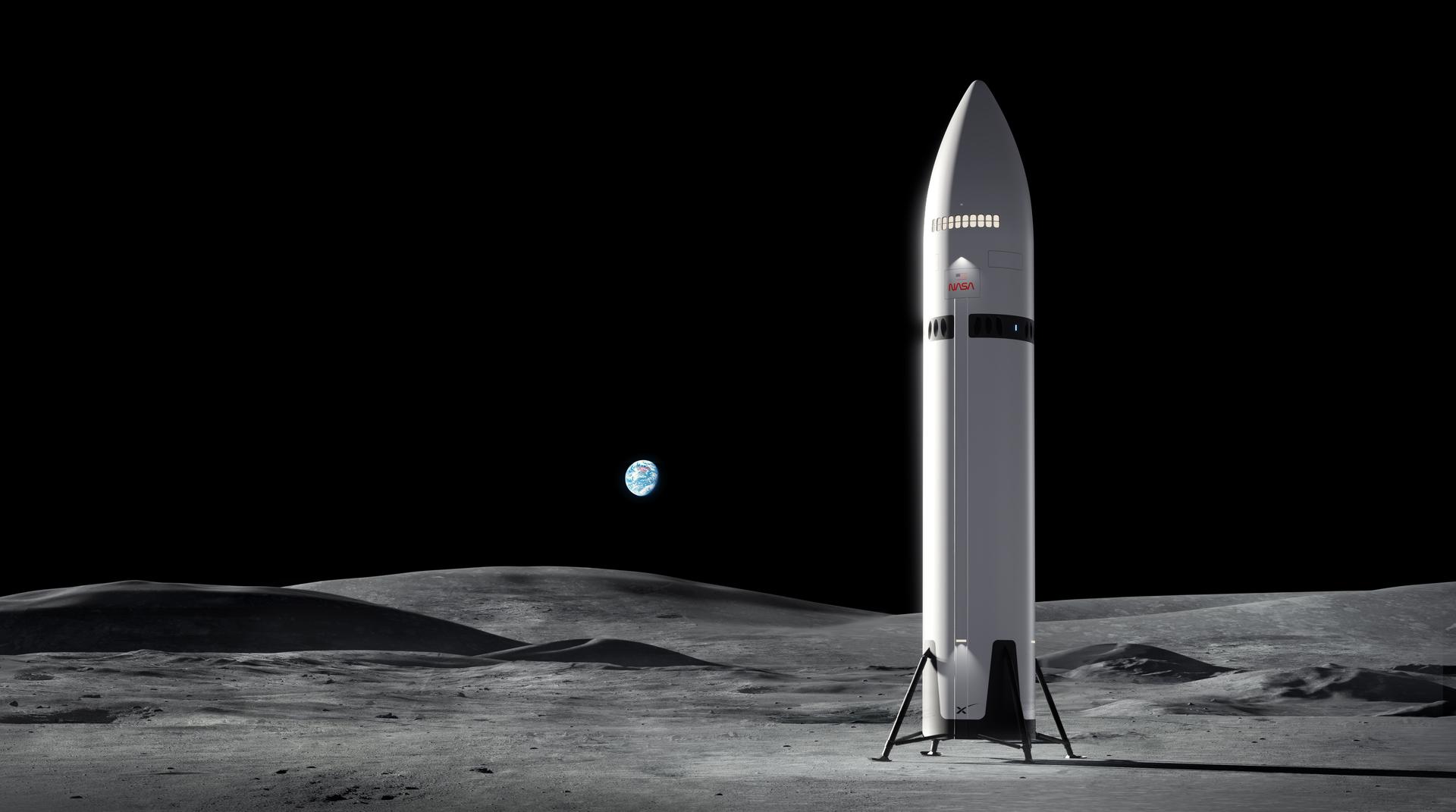
Image (Credit): Artist’s rendering of SpaceX’s Starship HLS on the Moon. (SpaceX)

“The HLS schedule is significantly challenged and, in our estimation, could be years late for a 2027 Artemis 3 moon landing.”

-Statement by Aerospace Safety Advisory Panel (ASAP) member Paul Sean Hill, as quoted by Space News. NASA contracted with SpaceX to develop the Human Landing System (HLS) for the astronauts landing on the Moon as part of Artemis III and later missions. While Blue Origin has also been tapped by NASA to assist with later missions, SpaceX was expected to provide the initial HLS. Maybe NASA should have picked two companies to provide the initial HLS, with the second in place still assisting with later landings. The ASAP’s 2024 Annual Report highlighted the many risks related to Artemis III, including several related to the HLS (shown below). Everyone knew this was going to be difficult, and no one wants to be asked to answer “Who Lost the Moon?” Also, it is good we still have a few advisory panels left after the recent purge.
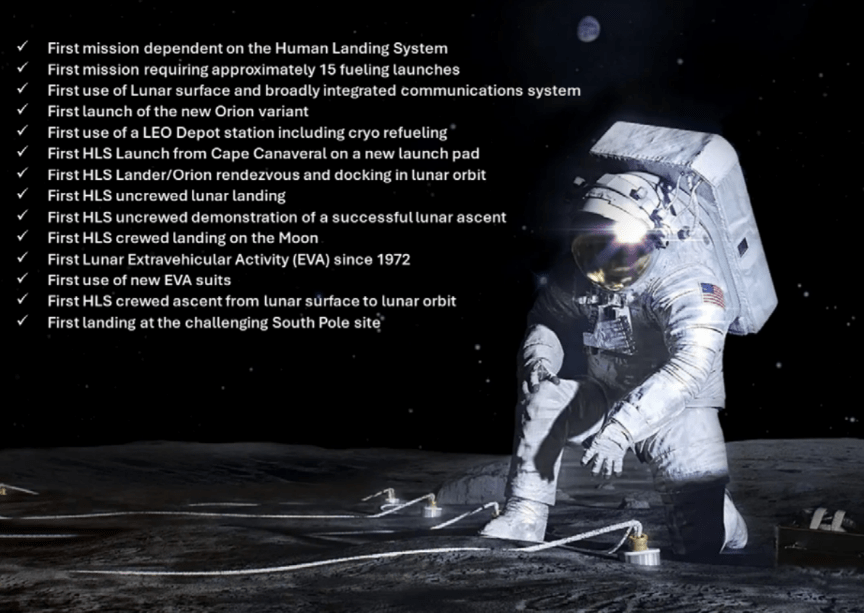
Image (Credit): Figure 1, “First-time milestones for the Artemis III mission,” contained in the ASAP’s 2024 Annual Report. (ASAP)

The VIPER Lives!

Image (Credit): The VIPER outside a testing chamber in the fall of 2024. (NASA/JSC David DeHoyos)

It was only last year that NASA gave up on its $450 million Volatiles Investigating Polar Exploration Rover (VIPER) project, but things have changed for the better.

Blue Origin has been selected by NASA to bring the rover to the Moon as part of a $190 million task order under the agency’s Commercial Lunar Payload Services program. Blue Origin’s Blue Moon Mark 1 robotic lander, which is scheduled to land on the Moon later this year, will include the VIPER was part of its future cargo in 2027.

As NASA has noted on its VIPER mission page, the rover was part of the Artemis program:

NASA’s Artemis lunar rover, the Volatiles Investigating Polar Exploration Rover, or VIPER, was designed to explore the relatively nearby but extreme environment of the Moon in search of ice and other potential resources. This mobile robot was slated to land at the South Pole of the Moon on a 100-day mission, in order to teach us about the origin and distribution of water on the Moon and help determine how we can harvest the Moon’s resources for future human space exploration.

While the VIPER mission was cancelled last summer, NASA continued to look for a partner to bring it to the Moon. Fortunately, Blue Origin was already going that way.

This is good news for scientists everywhere. It made no sense to turn a half billion dollar piece of equipment into a museum piece. We need more boots and tires on the lunar surface, and VIPER is fortunately part of those plans again.

Pic of the Week: Stellar Eruption Sharpless 2-284

Image (Credit): JWST image of stellar eruption Sh2-284. (NASA/ESA/CSA/STScI/NOAJ/Y. Cheng/J. DePasquale)

This week’s image from the James Webb Space Telescope (JWST) shows a stellar eruption called Sharpless 2-284 (or Sh2-284), which is located about 15,000 light-years away. The image provides a beautiful and delicate combination of colors.

As noted in Universe Today, Reseacher Yu Cheng stated:

We didn’t really know there was a massive star with this kind of super-jet out there before the observation. Such a spectacular outflow of molecular hydrogen from a massive star is rare in other regions of our galaxy. Massive stars, like the one found inside this cluster, have very important influences on the evolution of galaxies. Our discovery is shedding light on the formation mechanism of massive stars in low-metallicity environments, so we can use this massive star as a laboratory to study what was going on in earlier cosmic history.

NASA Delivery to the ISS Delayed

Image (Credit): Northrop Grumman’s insignia for the flight of its first Cygnus XL. (Northrop Grumman)

The Russian’s cargo spaceship arrived without incident at the International Space Station (ISS) over the weekend, but the NASA cargo spaceship has not been as smooth. The Northrop Grumman Cygnus XL cargo ship has experienced engine issues, which will delay its arrival. It was originally supposed to unload its cargo tomorrow morning (September 17).

This latest mission, labeled NG-23, is the first to use the Cygnus XL spacecraft, which has 33 percent more cargo capacity than the spacecraft it replaces.

Northrop Grumman’s vice president of civil space systems, Ryan Tintner, stated:

Our Cygnus XL is another step towards a thriving commercial space economy. The spacecraft carries more cargo, making each mission more efficient. We’ve supported NASA and the space station for decades, and we know what it takes to develop advanced capabilities for exploring space.

This is not a good start for the new spacecraft. Hopefully, the glitch will be quickly resolved. The spacecraft carries 11,000 pounds of needed supplies.

Update: The Cygnus XL mission is back on track. The spaceship is expected to arrive at the ISS on Thursday morning.

Second Update: The Cygnus XL mission was a success with supplies delivered successully to the ISS.