Image (Credit): The Martian rock nicknamed “Cheyava Falls” found in Jezero Crater last year. (NASA/JPL-Caltech/MSSS)
““The discovery of a potential biosignature, or a feature or signature that could be consistent with biological processes, but that requires further work and study to confirm a biological origin is something that we’re sharing with you all today that grows from years of hard work, dedication and collaboration between over 1,000 scientists and engineers here at the (NASA) Jet Propulsion Laboratory and our partner institutions around the country and internationally.”
–Statement by Katie Stack Morgan, Perseverance project scientist at the Jet Propulsion Laboratory (JPL), at a news conference earlier on Wednesday. The rock in question, found in an ancient dry riverbed in Jezero Crater, was sampled by the Perseverance rover last year. For more on the findings you can visit the NASA site here.
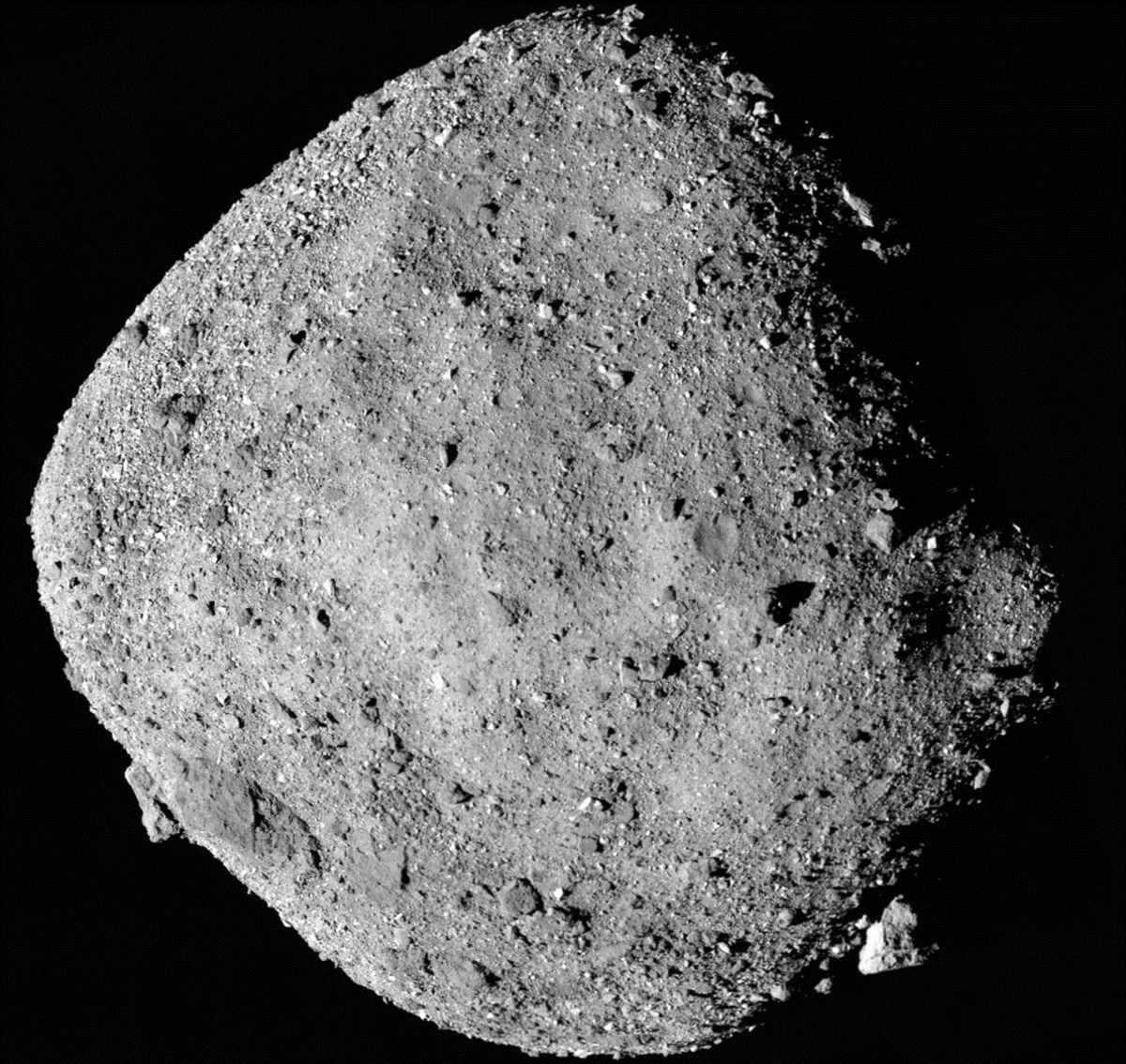
The first bodies to form in the Solar System acquired their materials from stars, the presolar molecular cloud and the protoplanetary disk. Asteroids that have not undergone planetary differentiation retain evidence of these primary accreted materials. However, geologic processes such as hydrothermal alteration can dramatically change their bulk mineralogy, isotopic compositions and chemistry. Here we analyse the elemental and isotopic compositions of samples from asteroid Bennu to uncover the sources and types of material accreted by its parent body. We show that some primary accreted materials escaped the extensive aqueous alteration that occurred on the parent asteroid, including presolar grains from ancient stars, organic matter from the outer Solar System or molecular cloud, refractory solids that formed close to the Sun, and dust enriched in neutron-rich Ti isotopes. We find Bennu to be richer in isotopically anomalous organic matter, anhydrous silicates, and light isotopes of K and Zn than its closest compositional counterparts, asteroid Ryugu and Ivuna-type (CI) carbonaceous chondrite meteorites. We propose that the parent bodies of Bennu, Ryugu and CI chondrites formed from a common but spatially and/or temporally heterogeneous reservoir of materials in the outer protoplanetary disk.
Citation: Barnes, J.J., Nguyen, A.N., Abernethy, F.A.J. et al. The variety and origin of materials accreted by Bennu’s parent asteroid. Nat Astron (2025).
NASA expects to spend up to $1.5 billion to support at least two companies to demonstrate crew-tended space stations as part of the agency’s revised approach to transition from the International Space Station. NASA released Sept. 5 a draft version of an announcement for partnership proposal, or AFPP, for the second phase of its Commercial Low Earth Orbit Development Program. NASA is seeking comments on the draft through Sept. 12. The draft reflects a new approach for supporting development of commercial space stations outlined in a July 31 policy directive by Acting Administrator Sean Duffy. Rather than award fixed-price contracts to cover certification of commercial space stations for use by NASA astronauts, it called for the use of funded Space Act Agreements for continued support of the design and development of such stations.
When stellar-mass black holes—”small” black holes that are still a few times more massive than the sun—are actively gobbling up matter, they’re even more of a hot mess than scientists expected. That’s according to an international research team, led by Jon Miller of the University of Michigan, that uncovered this surprise that could have galactic implications. What researchers learn from stellar-mass black holes can help them better understand supermassive black holes, the behemoths that steer the evolution of galaxies like our Milky Way.
For nearly five decades, NASA’s twin Voyager probes have plumbed the cosmos in search of answers to some of astronomy’s most perplexing mysteries about our solar system and its place in the wider universe. And now, both of the pioneering spacecraft – which launched two weeks apart in the late-1970s into space – have officially turned 48 years old. Voyager 2 was the first to have its birthday in August, followed now by Voyager 1, which marked its anniversary early in September.
One might think that acting NASA Administrator Sean Duffy’s job is now in question given a recent report from ProPublica that found three Trump administration officials have mortgage issues similar to Federal Reserve Governor Lisa Cook. One of those officials is Sean Duffy.
…at least three of Trump’s Cabinet members call multiple homes their primary residences on mortgages. We discovered the loans while examining financial disclosure forms, county real estate records and publicly available mortgage data provided by Hunterbrook Media…Labor Secretary Lori Chavez-DeRemer entered into two primary-residence mortgages in quick succession, including for a second home near a country club in Arizona, where she’s known to vacation. Transportation Secretary Sean Duffy has primary-residence mortgages in New Jersey and Washington, D.C. Lee Zeldin, the Environmental Protection Agency administrator, has one primary-residence mortgage in Long Island and another in Washington, D.C., according to loan records.
Notice I said “one might think,” but this is not the time for thinking individuals and the expectation that the law applies to everyone. The likelihood of Mr. Duffy being dumped for mortgage problems is pretty low. We know that the real threat to his job would be any indication that he donated to a democrat in the past (which President Trump did many times) or said anything even mildly even-handed about American politics.
NASA does not need any more disruptions, and the same could be said for the nation as well. Yet I think the political atmosphere ahead is more likely to mimic Space Mountain rather than It’s a Small World After All.
Image (Credit): Artist’s rendering of the Artemis Gateway. (NASA)
The hearing earlier this week held by the Senate Committee on Commerce, Science, and Transportation contained some clear warnings about the future of the US space program. In addition to comments by the Chairman and Ranking Member, we heard plenty from the witnesses about the importance of Artemis program in terms of political and economic outcomes, concerns about how the program is currently structured, and frustration with the continuing uncertainty about long term funding.
For instance, James Bridenstine, a Former Administrator for NASA, stated these concerns about NASA’s ability to land on the Moon under the Artemis program:
While the United States should celebrate orbiting the Moon in 2026, the United States does not have a lander. Unless something changes, it is highly unlikely the United States will beat China’s projected timeline to the Moon’s surface. Our complicated architecture requires a dozen or more launches in a short time frame, relies on very challenging technologies that have yet to be developed like cryogenic in-space refueling, and still needs to be human rated. While the capability could be transformational over time if payload capacity increases (so far it has decreased), the complexity of the architecture precludes alacrity.
Michael Gold, President of Civil and International Space for Redwire, emphasized the need for NASA to continue to resist White House cuts, such as the planned elimination of the Gateway piece in the initial budget proposal, in order to keep the program on track. He stated:
NASA’s waffling on Gateway has left our international partners confused, frustrated, and exploring alternatives to American partnerships. If we fail to continue with Gateway, we will force our partners to consider shifting support from Artemis and America, to China and its International Lunar Research Station (ILRS) program. Unlike the U.S., China has maintained strong and consistent continuity for its lunar beyond [low Earth orbit] spaceflight program, making a collaboration with China potentially far less risky than gambling on what, prior to Artemis, has been a mercurial American beyond LEO space strategy. If our international partners make such a shift to China, it will not only impact the space field but will have substantial diplomatic, geopolitical, and economic consequences on Earth.
And not to be outdone, Lieutenant General John Shaw, Former Deputy Commander of the U.S. Space Command, wanted to ensure the Artemis program was part of a “grand strategy” that could match the Chinese grand strategy integrating the exploration, economic opportunities, and security needs. In his testimony, he stated:
During my military career, I watched and studied – as any good soldier would of a potential adversary – as China slowly but surely developed and deployed its own civilian and military space capabilities and set its own agenda for space achievements. It is clear to me that the Chinese Communist Party is already employing its own integrated grand strategy for the earthmoon system, with only superficial distinction between civil, commercial, and national security activities, and all focused on a common purpose. I believe if we do not unify and synchronize our efforts, we will find ourselves, rather than the space leaders we are today, instead in a position of increasing disadvantage in space as we progress further into this century.
It was clear from what was said throughout the hearing that everyone in the room saw the benefits of a thriving Artemis mission that continued far beyond Artemis II. In fact, Artemis IX was mentioned as well. The real question was whether the US was willing to commit to a Moon and Mars mission for the long term and fund it appropriately so that our country, our commercial partners, and our country partners can realize the benefits for years to come.
That is the question that no one can answer here. However, the Chinese have already answered it for themselves. We can either watch them succeed, or fully commit to the Artemis program and win this latest space race.





 Our Awesome Universe