This Should Not Be Necessary: The Acting NASA Administrator Responds

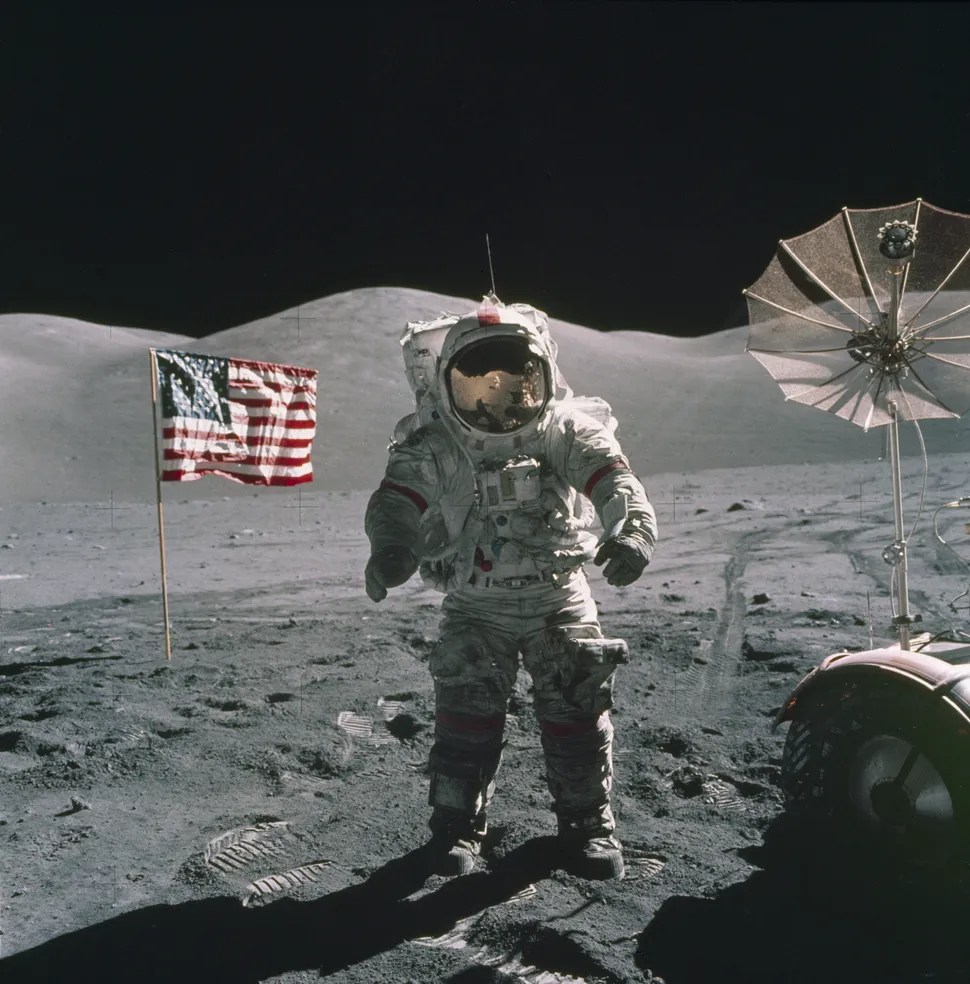
Image (Credit): Apollo 17 commander Eugene Cernan on the surface of the Moon. He was the last US astronaut to walk on the Moon. (NASA)

Acting NASA Administrator had to time time out of his day (or at least a staff member had to) to respond to a dumb comment by, let us say, a less-than-scientifically minded Kim Kardashian. She had earlier shared her doubts about whether the United States ever placed astronauts on the Moon. Of course, it is not an original sentiment, but it does gain traction in this social media age where dumb comments are golden.

Acting NASA Administrator Sean Duffy tweeted out:

Yes, @KimKardashian, we’ve been to the Moon before… 6 times!

And even better: @NASAArtemis is going back under the leadership of @POTUS.

We won the last space race and we will win this one too

I left out the little cartoons of a rocket and an American flag from the tweet, but you get the point.

We can all certainly agree with Mr. Duffy’s first point about the Moon landings, but the matter of the new space race is still up in the air. In that regard, he and NASA still have much more to do.

Maybe Ms. Kardashian can use her influence in a more helpful way by pushing for more NASA funding. If she really believes we missed the mark last time, maybe she can help ensure this new space race is a success. Hell, we can even put her name on the side of one of the rocket boosters.

Pic of the Week: Dead Comet From Halloween Past

Image (Credit): Asteroid 2015 TB145 as captured by the Arecibo Observatory in Puerto Rico on October 30, 2015. (NAIC-Arecibo/NSF)

This spooky image of a dead comet was captured 10 years ago, but it still serves this purpose this time of year. It passed the Earth on Halloween evening that year at a distance of about 302,000 miles.

Here is more from NASA’s Jet Propulsion Laboratory:

Scientists observing asteroid 2015 TB145 with NASA’s Infrared Telescope Facility (IRTF) on Mauna Kea, Hawaii, have determined that the celestial object is more than likely a dead comet that has shed its volatiles after numerous passes around the sun.

The belated comet has also been observed by optical and radar observatories around the world, providing even more data, including our first close-up views of its surface…

The first radar images of the dead comet were generated by the National Science Foundation’s 305-meter (1,000-foot) Arecibo Observatory in Puerto Rico. The radar images from Arecibo indicate the object is spherical in shape and approximately 2,000 feet (600 meters) in diameter and completes a rotation about once every five hours.

“The IRTF data may indicate that the object might be a dead comet, but in the Arecibo images it appears to have donned a skull costume for its Halloween flyby,” said Kelly Fast, IRTF program scientist at NASA Headquarters and acting program manager for NASA’s NEO Observations Program.

Highlights from the 2025 International Mars Society Convention

Image (Credit): Sci-fi panel discussion at the International Mars Society Convention. (Mars Society)

If you were unable to attend the 2025 International Mars Society Convention earlier this month in California, you can still get a taste of the event. The Mars Society has posted a one-hour video with highlights from the various presentations listed below:

  • Dr. Robert Zubrin, Mars Society Founder & President – An abbreviated version of his stirring Day 1 keynote talk, setting the tone for humanity’s journey to Mars.
  • Conference Introduction – An overview of the weekend’s groundbreaking discussions, from science and technology to policy and advocacy.
  • Hoppy Price (NASA JPL) – Concepts for Future Robotic Mars Exploration Missions, including an engaging Q&A on Mars Sample Return and next-generation rover systems.
  • David Malott, Founder & CEO, SpaceFactory.AI – Inside the award-winning Mars habitat design and its real-world implications for sustainable living beyond Earth.
  • Dr. Erika DeBenedictis, Pioneer Labs – A Path to Green Mars, exploring how synthetic biology and systems thinking can transform the Red Planet into a thriving, self-sustaining ecosystem.
  • Dr. Vicky Hamilton, MEPAG Chair – The Future of Mars Exploration, connecting today’s missions to tomorrow’s scientific frontiers.
  • Dr. Abigail Fraeman, Deputy Project Scientist, NASA’s Curiosity Rover – Mars Through the Eyes of Curiosity: 13 Years of Adventure, reflecting on discoveries from Gale Crater and what’s next.

It certainly isn’t the same as being there, but it gives you some background on what was discussed. You can also view the program guide for the convention at this link.

And should you want to hear more, try this video from another conference that Dr. Robert Zubrin recently attended -the 2025 New Worlds Conference in Austin. Dr. Zubrin spoke about the drive to explore and settle space.

Astronomy Question: Star Trek and Founding Species

Multiple Choice: In the television series Star Trek, which of the following was not a founding species of the United Federation of Planets, a collection of governments based on universal liberty and equality?

A. Vulcans
B. Andorians
C. Tellarites
D. Betazoids

Take a guess and then check your answer by going to the “Astronomy Question Answer Sheet” page.

Space Stories: Space Observatory in Need of Rescue, Alien Comet Activates Earth Defense, and Japan Sends Cargo to the ISS

Here are some recent space-related stories of interest.

KJZZ Phoenix: Flagstaff-based Company Wins $30M Contract for NASA Space Rescue Mission

A Flagstaff-based space company has won a $30 million contract to raise the orbit of a space-based NASA observatory next year before it can drop uncontrolled back into Earth’s atmosphere. NASA officials say they are in a race against time as the agency’s Neil Gehrels Swift Observatory and its three-telescope system studying gamma rays from space needs a rescue.

Space Coast Daily: NASA Activates Earth Defense Over Possible Alien Comet in Our Solar System

NASA has activated a global planetary defense group to study a massive interstellar object exhibiting strange, possibly artificial characteristics—fueling speculation that it could be an alien probe operating within our solar system. The object, designated 3I/ATLAS, is approximately the size of Manhattan and was first captured by the Hubble Space Telescope on July 21. It has been selected as the first-ever official target of the International Asteroid Warning Network (IAWN)—a NASA-backed coalition of global agencies and astronomers tasked with identifying and tracking potential threats to Earth.

ABC News: Japan Successfully Launches New Cargo Spacecraft to Deliver Supplies to ISS

Japan’s space agency successfully launched Sunday its most powerful flagship H3 rocket, carrying a newly developed unmanned cargo spacecraft for its first mission to deliver supplies to the International Space Station. The Japan Aerospace Exploration Agency said the HTV-X1 spacecraft successfully lifted off atop the No. 7 H3 rocket from Japan’s Tanegashima Space Center in the country’s south and confirmed it entered targeted orbit 14 minutes after liftoff. The spacecraft was separated and placed into a planned orbit, JAXA said. If everything goes smoothly, it is expected to arrive at the ISS in a few days to deliver supplies. Japanese astronaut Kimiya Yui, currently at the ISS, is set to catch the craft with a robot arm in the early hours of Thursday.